AGM Checklist for Associations, Strata, and Member Organisations
Friday, 5 June 2026, 7:07 pm

An AGM can be routine. It can also be the meeting that creates six months of governance headaches.
Most disputes we see around annual general meetings are not caused by major misconduct. They come from avoidable mistakes: incorrect notice periods, unclear voting procedures, poorly managed proxies, disputed elections, quorum issues, or technology that leaves members unable to participate properly.
The organisations that run smooth AGMs usually have one thing in common. They start preparing earlier than they think they need to.
Whether you’re managing an incorporated association, owners corporation, strata scheme, club, union, not-for-profit, or member-based organisation, a structured AGM checklist helps reduce risk and keeps the focus on decision-making rather than process.
Start with the rules that apply to your organisation
Before booking a venue or sending notices, check the documents and legislation that govern your organisation. That generally includes:
One of the most common mistakes is assuming that AGM requirements are the same across all organisations.
They are not.
An incorporated association in New South Wales operates under different legislation from a Victorian association. Strata and community title schemes have their own meeting requirements. Companies limited by guarantee may have obligations under the Corporations Act. Charities may also need to consider requirements from the Australian Charities and Not-for-profits Commission (ACNC).
The constitution should always be your starting point.
Confirm the AGM deadline
Missing the AGM deadline creates unnecessary compliance issues and often results in rushed preparation.
For example, NSW incorporated associations generally must hold their AGM within six months after the end of their financial year (NSW Government).
Other jurisdictions have different requirements. Victorian incorporated associations generally have five months after the end of the financial year unless an extension is granted (Consumer Affairs Victoria).
If you manage multiple entities across different states, avoid assuming the same timetable applies to all of them.
Review membership records early
Many AGM problems start before the meeting notice is issued. Check:
If membership records are inaccurate, voting disputes become much more likely.
A clean membership database also improves meeting attendance and reduces challenges to election outcomes.
Finalise motions and agenda items
Leave enough time for members and stakeholders to submit motions where permitted. Typical AGM business may include:
For strata and community title organisations, the agenda may also include budgets, levies, insurance matters, committee elections, and maintenance planning (NSW Government).
The agenda should be clear and specific.
Members should understand exactly what they are being asked to vote on.
Check notice requirements carefully
Notice periods vary significantly. The required notice may depend on:
A notice should generally include:
Late or defective notices remain one of the most common reasons AGM decisions are challenged.
Confirm quorum requirements
You cannot assume quorum will simply happen. Review:
Strata schemes, associations, and member organisations often have different quorum rules depending on their governing documents and applicable legislation.
It is worth monitoring RSVPs well before the meeting rather than discovering a problem on the day.
Decide how voting will occur
This is where many organisations underestimate the amount of planning required. Questions to answer include:
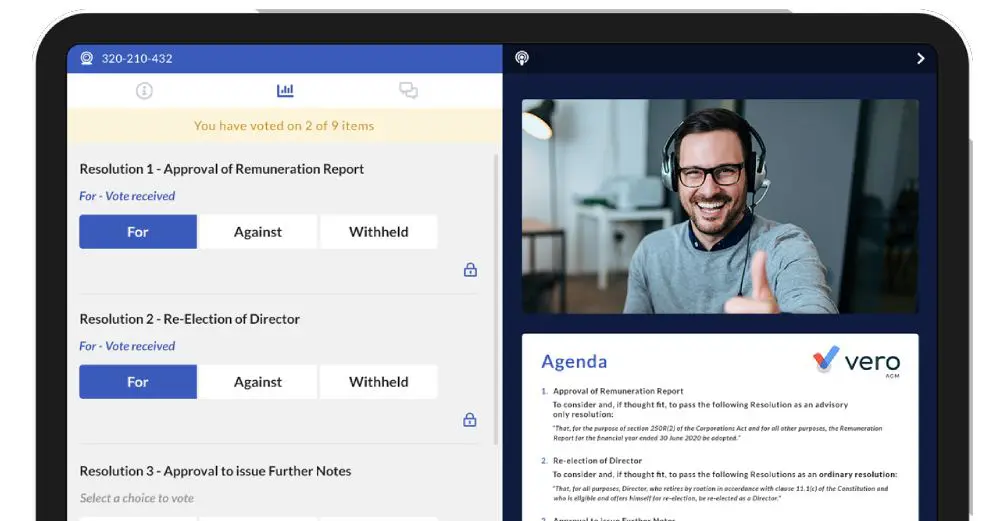
Australian legislation increasingly supports the use of technology for meetings and voting, provided members are given a reasonable opportunity to participate. Many incorporated associations can conduct meetings and voting electronically, even where older constitutions may not explicitly mention it (NSW Government).
For larger organisations, independent vote management can remove concerns about bias and improve confidence in the result.
If using virtual or hybrid meetings, test everything
Hybrid meetings are now a normal part of governance across Australia.
The challenge is not whether the technology works.
The challenge is whether members can genuinely participate.
The Australian Securities and Investments Commission has repeatedly emphasised that members attending virtually should have a reasonable opportunity to ask questions, make comments, and vote. A simple livestream is generally not enough (ASIC). Before the AGM:
A ten-minute test can prevent a two-hour governance problem.
Prepare election procedures
Board and committee elections often create the greatest scrutiny. Ensure there is a documented process covering:
Where elections are contested, independent oversight is often worthwhile.
Even where everyone acts appropriately, members are more likely to trust results when the process is transparent and independently administered.
Assign meeting-day responsibilities
Everyone should know their role before the meeting starts. That usually includes:
Too many AGMs rely on one person trying to manage everything.
That rarely ends well.
Prepare the post-AGM actions
The AGM is not finished when the meeting closes. After the meeting:
This step is frequently overlooked.
Months later, organisations discover that resolutions were passed but never formally implemented.
Why many organisations are moving to electronic voting
Attendance patterns have changed.
Many members expect the ability to participate remotely, particularly where organisations have geographically dispersed memberships.
Electronic voting can assist by:
For associations, unions, clubs, strata schemes, and member organisations with complex voting requirements, independent electronic voting systems can also provide a clear audit trail if results are questioned later.
That becomes particularly valuable during committee elections, constitutional amendments, or contentious resolutions.
FAQ
Can an AGM be held entirely online?
It depends on the organisation type, governing documents, and applicable legislation. Many organisations can hold hybrid meetings. Fully virtual meetings may require specific constitutional authority depending on the legal structure involved. Always check the governing rules that apply to your organisation (ASIC).
Can members vote by proxy?
Often yes, but the rules vary significantly. Proxy rights should be set out in the constitution, legislation, or scheme rules that apply to the organisation. Notice documents should clearly explain how proxies can be appointed and lodged (NSW Government).
What happens if quorum is not reached?
The answer depends on the governing rules. Some organisations must adjourn and reconvene the meeting. Others have procedures allowing a meeting to proceed after a specified period. Always check the constitution and applicable legislation (NSW Government).
Do AGM votes need scrutineers?
Not always. However, independent scrutineering is often advisable where elections are contested, resolutions are sensitive, or member confidence in the process is particularly important.
Final thoughts
A well-run AGM is usually unremarkable. Members receive information, ask questions, vote confidently, and move on.
The problems arise when preparation is left too late or when governance processes are treated as administrative formalities.
If your organisation is planning an AGM and needs guidance on electronic voting, proxy management, independent scrutineering, elections, polls, or hybrid meeting technology, Vero Voting can help you design a process that is compliant, transparent, and practical for your members.
Sources
ASIC – FAQs: Virtual meetings for companies and registered schemes
ASIC – What companies and registered schemes should know about virtual-only meetings
ACNC – Annual general meetings
NSW Government – Meetings for incorporated associations
Consumer Affairs Victoria – Incorporated association meetings
NSW Government – Meetings and voting for scheme associations
Frequently Asked Questions
Can an AGM be held entirely online?
It depends on the organisation type, governing documents, and applicable legislation. Many organisations can hold hybrid meetings. Fully virtual meetings may require specific constitutional authority depending on the legal structure involved. Always check the governing rules that apply to your organisation (ASIC).
Can members vote by proxy?
Often yes, but the rules vary significantly. Proxy rights should be set out in the constitution, legislation, or scheme rules that apply to the organisation. Notice documents should clearly explain how proxies can be appointed and lodged (NSW Government).
What happens if quorum is not reached?
The answer depends on the governing rules. Some organisations must adjourn and reconvene the meeting. Others have procedures allowing a meeting to proceed after a specified period. Always check the constitution and applicable legislation (NSW Government).
Do AGM votes need scrutineers?
Not always. However, independent scrutineering is often advisable where elections are contested, resolutions are sensitive, or member confidence in the process is particularly important.