AGM Voting Rules Explained for Australian Organisations
Wednesday, 3 June 2026, 10:33 am

AGM Voting Rules Explained for Australian Organisations
Every year, organisations spend weeks preparing for their AGM. The agenda is finalised, notices are issued, reports are prepared, and directors or committee members are nominated.
Then the voting starts.
This is where many organisations become uncertain. Questions around proxies, poll voting, electronic voting, quorum requirements, member eligibility and constitutional rules regularly create confusion — even for experienced boards.
The reality is that AGM voting is not governed by a single set of rules across Australia. The requirements depend on the type of organisation involved, the legislation that applies, and the organisation’s own constitution or governing rules.
Getting the voting process wrong can create disputes, challenges to election outcomes, member complaints and, in some cases, questions about the validity of resolutions that have already been passed.
Here is what Australian organisations need to understand.
The First Rule: Your Constitution Matters
Many people assume AGM voting is determined entirely by legislation.
That is only partly true.
The Corporations Act 2001 sets out requirements for companies, while incorporated associations, unions, strata schemes and other entities operate under their own legislation and regulations.
Alongside those laws sits the organisation’s constitution, rules, by-laws or governing documents.
In practice, the constitution often determines:
One of the most common governance mistakes is assuming a process used by another organisation automatically applies to yours.
It may not.
Before any AGM voting process is designed, the governing rules should be reviewed carefully.
Ordinary Resolutions and Special Resolutions
Not every motion requires the same voting threshold.
Most routine AGM business is decided through an ordinary resolution, which generally requires more votes in favour than against.
Special resolutions usually require a higher threshold. For companies governed by the Corporations Act, a special resolution generally requires at least 75% of votes cast by members entitled to vote. These resolutions are commonly used for constitutional amendments and other significant decisions.
For associations, strata organisations and unions, the required threshold depends on the legislation and governing rules that apply.
Boards should never assume a simple majority is sufficient.
Who Can Vote?
This sounds straightforward until the AGM actually arrives.
Voting eligibility often depends on factors such as:
Organisations frequently encounter problems when membership records are outdated or entitlement lists have not been properly verified before voting opens.
If there is uncertainty about voter eligibility, it should be resolved well before the meeting.
Waiting until members are standing at a registration desk or attempting to access an online voting portal is asking for trouble.
Understanding Proxy Voting
Proxy voting remains an important part of AGM participation, particularly for organisations with geographically dispersed members.
Under the Corporations Act, members of public companies generally have the right to appoint a proxy. Meeting notices must explain those rights and include relevant information about proxy appointments.
The organisation’s governing rules will often determine:
Proxy administration sounds simple until hundreds of forms begin arriving before a meeting.
This is one reason many organisations now use electronic proxy systems that automatically validate submissions and reduce administrative errors.
Show of Hands or Poll Voting?
Historically, many AGMs relied on a show of hands.
That approach is becoming less practical, particularly in larger organisations and hybrid meetings.
Under the Corporations Act, a poll can be demanded by:
A constitution may also allow lower thresholds.
A poll is generally considered the more accurate method because votes are counted according to actual voting entitlements rather than simply counting people in the room.
For listed companies, certain resolutions must be decided by a poll rather than a show of hands.
Many organisations now choose to conduct all substantive AGM voting by poll regardless of whether legislation requires it.
From a governance perspective, it removes a lot of ambiguity.
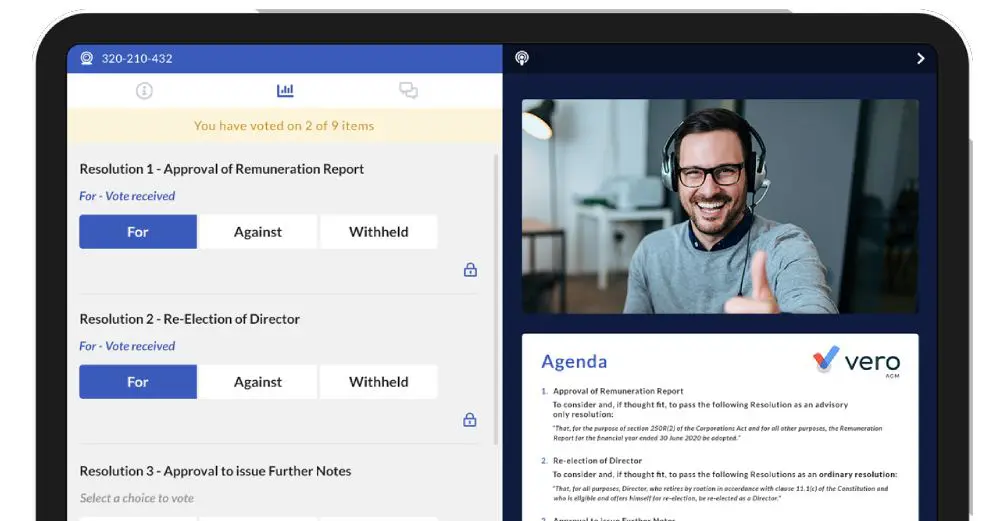
Electronic Voting at AGMs
Electronic voting has moved well beyond being a contingency measure.
Many Australian organisations now use electronic voting for:
The main advantage is not convenience.
It is auditability.
Electronic voting systems can create a clear record of:
For organisations dealing with contested elections or large memberships, having an independent audit trail can significantly reduce disputes.
The key point is that the organisation’s governing rules must support the voting method being used.
Virtual and Hybrid AGMs
The legal position around virtual meetings changed significantly following reforms introduced after the COVID period.
The Corporations Act now permits hybrid meetings, allowing members to attend either in person or through approved meeting technology. Virtual-only meetings are permitted where the constitution expressly allows them.
ASIC has made it clear that members attending virtually must have a reasonable opportunity to participate, ask questions, make comments and vote. Participation should be equivalent to what members would reasonably expect at a physical meeting.
This is where some organisations get into difficulty.
A webinar is not necessarily a meeting.
If members cannot meaningfully participate, ask questions or vote during proceedings, governance concerns start to emerge.
Technology should support member participation, not restrict it.
Independent Vote Management and Scrutineering
Most AGMs proceed without controversy.
Some do not.
Director elections, constitutional changes and contentious resolutions can attract close scrutiny from members.
Independent vote management provides reassurance that:
This is particularly relevant for associations, unions, clubs, strata organisations and member-based entities where election outcomes may be closely contested.
An independent scrutineer can often prevent disputes before they begin.
Common AGM Voting Mistakes
After supporting hundreds of member meetings, several patterns appear repeatedly.
The most common issues include:
Most AGM voting disputes are preventable.
The organisations that run smooth meetings usually invest time in preparation rather than trying to solve procedural problems during the meeting itself.
Frequently Asked Questions
Can members vote before the AGM?
Often yes, but it depends on the organisation’s governing rules and the voting method being used. Many organisations now offer pre-meeting electronic voting alongside live voting during the meeting.
Are virtual AGMs legal in Australia?
Yes. Hybrid meetings are permitted under the Corporations Act. Virtual-only meetings are generally permitted where the organisation’s constitution expressly allows them.
Can a proxy vote differently on different resolutions?
In many cases, yes. Proxy forms may allow members to provide directions on each resolution individually. The applicable rules depend on the legislation and governing documents.
Does every AGM require an independent scrutineer?
Not necessarily. Smaller organisations may manage voting internally. However, independent scrutineering can provide greater transparency and confidence, particularly for elections and contested resolutions.
Can electronic voting be used for director elections?
Generally yes, provided the organisation’s governing rules and applicable legislation allow for it. Many Australian organisations now use electronic voting for director and committee elections.
Final Thoughts
AGM voting is about more than counting votes. It is about member confidence.
When members trust the process, they are far more likely to accept the outcome, even if their preferred candidate or resolution does not succeed.
Clear procedures, accurate voter records, transparent vote management and appropriate meeting technology all contribute to that confidence.
For organisations planning an upcoming AGM, election or member vote, obtaining independent guidance early can prevent a great deal of frustration later. The team at Vero Voting works with companies, associations, unions, clubs, strata organisations and member-based bodies across Australia to help deliver voting processes that are transparent, compliant and practical.
Sources
Corporations Act 2001 (Cth): https://www.legislation.gov.au/
ASIC – FAQs: Virtual meetings for companies and registered schemes: https://www.asic.gov.au/regulatory-resources/corporate-governance/shareholder-engagement/faqs-virtual-meetings-for-companies-and-registered-schemes/
ASIC – Guidelines for investor meetings using virtual technology: https://www.asic.gov.au/about-asic/news-centre/news-items/asic-guidelines-for-investor-meetings-using-virtual-technology/
AustLII – Corporations Act 2001, sections 249L, 249R, 250L and related meeting provisions: https://www.austlii.edu.au/
Frequently Asked Questions
Can members vote before the AGM?
Often yes, but it depends on the organisation’s governing rules and the voting method being used. Many organisations now offer pre-meeting electronic voting alongside live voting during the meeting.
Are virtual AGMs legal in Australia?
Yes. Hybrid meetings are permitted under the Corporations Act. Virtual-only meetings are generally permitted where the organisation’s constitution expressly allows them.
Can a proxy vote differently on different resolutions?
In many cases, yes. Proxy forms may allow members to provide directions on each resolution individually. The applicable rules depend on the legislation and governing documents.
Does every AGM require an independent scrutineer?
Not necessarily. Smaller organisations may manage voting internally. However, independent scrutineering can provide greater transparency and confidence, particularly for elections and contested resolutions.
Can electronic voting be used for director elections?
Generally yes, provided the organisation’s governing rules and applicable legislation allow for it. Many Australian organisations now use electronic voting for director and committee elections.