Fair Work Voting Requirements for Enterprise Agreements Explained
Monday, 31 August 2026, 12:41 pm

An enterprise agreement vote can look like the simplest part of the bargaining process.
The negotiations are finished. The document has been drafted. The parties have reached a position they can live with. Now employees just need to vote.
That final step is where organisations can still run into trouble.
Under the Fair Work Act 2009, an enterprise agreement must be genuinely agreed to by the employees it covers before the Fair Work Commission (FWC) can approve it. The voting result matters, but so does the way the vote is conducted. Employees need a proper opportunity to understand the proposed agreement, access the relevant information and cast their vote freely and confidentially.
For employers, HR teams, unions and bargaining representatives, this means an enterprise agreement ballot should be treated as a formal governance process — not simply a yes-or-no survey.
This guide explains the key Fair Work voting requirements for enterprise agreements in Australia and what organisations should consider before opening the ballot.
This article provides general information, not legal advice. Enterprise bargaining can involve circumstances that require specific workplace relations advice. Always check the current Fair Work Act, Fair Work Commission guidance and the circumstances of your particular agreement.
What is an enterprise agreement vote?
An enterprise agreement is a negotiated workplace agreement between an employer and employees, generally setting terms and conditions of employment for a particular business or group of businesses.
Unlike an award, which establishes minimum conditions across an industry or occupation, an enterprise agreement is developed through bargaining and must be approved by the Fair Work Commission before it takes effect.
The employee vote is the point at which eligible employees are asked to approve the proposed agreement.
For a typical single-enterprise agreement, the agreement is made when a majority of employees who cast a valid vote approve it. It is not a requirement that more than half of all eligible employees vote.
For example, imagine 500 eligible employees are entitled to vote:
The Yes vote is a majority of the valid votes cast, so the agreement can be considered made, subject to the other requirements of the Fair Work Act and subsequent FWC approval.
That distinction is often misunderstood.
A low turnout does not automatically mean an enterprise agreement has failed. The bigger question is whether the employees who were asked to vote were appropriately eligible and sufficiently representative, and whether the voting process produced genuine agreement.
Who can vote on an enterprise agreement?
For the ordinary employee approval process, the employer requests employees who:
to approve the agreement by voting for it.
This makes the employee database one of the most important parts of preparing the ballot.
A common mistake is to simply export everyone currently listed in an HR system and send them a voting invitation.
That can be risky.
The organisation should first establish who will actually be covered by the proposed agreement. The voter list should then be checked against the relevant coverage and employment information before voting opens.
This is particularly important for large or geographically dispersed workforces where employees may:
The FWC also considers whether employees asked to vote have a sufficient interest in the terms of the agreement and are sufficiently representative of the employees the agreement covers.
That means voter eligibility should be considered as part of the bargaining and compliance process, rather than as an administrative task immediately before the ballot.
What does “genuinely agreed” mean?
Getting a majority Yes vote is necessary, but it is not the whole story.
The Fair Work Commission must be satisfied that the agreement has been genuinely agreed to by the employees covered by it. Section 188 of the Fair Work Act requires the Commission to take several matters into account, including the Statement of Principles on Genuine Agreement.
In practical terms, employees should have had a meaningful opportunity to understand what they were voting on.
The process should therefore address four basic questions:
Did employees have access to the proposed agreement?
They should be given access to the agreement and relevant material incorporated by reference.
Were the terms and their effect properly explained?
A simple email saying “please read the attached agreement” may not be enough. The FWC looks at the content of the explanation, how it was delivered and the particular circumstances and needs of the employees.
Did employees have a fair opportunity to vote?
The voting method and voting period should give eligible employees a reasonable opportunity to participate.
Was the vote conducted freely and confidentially?
The Statement of Principles says the voting process should ensure an employee’s vote is not disclosed to, or ascertainable by, the employer.
This is why the integrity of the ballot matters just as much as the final Yes/No number.
The 21-day requirement before voting
For agreements where a Notice of Employee Representational Rights (NERR) is required, an employer generally cannot request employees to approve the agreement until at least 21 days after the last NERR was given.
This is one of the dates that should be established early in the bargaining timeline.
The FWC’s current date calculator continues to identify the voting start date as being at least 21 clear days after the NERR date for the relevant single-enterprise agreement process.
The important point is that the ballot should not simply be scheduled when the bargaining parties feel ready.
The statutory timing needs to be checked first.
What about multi-enterprise agreements?
The rules can differ for multi-enterprise agreements.
For example, the Fair Work Act contains additional requirements concerning employee organisations acting as bargaining representatives before certain multi-enterprise agreements can be put to a vote. Depending on the type of agreement and bargaining circumstances, written agreement or a voting request order may be required.
This is one area where organisations should avoid assuming that the process used for a single-enterprise agreement can simply be copied across.
How much notice must employees receive before voting?
For enterprise agreements covered by the current Statement of Principles on Genuine Agreement, employees should generally be informed of the time, place and method of the vote at least seven full calendar days before voting starts, unless an alternative reasonable timeframe has been agreed in the circumstances specified by the Statement of Principles.
Employees should also have a reasonable opportunity to consider the proposed agreement before voting.
The Statement of Principles identifies at least seven full calendar days as a reasonable period where the employer provides employees with the full agreement and relevant incorporated material.
This is more than a technical deadline.
Suppose voting opens Monday morning. Employees should not receive the final agreement late on Friday afternoon and then be expected to make an informed decision first thing Monday.
The process should give people enough time to read the agreement, ask questions and understand the changes.
A practical voting timeline
A typical planning sequence may look like this:
Bargaining completed → agreement finalised → employee explanation and information → reasonable consideration period → voting notification → ballot opens → ballot closes → result confirmed → application lodged with FWC
The exact dates depend on the agreement and the applicable legal requirements.
The FWC provides a date calculator to help organisations plan the relevant milestones, but it cautions that the calculator is a planning aid rather than a substitute for the legislation and specific requirements applying to an agreement.
Does the agreement have to be explained to employees?
Yes.
This is one of the areas that deserves more attention than it sometimes receives.
The employer must take all reasonable steps to ensure the terms of the agreement and their effect are explained to employees who will be covered by it. The explanation must take into account the particular circumstances and needs of those employees.
For a large workforce, this may require more than sending a PDF.
Consider an organisation with:
A single information session during standard business hours may not give everyone a meaningful opportunity to understand the agreement.
The communication approach should reflect the workforce.
This could involve information sessions, written summaries, comparison documents, FAQs, translated material or other appropriate communication methods, depending on the circumstances.
The FWC can ask for evidence of how the terms were explained, including copies of explanatory material and information about how the explanation was delivered.
Can an enterprise agreement vote be conducted online?
Yes.
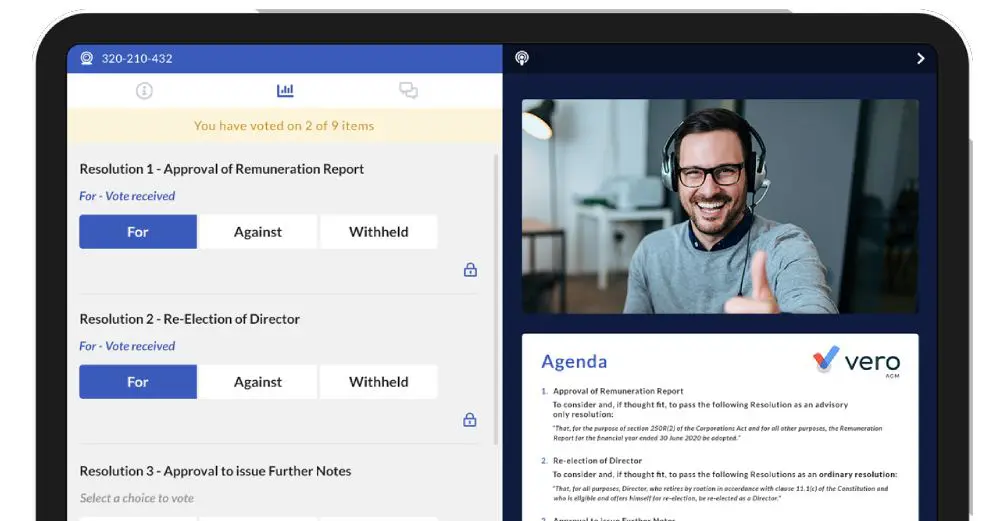
The Fair Work Act expressly allows an employer to request employees to vote by ballot or by an electronic method.
This is particularly useful for organisations with employees spread across multiple sites, regions or shifts.
An online ballot can remove many of the practical problems associated with paper voting:
But electronic voting does not remove the underlying Fair Work requirements.
The technology is not what makes the vote compliant.
The process does.
An online ballot still needs to provide eligible employees with an appropriate opportunity to consider the agreement and vote freely. The voting process should also protect the confidentiality of individual choices.
Does an enterprise agreement vote have to be a secret ballot?
The Fair Work Act does not simply say that every enterprise agreement approval vote must use a particular technology labelled a “secret ballot”.
The more useful way to look at the requirement is through the genuine agreement principles.
The Statement of Principles says the voting process should ensure that an employee’s vote is not disclosed to or ascertainable by the employer.
That makes confidential voting a critical feature of a properly designed enterprise agreement ballot.
For example, an employer should not ordinarily be in a position to see that a particular employee voted Yes or No.
A well-designed ballot separates voter authentication from vote choice.
The system may need to establish that an employee is eligible and has voted once. That does not mean the employer should be able to identify the employee’s individual choice.
The FWC has considered secret electronic ballots administered by third-party providers in agreement approval decisions, including a 2025 decision where the Commission was satisfied that the relevant principles had been met.
What happens if the majority votes Yes?
If the applicable voting requirements are met and the required majority approves the agreement, the agreement becomes made.
For a single-enterprise agreement, this occurs when a majority of employees who cast a valid vote approve it.
But a successful employee vote does not mean the agreement automatically starts operating.
The agreement must still be submitted to the Fair Work Commission for approval.
The FWC assesses whether the agreement meets the requirements of the Fair Work Act, including relevant approval tests such as the Better Off Overall Test (BOOT).
The application for approval generally needs to be lodged within 14 days after the agreement is made.
That means the period immediately following the vote should already be planned.
Do not wait until the ballot closes to work out who is preparing the FWC application and supporting documents.
What happens if employees vote No?
If the required majority is not achieved, the proposed agreement has not been approved by the employee vote.
That does not mean the bargaining process necessarily ends.
The parties may need to return to bargaining, address employee concerns, amend the proposed agreement and, if appropriate, conduct another vote.
The key lesson is that the voting process should not be treated as a box-ticking exercise designed to produce a particular outcome.
Employees need to be able to vote either way.
A credible ballot gives the Yes vote and the No vote equal procedural treatment.
Common mistakes in enterprise agreement voting
Most voting problems are not caused by complicated technology. They are caused by small process failures.
1. Using the wrong voter list
Including employees who are not covered by the agreement — or excluding employees who should be eligible — can create obvious questions about the integrity of the result.
Better approach: confirm the coverage and eligibility criteria before preparing the final voter roll.
2. Giving employees the agreement too late
Sending the final document shortly before voting begins can undermine the opportunity for informed consideration.
Better approach: plan the information and consideration period into the bargaining timetable rather than treating it as an afterthought.
3. Treating an email as the entire explanation
Attaching the agreement to an email is not necessarily the same thing as explaining its terms and effect.
Better approach: prepare an explanation that is appropriate for the workforce and keep evidence of how it was delivered.
4. Letting the employer see individual votes
This can undermine employee confidence and create issues under the genuine agreement principles.
Better approach: use a voting process where individual choices cannot be disclosed to or ascertained by the employer.
5. Assuming “majority” means 50% of all employees
For a standard single-enterprise agreement, the relevant threshold is a majority of those employees who cast a valid vote.
Better approach: distinguish between the number of eligible employees, turnout and valid votes when reporting the result.
6. Forgetting that the vote is only one part of approval
A successful employee ballot does not guarantee FWC approval.
Better approach: prepare for the approval application throughout the bargaining process and retain evidence of the steps taken.
7. Failing to preserve an audit trail
If questions arise later, organisations may need to demonstrate what information was provided, when employees were notified, who was eligible to vote and how the ballot was conducted.
Better approach: retain the relevant voting documentation, communications, voter eligibility records and result documentation in an organised manner.
What should a compliant enterprise agreement ballot record?
A robust ballot process should leave a clear record of what happened.
Depending on the circumstances, this may include:
The aim is not to create paperwork for its own sake.
The aim is to be able to demonstrate, if asked, that the ballot was properly planned and administered.
The FWC’s current application guidance specifically asks applicants to provide information and documents supporting the agreement approval process.
Is online voting a good option for large workforces?
For many organisations, it can be.
An online ballot is particularly practical when employees are spread across different locations or work different shifts. It can also provide a faster and more consistent voting experience than paper-based processes.
But the strongest reason to use electronic voting is not simply speed.
It is control.
A properly configured voting platform can help organisations manage:
The platform should support the governance process rather than dictate it.
That distinction matters.
The organisation still needs to determine the legal and industrial relations requirements that apply to its agreement.
How Vero Voting can assist with enterprise agreement ballots
For organisations preparing an enterprise agreement vote, Vero Voting’s Workplace Agreement Voting service provides an independent voting service designed specifically for workplace ballots.
Vero Voting can assist with planning, voter management, ballot administration, vote counting, reporting and audit documentation. Its workplace voting service supports enterprise agreements as well as other workforce ballots.
For dispersed workforces, Vero supports multiple voting channels, including online, SMS and telephone voting. It also provides an information portal where employees can access agreement information before voting.
That can be particularly useful when an organisation has employees working across multiple sites, shifts or locations.
The practical advantage of using an independent provider is that the employer does not need to administer the employee’s individual voting choice itself.
Vero Voting’s online voting channel can also be used where an organisation wants a fully digital voting experience.
The technology is only one part of the solution, however. The agreement, employee communications, eligibility rules, voting timetable and FWC requirements still need to be handled correctly.
A practical pre-vote checklist
Before opening an enterprise agreement ballot, ask:
If any of those answers is uncertain, it is worth resolving the issue before the ballot opens.
Key takeaways
The core Fair Work voting requirements for enterprise agreements are not simply about getting enough Yes votes.
A sound enterprise agreement ballot should provide:
Eligible voters
Employees who are employed at the time of the vote and will be covered by the agreement need to be correctly identified.
An informed electorate
Employees need a reasonable opportunity to consider the agreement and understand its terms and effect.
A fair voting opportunity
Employees should have a reasonable opportunity to participate, with appropriate notice of when, where and how voting will occur.
Confidential voting
The voting process should ensure an employee’s individual choice is not disclosed to or ascertainable by the employer.
A defensible process
The organisation should retain evidence showing how the agreement was communicated and how the ballot was conducted.
A proper approval process
After the agreement is made, it still needs to be lodged with and approved by the Fair Work Commission.
The safest approach is to design the ballot around these principles from the beginning rather than trying to prove compliance after the vote has finished.
If your organisation is preparing for an enterprise agreement ballot and needs an independent voting provider, contact Vero Voting to discuss your requirements or request a demonstration.
Fair Work Voting Requirements for Enterprise Agreements
Fair Work Voting Requirements for Enterprise Agreements
Fair Work Voting Requirements for Enterprise Agreements
Fair Work Voting Requirements for Enterprise Agreements
Fair Work Voting Requirements for Enterprise Agreements
FAQ Section
1. What are the voting requirements for an enterprise agreement under Fair Work?
For a typical single-enterprise agreement, employees who are employed at the time of the vote and will be covered by the agreement are asked to vote. The agreement is made when a majority of employees who cast a valid vote approve it. The FWC must also be satisfied that employees genuinely agreed to the agreement and that the other approval requirements have been met.
2. How many employees need to vote Yes for an enterprise agreement to pass?
For a standard single-enterprise agreement, more than half of the valid votes actually cast must be Yes. There is not generally a requirement for more than 50% of all eligible employees to participate.
For multi-enterprise agreements, different rules can apply, so the specific type of agreement should be checked.
3. How much notice do employees need before an enterprise agreement vote?
Under the current Statement of Principles on Genuine Agreement, employees should generally be told the time, place and method of voting at least seven full calendar days before voting starts, unless an alternative reasonable timeframe is agreed in the circumstances allowed by the principles.
Employees should also have a reasonable opportunity to consider the proposed agreement before voting.
Where a NERR is required, the employer generally cannot request the employee vote until at least 21 days after the last NERR was given.
4. Can an enterprise agreement vote be conducted online?
Yes. Section 181(3) of the Fair Work Act allows an employer to request employees to vote by ballot or by an electronic method. An online ballot still needs to satisfy the relevant requirements concerning eligibility, genuine agreement, access to information, voting opportunity and confidentiality.
5. Does an enterprise agreement vote have to be secret?
The Fair Work Act does not prescribe one particular voting technology as a “secret ballot”. However, the Statement of Principles says the voting process should ensure that an employee’s vote is not disclosed to or ascertainable by the employer. A confidential or secret ballot is therefore an important part of a properly designed enterprise agreement voting process.
Sources
The following are the primary official sources used to prepare this article and should be reviewed alongside the current legislation when planning an enterprise agreement vote:
Frequently Asked Questions
1. What are the voting requirements for an enterprise agreement under Fair Work?
For a typical single-enterprise agreement, employees who are employed at the time of the vote and will be covered by the agreement are asked to vote. The agreement is made when a majority of employees who cast a valid vote approve it. The FWC must also be satisfied that employees genuinely agreed to the agreement and that the other approval requirements have been met.
2. How many employees need to vote Yes for an enterprise agreement to pass?
For a standard single-enterprise agreement, more than half of the valid votes actually cast must be Yes. There is not generally a requirement for more than 50% of all eligible employees to participate.
3. How much notice do employees need before an enterprise agreement vote?
Under the current Statement of Principles on Genuine Agreement, employees should generally be told the time, place and method of voting at least seven full calendar days before voting starts, unless an alternative reasonable timeframe is agreed in the circumstances allowed by the principles.
Employees should also have a reasonable opportunity to consider the proposed agreement before voting.
Where a NERR is required, the employer generally cannot request the employee vote until at least 21 days after the last NERR was given.
4. Can an enterprise agreement vote be conducted online?
Yes. Section 181(3) of the Fair Work Act allows an employer to request employees to vote by ballot or by an electronic method. An online ballot still needs to satisfy the relevant requirements concerning eligibility, genuine agreement, access to information, voting opportunity and confidentiality.
5. Does an enterprise agreement vote have to be secret?
The Fair Work Act does not prescribe one particular voting technology as a “secret ballot”. However, the Statement of Principles says the voting process should ensure that an employee’s vote is not disclosed to or ascertainable by the employer. A confidential or secret ballot is therefore an important part of a properly designed enterprise agreement voting process.