Meeting Voting Software for AGMs, EGMs and Committee Meetings
Tuesday, 15 September 2026, 9:29 am

Meeting Voting Software: Choosing the Right Solution for AGMs, EGMs and Committee Meetings
Running a meeting is one thing. Running a meeting where important decisions have to be voted on, recorded and relied upon later is another.
For an AGM, EGM or committee meeting, the voting process needs to do more than simply collect a yes or no. The organisation may need to confirm who is entitled to vote, apply different voting rights, manage proxies, conduct elections, calculate weighted votes, record the result and retain a reliable audit trail.
That becomes more complicated when some members are in the room and others are attending online.
Meeting voting software can take much of this administrative burden away, but the software is only part of the solution. The voting process still needs to reflect the organisation’s constitution, governing rules and applicable legislation.
For companies, ASIC says members attending meetings using virtual technology must have a reasonable opportunity to participate, including the ability to ask questions, make comments and vote. The technology used must support meaningful participation.
For other organisations, such as incorporated associations, charities, unions and strata schemes, the applicable requirements can be different.
The right approach is therefore not simply to find the most convenient voting platform. It is to choose a system that can be configured around the rules of the meeting.
What is meeting voting software?
Meeting voting software is a digital system used to manage voting during formal meetings.
Depending on the organisation and meeting type, it can support:
The software can be used at an entirely virtual meeting, a hybrid meeting or even a traditional face-to-face meeting.
That last point is sometimes overlooked.
Electronic voting does not necessarily mean that the meeting itself has to be online. An organisation can hold a physical meeting and use electronic voting to make the voting process faster, easier to administer and less prone to manual counting errors.
Why organisations are moving beyond a show of hands
A show of hands works well when a meeting has a small number of participants and everyone has the same voting entitlement.
It becomes less practical when voting rights are more complicated.
Consider a meeting where:
A manual count can become surprisingly difficult.
The chair may need to stop the meeting while votes are counted. Staff may have to reconcile attendance records with ballot papers. Proxy instructions need to be checked. Someone has to calculate weighted votes. Then everyone needs confidence that the final number is correct.
For a routine resolution, this can be unnecessary administrative work.
For a contested election or significant resolution, it can become a governance risk.
What should meeting voting software actually do?
Not every voting platform is designed for formal organisational meetings.
A basic polling tool may tell you that 72% of respondents selected “Yes”. That does not necessarily make it suitable for an AGM.
Good meeting voting software should address the governance process around the vote, not just the button members press.
1. Confirm voter eligibility
Before a member can vote, the organisation needs to know that the person is entitled to vote.
Depending on the organisation, eligibility may depend on:
A voting system should therefore be capable of working from an approved voter list rather than allowing unrestricted participation.
2. Apply the correct voting entitlement
“One person, one vote” is not universal.
Some meetings involve weighted voting, shareholding, unit entitlements or different classes of members.
The system should be configured according to the organisation’s rules rather than assuming that every participant has identical voting power.
3. Handle proxies
Proxy voting can be one of the more administrative parts of preparing a meeting.
A member who cannot attend may appoint another person to vote on their behalf, subject to the applicable rules.
A well-designed meeting voting process can capture proxy appointments before the meeting and incorporate the relevant instructions into the voting process.
This avoids relying on spreadsheets, paper forms and last-minute manual calculations.
4. Support live voting
For a hybrid or virtual meeting, members should be able to vote while the relevant resolution is being considered.
This matters because members may want to hear the discussion before making their decision.
ASIC specifically states that members attending a company’s hybrid or virtual meeting must have a reasonable opportunity to participate, and the technology must be sufficient to allow them to vote.
The voting process should therefore fit naturally into the meeting rather than operate as a disconnected survey.
5. Provide real-time results
For many meetings, the chair needs the result quickly.
Once voting closes, the system should be able to calculate the outcome and provide the authorised meeting team with the relevant result.
Depending on the voting rules, that might involve:
Real-time reporting can keep the meeting moving without requiring staff to manually count ballots while everyone waits.
6. Produce an audit trail
The final number is only part of the story.
For significant meetings, organisations may also need to demonstrate how the voting process was conducted.
A useful voting system should provide appropriate records showing things such as:
The precise records required will depend on the organisation and its governing rules.
AGM voting software
AGMs often involve several different types of business in one meeting.
Members may vote on resolutions, elect directors or committee members, approve matters, consider reports and deal with other constitutional requirements.
For charities with members, the ACNC’s Governance Standard 2 also requires reasonable steps to be taken to remain accountable to members and give them adequate opportunities to raise concerns about how the charity is governed. The ACNC identifies meetings where members can ask questions and vote on resolutions as one way organisations can meet this standard.
That makes the voting process part of the broader governance experience.
A good AGM voting system should make it straightforward for eligible members to:
The administration team should be able to manage the same process from the other side.
EGM voting software
An extraordinary general meeting is usually called to deal with specific matters that cannot wait until the next AGM.
That means the voting process can be particularly important.
An EGM may involve a proposed constitutional change, a significant organisational decision or another resolution requiring member approval.
Because the agenda may be narrowly focused, there is often less room for administrative confusion.
The organisation should establish before the meeting:
The software should then be configured to implement those requirements.
Committee and board meeting voting
Not every formal vote happens at a general meeting.
Committees and boards regularly need to make decisions between AGMs.
Depending on the organisation’s rules, committee decisions may be made at physical meetings, electronically or through other approved processes.
For charities, the ACNC recommends that organisations have clear rules and procedures for their meetings and decision-making. Its guidance also distinguishes between informal discussions and official meetings that need to follow proper decision-making processes.
Committee voting software can be useful when:
For a small committee, a simple voting process may be sufficient.
For larger or more complex organisations, having a dedicated voting system can make governance administration considerably easier.
Hybrid meetings need more than a video-conferencing link
A common mistake is to treat a hybrid meeting as a physical meeting with a video call added to it.
The meeting may technically be hybrid, but the voting process can still be entirely manual.
That creates two separate experiences.
People in the room may vote by raising their hands, while remote participants use chat, reactions or another process. Staff then have to reconcile the two.
A better approach is to give both groups access to the same voting process.
ASIC’s current guidance emphasises that members using virtual technology should have an equivalent opportunity to participate, including asking questions, making comments and voting.
The meeting technology and voting technology should therefore work together.
What about virtual AGMs?
For companies governed by the Corporations Act 2001, the legislation provides for member participation using virtual meeting technology, subject to the applicable requirements.
Section 249S requires a company holding a members’ meeting to give members, as a whole, a reasonable opportunity to participate. The current legislation also addresses the reasonableness of the technology and the participation rights of members attending virtually.
ASIC’s guidance makes the practical implication clear: virtual meeting technology must allow members to participate meaningfully, including asking questions, making comments and voting.
There is no single software platform mandated by the Corporations Act.
The issue is whether the technology and meeting process satisfy the applicable requirements.
That distinction is important.
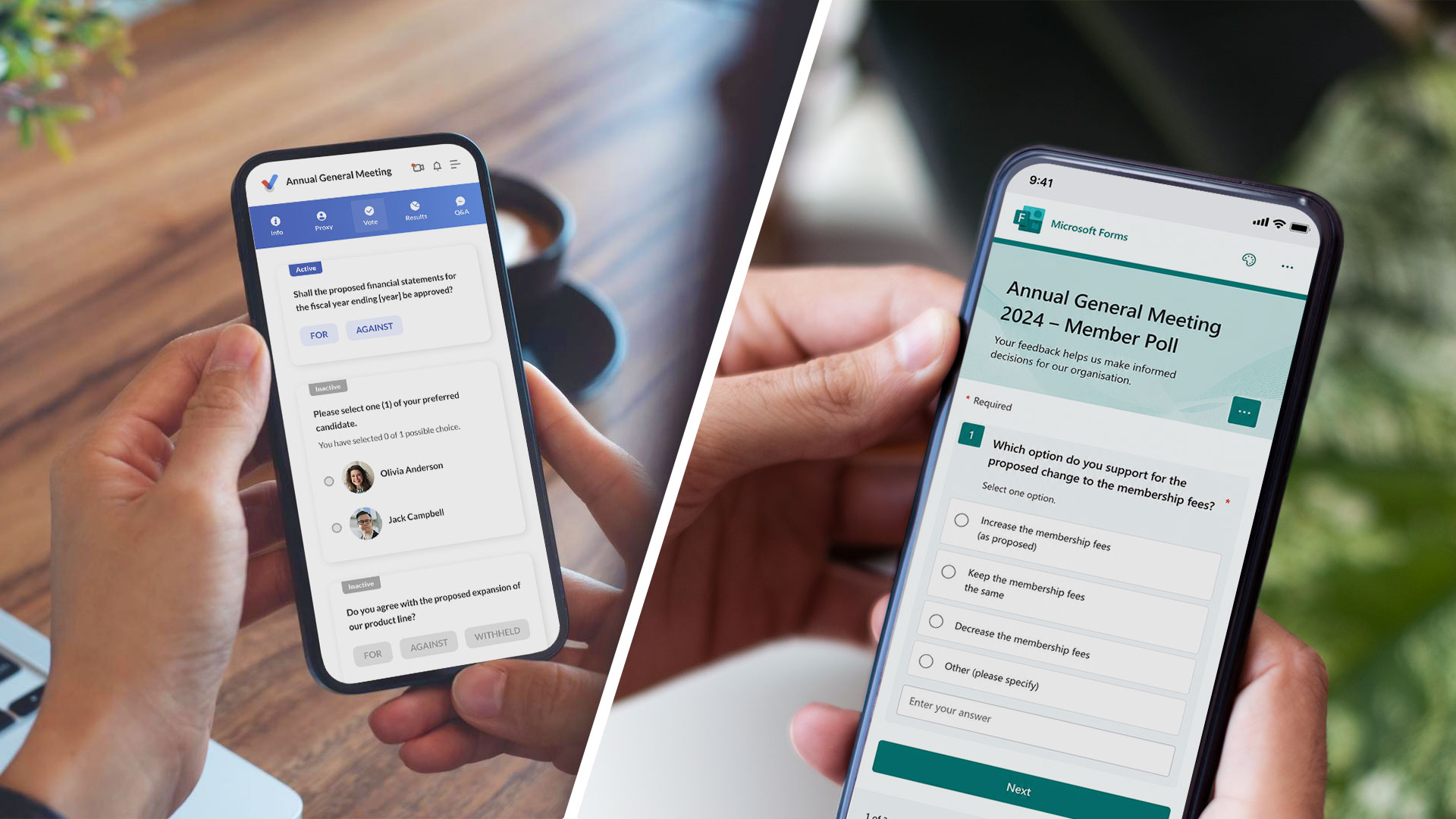
Choosing Zoom, Microsoft Teams or another conferencing platform does not, by itself, solve the voting problem. A meeting may still need dedicated voting functionality for eligibility, polls, elections, proxies and reporting.
Electronic voting is not the same as a simple online poll
This is one of the biggest misconceptions.
A general-purpose polling tool is designed to measure responses.
Formal meeting voting is designed to support a governance decision.
The difference becomes obvious when a meeting involves 500 members with different voting rights and 80 proxy appointments.
A simple poll may tell you how many people clicked “Yes”.
A proper voting process needs to determine who was entitled to vote, what voting power they had, whether their vote was valid and how the final result should be calculated.
That is why organisations should assess voting software against their actual governance requirements rather than choosing a platform based purely on price or appearance.
Common mistakes when choosing meeting voting software
Treating all votes as one-person-one-vote
This can produce incorrect results where voting rights are weighted or otherwise differentiated.
Forgetting proxies
Proxy appointments need to be incorporated into the voting process where the rules permit or require them.
Using the meeting platform’s built-in poll
A video-conferencing platform’s polling feature may be convenient, but convenience is not the same as governance functionality.
Mixing different voting methods
If people in the room vote by show of hands while online members vote electronically, the meeting team has to reconcile two processes.
Failing to test the system
A voting platform should be tested before the meeting, particularly where there are complex voting rules.
Not planning for technical problems
A contingency process should be established before voting begins.
Who can pause a poll? Who can reopen it? What happens if a participant loses connection? Who can see the results? Who has authority to make a decision if the voting technology fails?
These questions are much easier to answer before the meeting than during it.
Treating the software as a substitute for the constitution
Technology cannot determine whether a motion is legally valid or whether a particular voting threshold applies.
The organisation’s constitution, rules and applicable legislation come first.
The software should be configured around them.
A practical checklist for choosing meeting voting software
Before selecting a platform, ask:
Voting functionality
Member management
Meeting participation
Reporting
Security
Ask how the provider protects member information and voting data.
For sensitive elections and high-stakes resolutions, security should not be treated as a marketing checkbox. Look for evidence of established information security practices and independent assurance.
How Vero Voting can assist
Vero Voting provides voting technology and managed voting services for organisations running AGMs, EGMs, elections and other formal meetings.
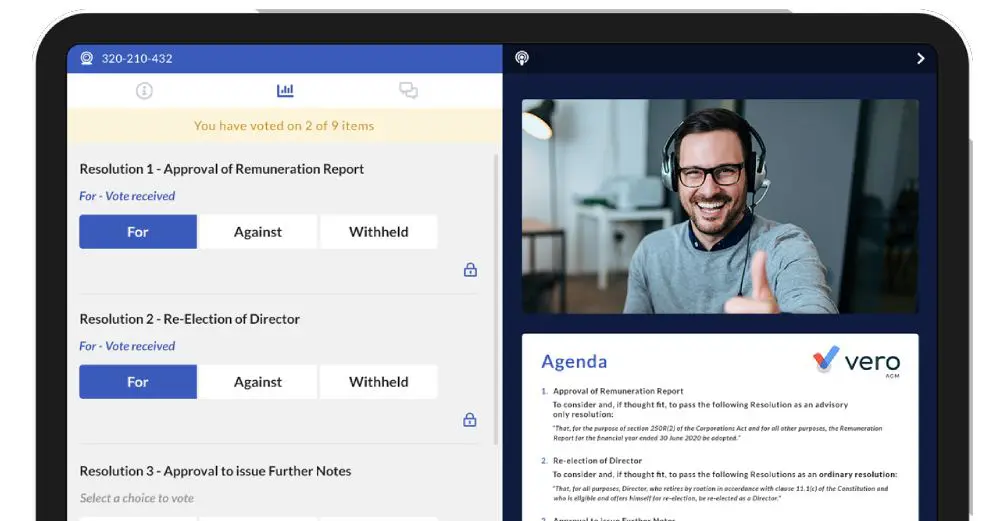
The system can support voting for both physical and virtual meetings, including real-time voting, proxy management, elections and reporting. Vero also provides virtual and hybrid meeting solutions where meeting management and voting need to work together.
That can be useful for organisations that do not simply need a generic online poll, but need a voting process configured around their own rules.
Vero’s meeting solutions can also integrate voting with common video-conferencing environments, allowing organisations to combine online meeting participation with dedicated voting functionality.
For organisations with more specialised requirements, Vero offers custom voting solutions designed around particular voting and governance workflows.
Vero Voting is ISO/IEC 27001:2022 certified and SOC 2 Type II audited, providing independent assurance around its information security controls and practices.
The important point is that the technology should fit the meeting — not the other way around.
Key takeaways
Meeting voting software is most valuable when voting is more complicated than simply asking a room to raise their hands.
A suitable system can help organisations:
But software does not replace good governance.
Before configuring a vote, confirm the requirements in the organisation’s constitution, governing rules and applicable legislation. Then choose technology capable of implementing those requirements accurately.
For companies, ASIC’s current guidance makes clear that virtual meetings must provide members with a reasonable opportunity to participate, including the ability to ask questions, make comments and vote.
For charities, associations, strata organisations and other member-based bodies, the applicable rules may differ.
If your next AGM, EGM or committee election involves complex voting requirements, Vero Voting can help you design and manage a voting process that fits your meeting.
Need help choosing the right meeting voting solution? Contact Vero Voting or request a demonstration to discuss your requirements.
Meeting Voting Software for AGMs
Meeting Voting Software for AGMs
Meeting Voting Software for AGMs
Meeting Voting Software for AGMs
Meeting Voting Software for AGMs
FAQ Section
1. What is meeting voting software?
Meeting voting software is a digital system that allows organisations to manage formal votes during AGMs, EGMs, committee meetings and elections. Depending on the system, it can handle voter eligibility, proxies, weighted voting, live polls, elections, results and audit records.
2. Can voting software be used for an in-person AGM?
Yes. Electronic voting does not require the meeting itself to be virtual. A physical AGM can use electronic voting to manage resolutions, elections and other votes while members attend at the venue.
3. Can meeting voting software handle proxy votes?
Some dedicated voting platforms can manage proxy appointments and incorporate valid proxy instructions into the voting process. The exact process needs to be configured according to the organisation’s constitution, rules and applicable legislation.
4. Is online voting allowed at an Australian AGM?
It can be, but the answer depends on the organisation and the rules that apply to it. For companies covered by the Corporations Act, virtual meetings are permitted subject to requirements including giving members a reasonable opportunity to participate. ASIC says the technology used must also enable members to vote and participate appropriately.
Other organisations, including incorporated associations, charities and strata bodies, may be governed by different legislation and rules.
5. Is Zoom or Microsoft Teams enough for AGM voting?
A video-conferencing platform can provide the meeting environment, but it may not provide everything required for formal voting. Organisations with complex voting rights, proxies, elections, weighted votes or audit requirements may benefit from dedicated meeting voting software integrated with their meeting platform.
Sources
The following are the primary Australian authorities used to verify the legal and governance information in this article:
Important: The legal requirements for meetings and voting vary according to the organisation’s legal structure, governing document and jurisdiction. This article is general information, not legal advice.
Frequently Asked Questions
What is meeting voting software?
Meeting voting software is a digital system that allows organisations to manage formal votes during AGMs, EGMs, committee meetings and elections. Depending on the system, it can handle voter eligibility, proxies, weighted voting, live polls, elections, results and audit records.
Can voting software be used for an in-person AGM?
Yes. Electronic voting does not require the meeting itself to be virtual. A physical AGM can use electronic voting to manage resolutions, elections and other votes while members attend at the venue.
Can meeting voting software handle proxy votes?
Some dedicated voting platforms can manage proxy appointments and incorporate valid proxy instructions into the voting process. The exact process needs to be configured according to the organisation’s constitution, rules and applicable legislation.
Is online voting allowed at an Australian AGM?
It can be, but the answer depends on the organisation and the rules that apply to it. For companies covered by the Corporations Act, virtual meetings are permitted subject to requirements including giving members a reasonable opportunity to participate. ASIC says the technology used must also enable members to vote and participate appropriately.
Other organisations, including incorporated associations, charities and strata bodies, may be governed by different legislation and rules.
Is Zoom or Microsoft Teams enough for AGM voting?
A video-conferencing platform can provide the meeting environment, but it may not provide everything required for formal voting. Organisations with complex voting rights, proxies, elections, weighted votes or audit requirements may benefit from dedicated meeting voting software integrated with their meeting platform.