Understanding Quorum Requirements for AGMs in Australia
Wednesday, 16 September 2026, 8:27 am

AGM Quorum Requirements in Australia: A Practical Guide
An AGM can be carefully planned, the agenda can be ready, the voting system can be tested — and then the meeting cannot properly proceed because there are not enough eligible members present.
That is the practical significance of a quorum.
A quorum is the minimum number of eligible people who must be present for a meeting to validly conduct business. The exact requirement depends on the organisation. A company, incorporated association, charity, owners corporation or other member-based organisation may be subject to different legislation, constitutional rules or meeting procedures.
For organisations running AGMs across Australia, the safest approach is not to assume that a particular percentage or number always applies. Instead, identify the legal structure, check the governing document and confirm how attendance, proxies and electronic participation are treated.
This guide explains how AGM quorum requirements work, where organisations commonly get them wrong, and how to manage quorum more reliably.
What is a quorum at an AGM?
A quorum is the minimum number of eligible participants required for a meeting to conduct business.
It is more than an attendance target. If the required quorum has not been reached, the meeting may not have authority to validly consider resolutions or conduct other business.
For example, imagine an association has 100 voting members and its constitution specifies a quorum of 10 members. If only eight eligible members attend, the organisation cannot simply proceed because those eight people represent the members who bothered to attend.
The quorum requirement exists precisely to prevent important decisions being made by an inadequately represented group.
A quorum can be expressed as:
The first question should therefore be:
What does our governing document and applicable legislation say about quorum?
Is there a standard AGM quorum in Australia?
No. There is no single quorum requirement that applies to every AGM in Australia.
The answer depends on the organisation’s legal structure and the rules governing its meetings.
For companies, the Corporations Act 2001 (Cth) contains a replaceable rule in section 249T providing for a quorum of two members at a meeting of members, with the quorum required to remain present throughout the meeting. However, because this is a replaceable rule, the company’s constitution may provide a different requirement.
For charities and incorporated associations, the position can be different again. The ACNC explains that organisations need to check their governing documents and applicable legislation when determining meeting requirements. Incorporated associations are generally regulated under state or territory legislation.
Strata schemes are another example where specific legislation applies. In NSW, for example, the quorum for a general meeting is based on eligible voters or unit entitlements, with specific rules applying when a quorum is not reached.
So a statement such as “the AGM quorum is 10%” may be correct for one organisation and completely wrong for another.
AGM quorum requirements for companies
Companies are generally governed by the Corporations Act 2001 and their constitution.
The default company quorum
Section 249T of the Corporations Act provides a replaceable rule that the quorum for a meeting of company members is two members.
The quorum must be present throughout the meeting.
When determining whether the quorum is present, certain representatives and proxies can be counted. However, the legislation contains rules preventing the same individual from being counted more than once in particular circumstances.
This distinction matters when an AGM has proxy appointments.
For example, an organisation should not simply count every proxy appointment as an additional person physically present. The relevant rules concern the people actually attending and how they are counted for quorum purposes.
What if the constitution specifies a different quorum?
The two-member requirement is a replaceable rule, meaning a company’s constitution can deal with the matter differently.
That is why company secretaries should check the constitution rather than relying solely on the default Corporations Act rule.
This is particularly relevant for companies limited by guarantee, which are commonly used by not-for-profit organisations and other member-based bodies.
ASIC notes that the quorum requirement for company members is at least two members under the replaceable rule, unless the company’s constitution provides something different.
What happens if there is no quorum?
Under section 249T, if a meeting does not have a quorum within 30 minutes after the scheduled start time, the meeting is adjourned to a resumed meeting at a later time, subject to the requirements in the Act.
The organisation should follow its constitution and the applicable legislation when dealing with the adjourned meeting.
Do not simply decide to continue because “everyone who matters is here”. The quorum is a governance requirement, not an attendance preference.
Quorum requirements for charities and not-for-profits
Charities do not all operate under the same legal structure.
A registered charity might be:
That structure affects which rules apply.
The ACNC states that incorporated associations are incorporated under state or territory legislation, while companies limited by guarantee are registered with ASIC.
For charities, the governing document may therefore be just as important as the organisation’s regulator.
The ACNC’s guidance on holding meetings recommends checking the organisation’s rules and legislation to determine whether a quorum is required and what that quorum is. It also highlights a practical point that is sometimes missed: the required number should remain present for the whole meeting, not just at the beginning.
Why charities should check their constitution
Consider a charity with 500 members.
Its constitution might specify a quorum of 10 members, 10% of eligible members, or another formula.
Those requirements produce very different results:
The ACNC specifically recommends considering whether a quorum is practical. A quorum that is too high can make it difficult to hold a valid meeting, while one that is too low may not provide an appropriate level of member participation.
This is a governance issue worth reviewing when membership numbers change substantially.
Quorum requirements for incorporated associations
Incorporated associations are primarily regulated at state or territory level.
That means the rules can differ between NSW, Victoria, Queensland, Western Australia, South Australia, Tasmania, the ACT and the Northern Territory.
The association’s constitution or rules will generally set out important meeting procedures, including quorum.
For example, Consumer Affairs Victoria identifies quorum as one of the matters an incorporated association’s rules must address, including the minimum number or percentage of members required to conduct a valid general meeting.
The ACNC similarly notes that requirements for incorporated associations vary according to the state or territory in which they are incorporated.
Do not assume the same rule applies nationally
An association operating in Queensland should not automatically copy its AGM procedure from an organisation incorporated in Victoria.
Even organisations with similar purposes can have different constitutions and different statutory requirements.
Before an AGM, the secretary or meeting administrator should confirm:
Strata AGM quorum requirements
Strata is a particularly good example of why the phrase “AGM quorum” cannot be treated as a single national rule.
Strata legislation is state and territory based, and the requirements can vary significantly between jurisdictions.
Example: NSW strata schemes
Under NSW strata rules, the quorum at a general meeting is based on either:
The quorum must be met within 30 minutes of the scheduled start. If it is not, the meeting can be postponed for seven days, or the chairperson may decide that those present constitute a quorum. A postponed meeting proceeds after seven days even if the quorum is not reached again.
This is very different from simply saying “two members constitute a quorum”.
For strata managers, the practical lesson is straightforward: always work from the legislation applicable to the scheme’s jurisdiction and the current meeting rules.
Quorum vs voting majority: they are not the same
One of the most common AGM misunderstandings is treating quorum and voting thresholds as the same thing.
They are different.
Quorum
Quorum answers:
Are enough eligible people present for the meeting to conduct business?
Voting threshold
The voting threshold answers:
Once the meeting can validly conduct business, how many votes are needed to pass this particular resolution?
A meeting can have a valid quorum and still fail to pass a motion.
For example:
The meeting was quorate, but the resolution may still fail.
The exact voting threshold depends on the type of resolution and the rules applying to the organisation.
For companies, ASIC distinguishes between ordinary resolutions and special resolutions, with a special resolution generally requiring at least 75% of votes cast by members entitled to vote.
Does a proxy count towards quorum?
Sometimes, yes — but the answer depends on the applicable rules.
For companies operating under section 249T, individuals attending as proxies or body corporate representatives can be counted when determining quorum, subject to the statutory counting rules.
Other organisations may have specific provisions in their constitution or legislation dealing with proxies.
This is why the meeting administrator should establish who counts towards quorum before the meeting begins, rather than trying to work it out halfway through a contentious resolution.
A good attendance process should distinguish between:
Simply counting everyone in the meeting room is not enough.
Does online attendance count towards AGM quorum?
It can, but the applicable rules must be checked.
For companies, the Corporations Act contains provisions dealing with meetings using technology and requires the technology to provide members with a reasonable opportunity to participate.
For charities and associations, the governing rules may also expressly allow participation through technology.
The ACNC’s template guidance, for example, recognises members attending through technology when determining quorum under the relevant model provisions.
The key point is that using Zoom, Teams or another meeting platform does not automatically make an attendee part of the quorum. The organisation needs to establish that electronic participation is permitted under the rules applying to that meeting.
What happens when an AGM does not reach quorum?
The consequences depend on the organisation’s rules and legislation.
Common outcomes include:
The chairperson should not improvise.
The meeting notice, constitution and applicable legislation should determine what happens next.
A practical example
Suppose an association requires 10 members for a quorum.
The AGM is scheduled for 6:00 pm.
At 6:00 pm, only seven eligible members are present.
Rather than immediately declaring the meeting cancelled, the chair should check the rules. The constitution may specify a waiting period, an adjournment procedure or a different requirement for a resumed meeting.
The secretary should record what occurred and why the meeting was unable to proceed.
That record can become important later if a member questions the validity of the meeting or a resolution.
Common AGM quorum mistakes
1. Assuming every AGM requires 10% of members
There is no universal Australian 10% quorum rule.
Some organisations use 10%. Others use a fixed number. Some have different statutory arrangements altogether.
Always check the governing rules.
2. Counting people who cannot vote
Quorum is generally concerned with the people who are legally entitled to participate in the relevant meeting, subject to the specific rules.
Guests, observers and other attendees should not automatically be counted.
3. Counting proxy appointments instead of people
A proxy appointment is not necessarily the same thing as another person physically attending the meeting.
The applicable rules determine how proxies are counted.
4. Checking quorum only at the beginning
For many meeting rules, quorum must continue throughout the meeting.
The ACNC specifically highlights this point in its meeting guidance.
If several members leave halfway through the AGM, the chair should know whether the meeting remains quorate.
5. Confusing quorum with a majority vote
Having enough people present does not mean that a motion has automatically passed.
Quorum and voting thresholds answer two different questions.
6. Ignoring electronic participation rules
An online attendee should not simply be added to the quorum count without checking whether electronic attendance is permitted and whether the technology satisfies the relevant meeting requirements.
7. Relying on an outdated constitution
Membership numbers, legislation and organisational structures change.
A constitution written years ago may contain a quorum provision that is difficult to operate in practice or no longer reflects the organisation’s current circumstances.
The ACNC recommends reviewing quorum arrangements periodically, particularly where membership numbers change significantly.
How to manage AGM quorum effectively
A reliable quorum process starts well before the meeting.
Before sending the AGM notice
Check:
Do not leave these checks until the chair asks, “Do we have a quorum?”
Before the meeting starts
Prepare an attendance register that clearly identifies:
For a large AGM, manual counting can become surprisingly difficult.
During the AGM
The chair or meeting administrator should know:
If attendance changes materially, update the count.
After the meeting
Keep an appropriate record of:
Good governance is not only about getting the decision right. It is also about being able to demonstrate how the decision was reached.
How voting technology can help with quorum management
Technology does not determine the legal quorum for an organisation. That remains a matter for the applicable legislation and governing rules.
What technology can do is make the administrative side much easier to control.
For example, a meeting voting platform can help administrators:
This becomes particularly useful for AGMs involving hundreds or thousands of members, remote participants, proxies or multiple voting methods.
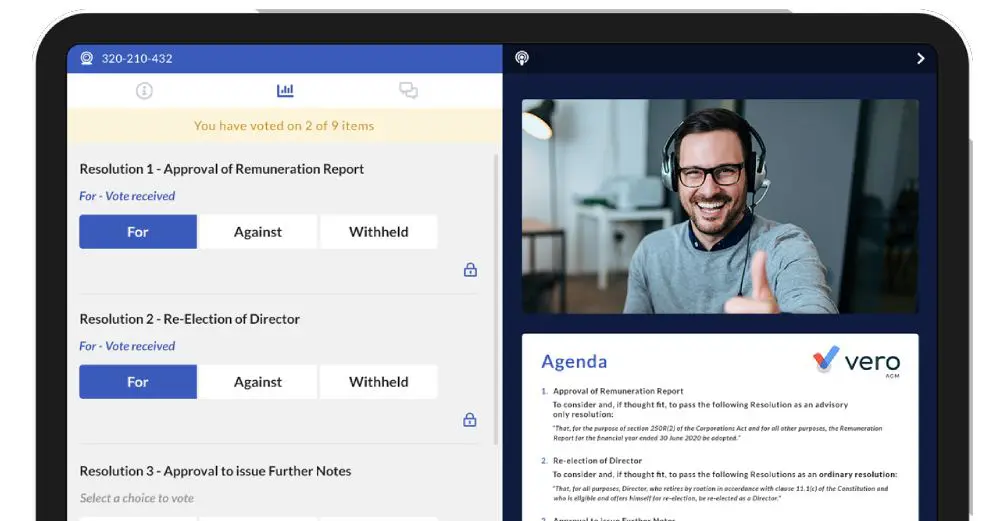
Vero Voting, for example, provides AGM and meeting solutions that combine attendance, proxy management and voting processes. Its AGM platform supports virtual and hybrid meetings, proxy voting, real-time voting and reporting.
For strata organisations, Vero’s strata voting platform can also configure proxies, quorum rules and unit-entitlement weighting, with reporting that brings these elements together.
The technology should support the governance process — not replace the organisation’s responsibility to determine what its rules require.
A practical AGM quorum checklist
Before your next AGM, run through this checklist:
Governance
Members
Meeting technology
Meeting administration
A few minutes spent checking these points can prevent a great deal of trouble later.
Where Vero Voting can assist
For organisations running larger or more complex AGMs, the challenge is often not understanding what quorum means. It is managing all the moving parts at the same time.
Members may be attending in person and online. Some may have appointed proxies. Voting rights may differ. Motions may need different voting methods. And the organisation still needs a reliable record of what happened.
Vero Voting provides online voting and meeting solutions for organisations running AGMs, elections, member votes and other formal decision-making processes. Its AGM solution supports virtual and hybrid meetings, proxy management, real-time voting and reporting.
For organisations with more specialised requirements, Vero also provides custom voting solutions designed around particular governance and regulatory workflows.
The right system will not replace your constitution or legal advice. It can, however, make it much easier to administer the rules consistently and maintain a clear record of the process.
Key takeaways
A quorum is the minimum level of eligible participation required for an AGM to validly conduct business.
The most important points to remember are:
The safest AGM is one where the quorum requirements are settled before the meeting starts — not debated after a resolution has already been challenged.
If your organisation is planning an AGM and needs help managing attendance, proxies, voting or meeting administration, contact Vero Voting or request a demonstration to discuss the requirements of your next meeting.
Understanding Quorum Requirements for AGMs in Australia
Understanding Quorum Requirements for AGMs in Australia
Understanding Quorum Requirements for AGMs in Australia
Understanding Quorum Requirements for AGMs in Australia
Understanding Quorum Requirements for AGMs in Australia
Understanding Quorum Requirements for AGMs in Australia
Understanding Quorum Requirements for AGMs in Australia
Frequently Asked Questions About AGM Quorum Requirements
What is the quorum for an AGM in Australia?
There is no single quorum requirement for every Australian AGM. The required quorum depends on the organisation’s legal structure, applicable legislation and constitution or governing rules. Companies, incorporated associations and strata schemes can have different requirements.
Is two people enough for an AGM quorum?
For a company using the Corporations Act’s replaceable rule, the quorum for a meeting of members is two members, and the quorum must remain present throughout the meeting. However, a company’s constitution can provide a different quorum.
Does a proxy count towards AGM quorum?
A proxy may count towards quorum where the applicable legislation or governing rules allow it. For companies, section 249T contains specific rules for counting individuals attending as proxies or representatives. Other organisations may have different provisions.
Can an online attendee count towards AGM quorum?
Potentially. Electronic participation is permitted for many meetings, but the organisation must follow the legislation and governing rules that apply to the meeting. For companies, the Corporations Act includes requirements concerning participation using technology.
What happens if an AGM does not reach quorum?
The outcome depends on the applicable legislation and governing document. The meeting may need to wait for a specified period, be adjourned, postponed or reconvened. The chair should follow the prescribed procedure rather than simply proceeding without quorum.
Sources
The article is based primarily on Australian legislation and official regulator/government guidance.
Frequently Asked Questions
What is the quorum for an AGM in Australia?
There is no single quorum requirement for every Australian AGM. The required quorum depends on the organisation’s legal structure, applicable legislation and constitution or governing rules. Companies, incorporated associations and strata schemes can have different requirements.
Is two people enough for an AGM quorum?
For a company using the Corporations Act’s replaceable rule, the quorum for a meeting of members is two members, and the quorum must remain present throughout the meeting. However, a company’s constitution can provide a different quorum.
Does a proxy count towards AGM quorum?
A proxy may count towards quorum where the applicable legislation or governing rules allow it. For companies, section 249T contains specific rules for counting individuals attending as proxies or representatives. Other organisations may have different provisions.
Can an online attendee count towards AGM quorum?
Potentially. Electronic participation is permitted for many meetings, but the organisation must follow the legislation and governing rules that apply to the meeting. For companies, the Corporations Act includes requirements concerning participation using technology.
What happens if an AGM does not reach quorum?
The outcome depends on the applicable legislation and governing document. The meeting may need to wait for a specified period, be adjourned, postponed or reconvened. The chair should follow the prescribed procedure rather than simply proceeding without quorum.