Proxy Management Software Australia: Lodgement & Attendance
Monday, 23 November 2026, 9:53 am

Anyone who has run an Annual General Meeting (AGM) or Special General Meeting knows the exact moment things get tense. It is usually ten minutes before the Chair calls the meeting to order. The proxy cut-off passed two days ago, a stack of last-minute forms has been reconciled on a master spreadsheet, and suddenly three members who already lodged directed proxies walk through the door—or log into the virtual waiting room—asking for a live voting handset.
If your attendance register does not talk directly to your proxy register, you have an immediate governance headache. Either you risk double-counting a member’s vote, or you hold up the start of the meeting while a returning officer scrambles to manually void rows in Excel.
Modern proxy management software in Australia exists to eliminate that exact bottleneck. Rather than treating proxy collection, eligibility checks, and room check-in as disconnected tasks, purpose-built platforms connect them into one continuous, auditable workflow.
What Proxy Management Software Actually Does
At a basic level, proxy software replaces paper forms, emailed PDFs, and manual data entry with a secure digital portal. Yet for Australian company secretaries, strata managers, and association administrators, the real value lies in how the software enforces rules automatically behind the scenes.
A capable platform manages three core stages of the meeting lifecycle:
Why Manual Proxy Reconciliation Breaks Down
Spreadsheets work fine when you have twenty members and three straightforward resolutions. They start to fail the moment complexity enters the room.
Consider a typical Australian strata scheme, industry association, or unlisted public company. You might be dealing with tiered membership classes, weighted unit entitlements, split proxy allocations between two nominees, and corporate representatives acting on behalf of member entities. Add a hybrid meeting format where half the room is in Sydney and the other half is dialling in from regional centres, and manual reconciliation becomes a liability.
Under the Corporations Act 2001 (Cth), proxy administration is governed by strict statutory mechanics. For example:
When administrators track these rules manually, small human errors—like forgetting to transfer an absent proxy holder’s directed votes to the Chair, or failing to suspend a proxy when the appointing member checks in live—can invalidate a resolution or invite a formal challenge.
Three Critical Workflows to Automate
If you are evaluating proxy lodgement and meeting management tools, pay close attention to how the system handles the transitions between pre-meeting preparation and live floor polling.
1. Authenticated Lodgement and Cut-Off Enforcement
Chasing unreadable handwriting on scanned PDF forms wastes hours of administrative time. Worse, informal errors—such as ticking both “For” and “Against”, forgetting to sign, or allocating more than 100% of a shareholding across split proxies—force your team to track down members before the deadline.
Digital proxy portals validate submissions at the point of entry. Members log in using unique credentials tied directly to your verified voter register. The interface prevents conflicting selections, enforces split-allocation limits, and timestamps every submission. Once the constitutional cut-off window hits—say, 48 hours before the scheduled start time—the portal locks automatically. Nobody can slip a late form into the pile, giving your Returning Officer a clean, frozen baseline to audit before meeting day.
2. Live Attendance Reconciliation and Automatic Suspension
The single biggest advantage of integrated proxy software is real-time attendance reconciliation.
In Australian governance practice, a member who appoints a proxy retains the right to attend the meeting themselves. If that member checks in and votes on a resolution, their prior proxy appointment for that resolution is suspended or revoked.
When your check-in system and proxy database are unified:
3. Real-Time Weighted Calculation and Chair Visibility
During a live meeting, the Chair should never have to pause proceedings while scrutineers tally paper slips with calculators.
Modern platforms provide a dedicated Chair Proxy Console. Before calling a poll, the Chair can see a clear breakdown of pre-lodged directed votes (“For”, “Against”, and “Abstain”) alongside the pool of undirected discretionary votes held by the Chair. When the poll closes, the engine combines:
Whether your rules operate on one-member-one-vote, shareholdings, or strata lot entitlements, the software applies the exact mathematical weighting instantaneously and generates a timestamped audit log for scrutineers.
Common Mistakes When Digitising Proxy Management
Moving away from paper solves many issues, but organisers still run into trouble when software settings do not match their governing documents. Watch out for these frequent pitfalls:
How Vero Voting Supports Australian Meeting Organisers
For more than two decades, Vero Voting has helped Australian companies, associations, strata managers, and member organisations run compliant, transparent general meetings.
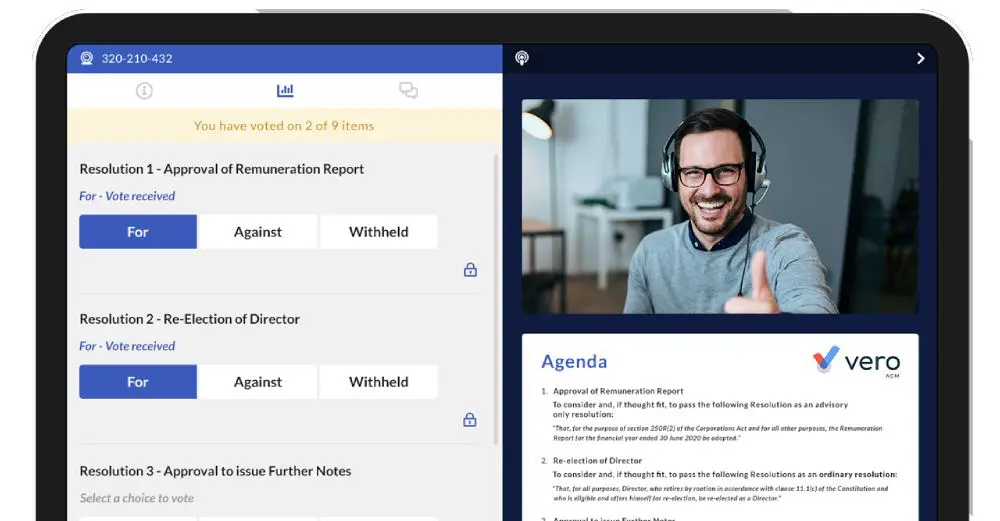
Vero Voting’s integrated AGM and proxy management platform brings pre-meeting lodgement, eligibility validation, live attendance check-in, and real-time poll calculation together in one system. Members receive unique login credentials matched directly against your roll, allowing them to lodge directed, undirected, or split proxies online before your exact constitutional cut-off.
On meeting day—whether in-person, virtual, or hybrid—Vero’s check-in tools reconcile floor and online attendance against the proxy register automatically. If a member arrives after lodging a proxy, their proxy is immediately suspended to prevent double-voting. If a third-party proxy fails to attend, directed votes transfer to the Chair automatically. Operating within an ISO/IEC 27001:2022 certified and SOC 2 Type II audited environment, Vero Voting gives Returning Officers, scrutineers, and boards complete confidence in every result.
Key Takeaways
If you are planning an upcoming AGM or general meeting and want to remove the stress of manual proxy reconciliation, get in touch with the Vero Voting team to walk through how our platform handles your specific constitutional rules.
Frequently Asked Questions
What happens if a member lodges a proxy and then attends the AGM in person or online?
If a member validly appoints a proxy but subsequently attends the meeting and votes on a resolution themselves, their proxy appointment for that resolution is automatically suspended or revoked. Integrated proxy management software detects the member’s check-in and updates the active voting roll immediately so the vote is never counted twice.
What is the standard proxy lodgement cut-off in Australia?
Under section 250B of the Corporations Act 2001 (Cth), proxy appointments for a company meeting must generally be received at least 48 hours before the meeting, unless the company’s constitution specifies a shorter timeframe. Incorporated associations, strata schemes, and unions follow their own state legislation and constitutional deadlines, which proxy software can enforce automatically.
What happens if an appointed proxy holder does not attend the meeting?
Under section 250BB of the Corporations Act 2001 (Cth), if a member appoints someone other than the Meeting Chair as their proxy with directed voting instructions, and that proxy holder does not attend the meeting (or does not vote on the poll), the directed proxy votes automatically transfer to the Meeting Chair. The Chair is legally required to cast those votes as directed.
Can proxy management software handle weighted voting and strata lot entitlements?
Yes. Purpose-built proxy software imports your member register along with shareholdings, strata unit entitlements, or tiered membership weights. When a proxy is lodged or a poll is calculated, the system applies the exact weighting automatically without manual spreadsheet formulas.
Do proxies count towards an AGM quorum in Australia?
It depends on your organisation’s legal structure and governing rules. For companies relying on the replaceable rule in section 249T of the Corporations Act 2001 (Cth), specific rules govern how individuals attending as proxies or corporate representatives are counted towards the two-member quorum. Always check your constitution or state legislation to ensure your registration software counts proxy attendance accurately.