Association Voting Services in Australia: How to Run Fair and Well-Managed Member Elections
Friday, 16 October 2026, 8:38 am

Association Voting Services in Australia: How to Run Fair and Well-Managed Member Elections
Running a member election sounds straightforward until an association has to do it properly.
There may be hundreds or thousands of members on the register. Some members may be eligible to vote while others are not. Nominations need to be checked. The constitution may prescribe a particular voting method. A secret ballot may be required. There may be several committee positions to fill, and the association may need to explain how the final result was determined.
For a small association, volunteers may be able to manage the process manually.
For a larger or contested election, that approach can become difficult very quickly.
That is where association voting services can help.
A professional voting service can provide the technology, election administration or independent oversight needed to run member elections and ballots in a structured way. The objective is not simply to collect votes. It is to give members confidence that the right people were allowed to vote, the voting rules were followed and the result was properly recorded.
There is another point that often gets overlooked.
The voting software should come after the rules, not before them.
Before choosing an online voting system, an association needs to understand its constitution, membership rules and the legislation that applies to it.
What are association voting services?
Association voting services help member-based organisations conduct elections, ballots and other member votes.
Depending on the organisation and the type of vote, a service may include:
Some associations only need voting software.
Others benefit from a managed election service where an independent provider helps administer the process from nominations through to the final result.
The right option depends on the size of the electorate, the complexity of the election and the rules that govern the organisation.
Why fair election management matters
Members are more likely to accept an election result when they understand how the election was conducted.
That does not mean every election needs to be complicated.
It means the process should be clear.
A well-managed association election should answer basic questions such as:
If those questions are unclear, the association can face complaints even when nobody has deliberately done anything wrong.
The perception of fairness matters too.
An election managed by current committee members can become uncomfortable when those same people are candidates. An independent returning officer or voting provider can create a useful separation between the organisation’s leadership and the administration of the ballot.
Start with the constitution and rules
The first step in planning an association election should be reviewing the governing document.
This is where many organisations go wrong.
They choose an online voting platform and then try to work out how the election should operate.
The better approach is the reverse.
Check the rules before setting up the ballot
Look for provisions dealing with:
The requirements can be very different between organisations.
For example, Victorian incorporated association rules must address matters including how voting is conducted and how committee members are elected or appointed. An association can use model rules or develop its own rules, subject to the requirements of the Victorian legislation.
In NSW, an incorporated association’s constitution must identify the types of resolutions that can be decided by postal or electronic ballot if those methods are to be used.
The rules therefore determine much of the election process.
Software should support those rules rather than replace them.
Association voting rules vary between states
There is no single national process for incorporated association elections.
An association may be governed by state or territory legislation, its own constitution, model rules, or another regulatory framework depending on its structure.
New South Wales
NSW provides a particularly useful example of why election administration needs to be taken seriously.
For postal, electronic or combined ballots, the NSW framework requires the committee to appoint a returning officer and set the ballot’s closing date.
The returning officer prepares the roll of members entitled to vote. For an electronic ballot, members must receive the required ballot information and instructions within the prescribed timeframe.
The rules also deal with secret electronic ballots and require ballot information to be securely stored until the votes are counted.
The returning officer then reviews the information and reports to establish the result.
This is much more structured than simply emailing members a survey link.
Victoria
Victoria takes a different approach.
Consumer Affairs Victoria explains that incorporated association rules must cover matters including voting procedures, quorum, proxy voting and the election or appointment of committee members.
Victorian associations can use their own rules or model rules, so the actual constitution of the organisation needs to be checked before an election is designed.
Technology can be used to support general meetings, including online participation, but the organisation still needs to follow its governing rules.
Queensland
Queensland also has specific rules for incorporated associations.
Under the Queensland Associations Incorporation Act, management committee members are elected at an annual general meeting or general meeting in accordance with the association’s rules.
That means the election method needs to be considered alongside the organisation’s own rules.
Other jurisdictions
Western Australia, South Australia, Tasmania, the ACT and Northern Territory have their own association legislation and requirements.
The practical lesson is simple:
Never assume that an election process used by another association is automatically suitable for your organisation.
The constitution and applicable legislation should be checked first.
Build an accurate voter roll
A reliable election starts with an accurate list of eligible members.
This can be more complicated than it sounds.
An association may have:
Not everyone on the membership database will necessarily have the same voting rights.
The association should establish the electorate before the ballot opens.
A professional voting platform can then use the approved voter list to control access to the election.
That distinction is important.
The association determines who is eligible. The voting system applies that decision consistently.
Manage nominations as part of the election
The election begins before the ballot opens.
Nominations can create just as many governance questions as voting itself.
A sound nomination process should clearly establish:
For a larger association, online nomination forms can reduce administration and provide a consistent record of submissions.
But automation should not replace the eligibility check.
Someone still needs to confirm that each nomination meets the organisation’s rules.
Choose the right voting method
Not every association election should be run in the same way.
Depending on the rules, the organisation may use:
For a contested committee election, a secret ballot may provide greater confidence than an open show of hands, particularly where members are voting on people they know personally.
A voting platform should be able to support the required method rather than forcing the election into a standard yes/no poll.
Secret ballots need genuine ballot secrecy
There is a major difference between saying a vote is confidential and actually designing the system so that individual choices cannot be identified unnecessarily.
A properly designed secret ballot separates voter authentication from the ballot choice.
The organisation may need to know that:
But that does not mean administrators should automatically be able to see which candidate the member selected.
When evaluating association voting services, ask specifically:
Those are much better questions than simply asking whether the platform is “private”.
Prevent duplicate voting
A member election needs reliable controls against duplicate voting.
This becomes particularly important where members:
The voting system should connect each voting opportunity to the approved voter record and prevent a member from submitting multiple votes where the election rules allow only one.
Administrators should also have a way to identify problems without exposing confidential ballot choices.
Does your election require preferential voting?
Some association elections use preferential voting.
Others do not.
The organisation’s rules determine the appropriate method.
If members are required to rank candidates, the voting system needs to understand that ranking and apply the correct counting process.
That is fundamentally different from asking members to tick one or more names.
For example, an association may have five candidates competing for two positions. If its rules require preferences, voters may need to rank candidates in a particular order rather than simply selecting their preferred two.
The system needs to match the actual election method.
Before purchasing software, ask the provider to demonstrate how the specific counting method would work.
What happens when there are more candidates than positions?
This is where an election becomes genuinely contested.
Suppose an association has six committee positions and eight eligible candidates.
The association now needs a clear process for determining the successful candidates.
Depending on its rules, that may involve:
A dedicated election platform can make the administration easier, but it cannot decide which counting method the association should use.
That comes from the rules.
Independent election management can improve confidence
Independence is particularly useful when the election is closely contested.
Consider an association where three existing committee members are standing for re-election and several other members are challenging them.
If the sitting committee is responsible for preparing the voter list, issuing ballots, monitoring voting and counting the result, members may question the process even if everything was handled honestly.
An independent returning officer can separate election administration from candidates.
This can be especially valuable for:
Independence does not mean the provider decides who is eligible or who wins.
The organisation’s rules still determine those matters.
The independent role is to administer the agreed process consistently.
Online voting can make member participation easier
For associations with members spread across different locations, online voting can remove some of the practical barriers associated with paper ballots.
Members may be able to vote from:
This can be particularly useful for organisations with geographically dispersed members.
But accessibility should remain part of the planning.
A ballot that is technically available online is not necessarily easy for every member to use.
Voting instructions should be straightforward, the process should work on common devices and members should have a clear way to obtain assistance if something goes wrong.
Member accountability matters
For member-based charities, the issue goes beyond simply conducting an election.
The ACNC’s Governance Standard 2 requires charities with members to take reasonable steps to be accountable to their members and provide adequate opportunities for members to raise concerns about how the charity is run.
The ACNC gives examples including holding an annual meeting where members can ask questions and vote on resolutions, and having clear processes for appointing responsible people such as board or committee members.
A transparent election process therefore forms part of broader member governance.
Members should understand how their organisation makes important decisions and how its leaders are appointed.
Protect member information
Association elections involve personal information.
A voting provider may receive:
The security arrangements around that information deserve careful consideration.
The OAIC’s current APP 11 guidance says APP entities must take reasonable steps to protect personal information against misuse, interference and loss, as well as unauthorised access, modification or disclosure.
The OAIC also identifies technical and organisational measures, third-party providers, cloud computing, access security, data breaches and destruction or de-identification as relevant security considerations.
When assessing an association voting provider, ask:
Security should be something the provider can explain clearly.
Keep an audit trail without compromising secrecy
An election should leave a reliable record.
That might include:
But an audit trail should not automatically expose confidential votes.
The aim is to preserve evidence that the election was administered correctly while protecting the secrecy of individual choices where secrecy is required.
That distinction is particularly important when choosing online election software.
Test the election before members vote
One of the simplest ways to prevent problems is to test the election before it opens.
The test should cover:
A small configuration error can have a large impact once thousands of members receive voting access.
A proper test gives administrators a chance to catch those issues before the ballot goes live.
Common mistakes in association elections
What should you look for in association voting services?
When comparing providers, look at the whole election rather than one software feature.
Voter management: The system should ideally support member-list imports, eligibility controls, secure authentication, duplicate-vote prevention, membership categories and voter updates.
Candidate management: Look for online nominations, candidate eligibility checks, nomination closing dates, candidate information and withdrawal management.
Voting functionality: Consider whether the platform supports secret ballots, committee elections, multiple positions, preferential voting, member ballots, online voting, postal or hybrid processes where appropriate, and different voting methods.
Election administration: Ask whether the provider can offer returning officer services, ballot setup, pre-election testing, member communications, voting reminders, support during the ballot and result verification.
Security and privacy: Ask about encryption, authentication, access controls, audit logs, security testing, data retention, incident response, third-party providers and independent certifications or audits.
Results and reporting: Look for reliable counting, clear result calculations, participation reporting, election result reports, audit information and appropriate preservation of ballot secrecy.
When should an association use professional voting services?
A small association with a straightforward uncontested election may be able to manage its election internally.
Professional support becomes more useful as complexity increases.
Consider using a specialist provider when:
There is also a practical consideration.
The cost of getting an election wrong can extend well beyond the cost of running it.
An election may have to be repeated. Members may challenge the result. Committee relationships can become strained. The organisation may spend weeks reconstructing what happened.
Good election administration is preventative.
A practical association election process
A well-managed member election can follow this general sequence:
The exact procedure should always be adapted to the organisation’s governing rules and applicable legislation.
How Vero Voting can assist associations
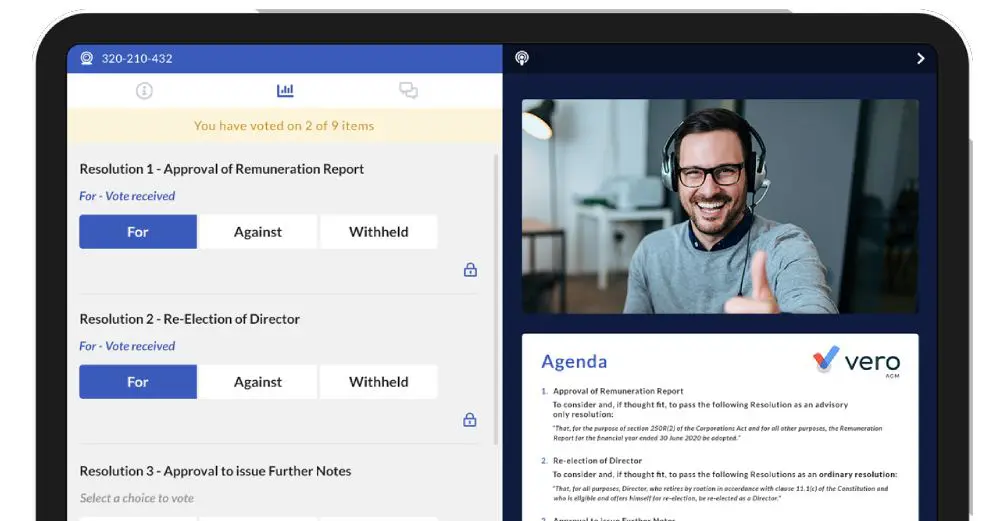
Vero Voting provides election and voting services for organisations that need a more structured approach to member voting.
For an association, that can include support with member elections, committee elections, nominations, preferential voting, secure online ballots and election administration.
This is particularly useful when the association wants to separate election administration from its current committee or does not have the internal resources to manage a complex ballot. You can explore these association voting services to see how they support member elections.
A specialist provider can also help reduce the manual work involved in maintaining voter lists, issuing voting access, managing the ballot and producing results.
The technology should remain in the background.
Members should experience a clear voting process. Administrators should have the controls they need. The organisation should be left with a reliable record of the election.
That is the real purpose of voting software.
Association election checklist
Before appointing an association voting provider, ask:
If the answers are unclear, the association should resolve those issues before the ballot opens.
Key takeaways
A fair association election does not begin when members receive a voting link.
It begins with the rules.
The organisation needs to establish the electorate, manage nominations properly, choose the correct voting method and decide who should administer the election. Technology can then make the process more efficient, secure and easier to manage.
For larger or contested elections, professional association voting services can also provide independence and reduce the administrative burden on committee members and volunteers.
The strongest election processes are the ones members can understand and trust.
If your association is planning a committee election, member ballot or online vote and needs help with the voting process, you can contact Vero Voting for any assistance or request a demonstration.
Association Voting Services Australia: Run Fair Elections
Association Voting Services Australia: Run Fair Elections
Association Voting Services Australia: Run Fair Elections
Association Voting Services Australia: Run Fair Elections
Association Voting Services Australia: Run Fair Elections
FAQ: Association Voting Services in Australia
What are association voting services?
Association voting services help member-based organisations conduct elections and ballots. Depending on the provider, services may include voter-roll management, candidate nominations, secure online voting, secret ballots, preferential voting, vote counting, result reporting and returning officer services.
Can an incorporated association run an online election?
It depends on the association’s legislation and governing rules. Some Australian jurisdictions expressly provide for electronic or online voting in particular circumstances, while an association’s constitution may determine the voting method. The organisation should confirm its rules before conducting an electronic ballot.
How do associations make member elections fair?
A fair election starts with clear rules, an accurate eligible voter list, consistent nomination procedures, a clearly defined voting method, secure ballot access and reliable counting. Independent administration can also improve confidence where an election is contested or current committee members are candidates.
Should an association use an independent returning officer?
An independent returning officer can be valuable where the election is contested or where members may question the impartiality of the administration. Some jurisdictions also prescribe a returning officer for particular ballot processes. The organisation should check its applicable legislation and constitution.
What is the best online voting system for an association?
The best system depends on the organisation’s rules and election requirements. A suitable platform should support the required voting method, manage eligible voters, prevent duplicate voting, protect ballot secrecy where required, provide reliable counting and produce appropriate election records.
Sources
Frequently Asked Questions
What are association voting services?
Association voting services help member-based organisations conduct elections and ballots. Depending on the provider, services may include voter-roll management, candidate nominations, secure online voting, secret ballots, preferential voting, vote counting, result reporting and returning officer services.
Can an incorporated association run an online election?
It depends on the association’s legislation and governing rules. Some Australian jurisdictions expressly provide for electronic or online voting in particular circumstances, while an association’s constitution may determine the voting method. The organisation should confirm its rules before conducting an electronic ballot.
How do associations make member elections fair?
A fair election starts with clear rules, an accurate eligible voter list, consistent nomination procedures, a clearly defined voting method, secure ballot access and reliable counting. Independent administration can also improve confidence where an election is contested or current committee members are candidates.
Should an association use an independent returning officer?
An independent returning officer can be valuable where the election is contested or where members may question the impartiality of the administration. Some jurisdictions also prescribe a returning officer for particular ballot processes. The organisation should check its applicable legislation and constitution.
What is the best online voting system for an association?
The best system depends on the organisation’s rules and election requirements. A suitable platform should support the required voting method, manage eligible voters, prevent duplicate voting, protect ballot secrecy where required, provide reliable counting and produce appropriate election records.