How to Run an AGM in Australia: Complete Step-by-Step Guide
Thursday, 2 July 2026, 10:54 pm

Annual General Meetings (AGMs) are more than an annual obligation. They’re one of the most important opportunities an organisation has to demonstrate transparency, accountability and good governance.
A well-run AGM gives members confidence that decisions are made fairly, directors remain accountable, and voting is conducted accurately. A poorly managed AGM can lead to disputes, procedural challenges, dissatisfied members and, in some cases, legal consequences.
If you’re responsible for organising an AGM, this guide walks through the process from planning through to finalising the meeting.
How to Run an AGM: What Is an AGM?
An Annual General Meeting is the formal yearly meeting where members or shareholders receive reports about the organisation, review financial performance, ask questions of directors or committee members, and vote on matters requiring member approval.
Depending on the type of organisation, legislation or governing documents may require an AGM.
For example:
Before planning an AGM, always check:
Step 1: Confirm Your Legal Requirements
Every AGM starts with understanding the rules that apply to your organisation.
Review:
Many governance issues occur because organisations assume the same rules apply to everyone. They don’t.
For example, a public company follows different legislative requirements from an incorporated association or a strata scheme.
Step 2: Set the Date, Time and Meeting Format
Choose a meeting date that allows enough time to prepare reports and distribute notices.
You’ll also need to decide whether the AGM will be:
Hybrid meetings have become increasingly popular because they allow members to attend regardless of location while still enabling face-to-face participation.
When selecting an online platform, consider:
Step 3: Prepare the Agenda
A clear agenda keeps the meeting organised.
Typical AGM agenda items include:
Avoid adding unnecessary items that should instead be handled by committee meetings.
Step 4: Prepare Meeting Documents
Members should receive sufficient information before voting.
Documents commonly include:
Providing documents early gives members time to consider each resolution.
Step 5: Send the Notice of Meeting
The Notice of Meeting is one of the most critical compliance requirements.
Depending on your governing rules, it should generally include:
Failure to provide proper notice can invalidate decisions made during the AGM.
Step 6: Confirm Quorum Before Starting
A meeting cannot proceed unless quorum requirements are met.
Quorum is usually defined within your constitution or legislation.
If quorum is not achieved, your governing rules normally specify whether:
Always record quorum in the minutes.
Step 7: Conduct Voting Properly
Voting is often the most scrutinised part of an AGM.
Common voting methods include:
Electronic voting has become increasingly common because it can:
Regardless of the voting method, every vote should be recorded fairly, securely and consistently.
Step 8: Record Accurate Minutes
Minutes are the official record of the AGM.
They should record:
Minutes should summarise decisions rather than provide a word-for-word transcript.
Common AGM Mistakes
Even experienced organisations occasionally encounter avoidable problems.
Common issues include:
Sending notices too late
Members must receive sufficient notice under applicable legislation or governing rules.
Unclear voting procedures
Members should understand exactly how voting will occur before the meeting begins.
Poor attendance management
Accurate attendance records help confirm quorum and voting eligibility.
Last-minute document changes
Changing resolutions shortly before the AGM often causes confusion and procedural challenges.
Manual vote counting
Paper-based counting increases the risk of human error, particularly where weighted or proxy voting is involved.
Best Practices for a Smooth AGM
Experienced governance professionals generally recommend:
Small improvements in preparation often prevent major issues on the day.
How Vero Voting Helps
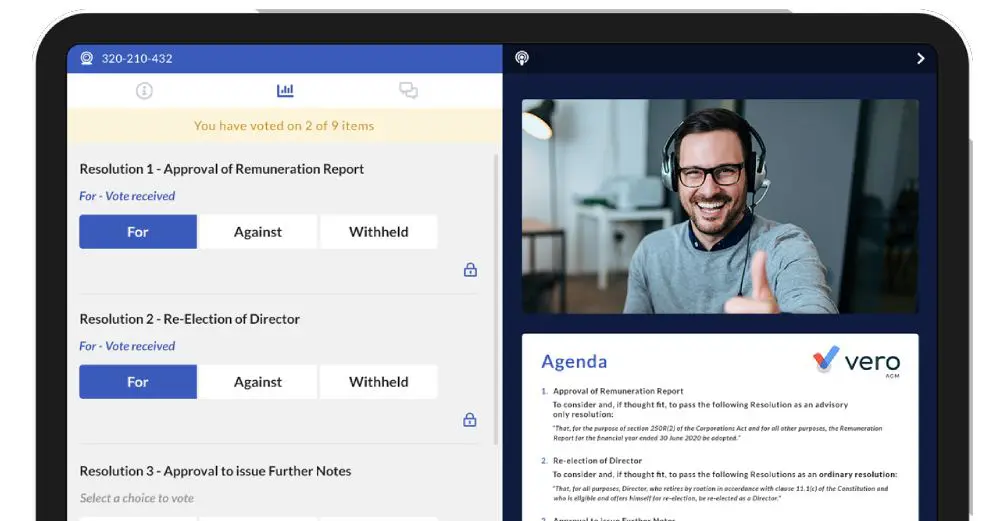
Many organisations now choose to digitise their AGM voting process to improve accuracy and reduce administrative workload.
Vero Voting supports organisations by providing secure online voting, proxy management, attendance tracking, weighted voting where required, detailed reporting and transparent audit trails.
Whether an AGM is held entirely online or as a hybrid meeting, electronic voting can simplify administration while helping organisations demonstrate good governance and member confidence.
Rather than replacing existing meeting procedures, it complements them by making voting easier for administrators and participants alike.
Key Takeaways: How to Run an AGM Successfully
Running an AGM successfully isn’t simply about following an agenda.
It requires careful planning, compliance with applicable legislation, transparent voting processes and accurate record keeping.
The most successful AGMs are those where members understand the process, have confidence in the results and leave knowing their organisation has been governed fairly.
Investing time in preparation—and using reliable voting technology where appropriate—can make the entire meeting more efficient while reducing risk.
How to Run an AGM in Australia
How to Run an AGM in Australia
How to Run an AGM in Australia
How to Run an AGM in Australia
Frequently Asked Questions
Is an AGM legally required in Australia?
It depends on the organisation. Public companies generally must hold AGMs under the Corporations Act 2001. Incorporated associations, strata schemes, unions and other entities should refer to their governing legislation and constitution.
Can an AGM be held online?
Yes. Australian legislation now permits many organisations to hold virtual or hybrid meetings, provided legal and constitutional requirements are met and members can participate effectively.
What happens if there is no quorum?
Most constitutions specify that the meeting must be adjourned or reconvened. The exact process varies depending on the governing rules.
Can members vote by proxy?
Often yes, but proxy voting depends on the applicable legislation and the organisation’s constitution. Proxy forms and deadlines should be clearly explained in the Notice of Meeting.
How can electronic voting improve an AGM?
Electronic voting provides faster counting, reduces manual errors, supports remote participation, creates an audit trail and simplifies administration, particularly for larger organisations.
Sources
Official sources referenced:
Frequently Asked Questions
Is an AGM legally required in Australia?
It depends on the organisation. Public companies generally must hold AGMs under the Corporations Act 2001. Incorporated associations, strata schemes, unions and other entities should refer to their governing legislation and constitution.
Can an AGM be held online?
Yes. Australian legislation now permits many organisations to hold virtual or hybrid meetings, provided legal and constitutional requirements are met and members can participate effectively.
What happens if there is no quorum?
Most constitutions specify that the meeting must be adjourned or reconvened. The exact process varies depending on the governing rules.