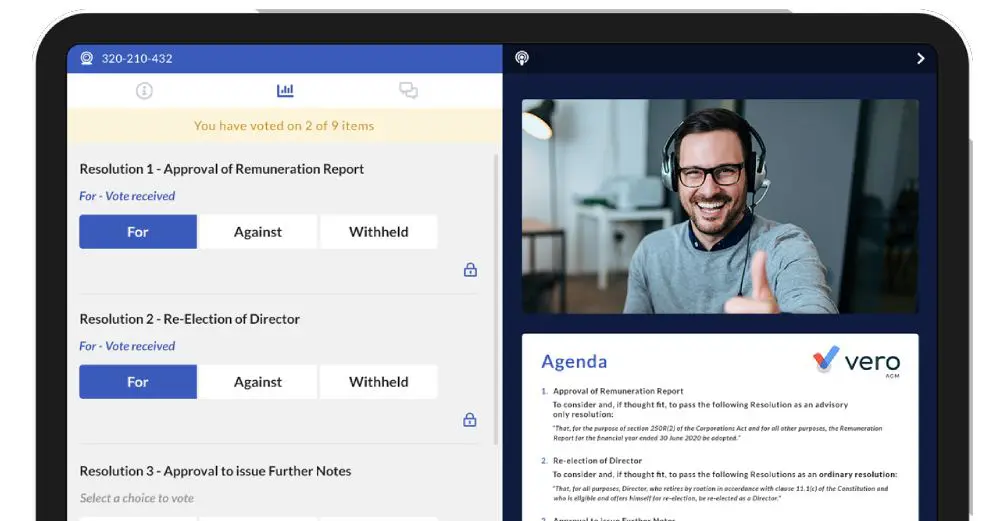
Hybrid AGM Voting Explained
Monday, 8 June 2026, 3:27 pm

For many organisations, hybrid AGMs have gone from being a contingency plan to becoming the preferred meeting format.
Members expect flexibility. Some want to attend in person. Others are interstate, travelling, working remotely, or simply prefer to join online. A well-run hybrid AGM can increase participation and make meetings more accessible without sacrificing governance standards.
The challenge is that hybrid meetings are not just physical meetings with a Zoom link attached.
The voting process, member participation, proxy handling, meeting technology, and legal requirements all need to work together. When they don’t, disputes tend to follow.
Here’s what boards, company secretaries, strata managers, associations, clubs, and member-based organisations should understand before running a hybrid AGM.
What is a Hybrid AGM?
A hybrid AGM combines a physical meeting venue with virtual participation technology.
Members can choose whether to attend in person or participate remotely. Importantly, members joining online are treated as being present at the meeting for all purposes under the Corporations Act. This includes participating in discussions, asking questions, and voting on resolutions.
Hybrid meetings are different from virtual-only meetings.
A virtual-only AGM takes place entirely online with no physical venue. Under current Australian corporate law, companies can only hold virtual-only meetings where their constitution expressly permits or requires that format.
Hybrid meetings are generally permitted without requiring a constitutional amendment, which is one reason many organisations have adopted them as the default approach.
Why Hybrid AGMs Have Become Popular
The biggest benefit is participation.
Many organisations saw attendance increase significantly when remote participation became available. Members who previously could not attend due to distance, mobility issues, family commitments, or work schedules suddenly had access.
For national associations, unions, professional bodies, and companies with geographically dispersed memberships, the difference can be substantial.
There is also a practical governance benefit.
Achieving quorum can be easier when members are not required to physically travel to a venue. Boards can engage with a broader cross-section of members, and members have more opportunities to ask questions directly.
That said, accessibility only helps if the meeting is properly managed.
Poor technology, unclear voting procedures, or inadequate member support can quickly undermine confidence in the process.
The Legal Position in Australia
The Corporations Act 2001 allows companies and registered schemes to hold hybrid meetings.
The legislation requires members, as a whole, to have a reasonable opportunity to participate. Members attending through virtual technology must be able to ask questions, make comments, and vote using reasonable technology.
ASIC has made it clear that participation should be meaningful.
Simply providing a livestream or webcast is not enough if members cannot interact with the meeting. Members need genuine opportunities to engage, not just observe.
Boards should also remember that meeting requirements extend beyond the technology itself. Notice periods, quorum requirements, proxy arrangements, constitutional rules, and voting procedures still apply.
Hybrid meetings do not reduce governance obligations. They simply change how members access the meeting.
Voting in a Hybrid AGM
Voting is often where hybrid meetings become complicated.
In a traditional in-person meeting, voting may occur by a show of hands or by poll, depending on the organisation’s rules and the resolution being considered.
Hybrid meetings create additional challenges because online participants cannot practically participate in a show of hands in the same way as attendees physically present in the room.
This is why poll voting has become the preferred method for hybrid AGMs.
A poll ensures every eligible vote is counted according to the member’s voting entitlement, regardless of whether they are attending in person, online, or by proxy.
For organisations with weighted voting structures, unit entitlements, shareholdings, or complex membership classes, poll voting is often the only practical way to ensure accuracy.
Electronic polling systems can also provide a complete audit trail, helping reduce disputes and supporting post-meeting verification if questions arise later.
Managing Proxies in a Hybrid Environment
Proxies remain a critical part of AGM governance.
One misconception is that hybrid meetings reduce the need for proxy voting. In practice, many organisations still receive substantial proxy volumes, particularly where members cannot attend live at all.
Boards need clear processes for:
The administrative burden increases when proxy votes, physical attendees, and virtual attendees all participate simultaneously.
This is one reason many organisations engage independent vote managers to oversee the process.
Independent administration helps separate meeting management from voting administration and can provide additional confidence to members that results have been accurately calculated.
Technology is a Governance Issue
Many boards view AGM technology as an IT decision.
It is really a governance decision.
The technology platform directly affects members’ ability to exercise their rights.
If members cannot log in, ask questions, hear proceedings clearly, submit votes, or access support when needed, the organisation may face challenges regarding whether members were given a reasonable opportunity to participate.
Practical considerations include:
Boards should test systems thoroughly before the meeting rather than assuming everything will work on the day.
Most governance professionals have seen at least one AGM where technology became the dominant topic of discussion. Usually for the wrong reasons.
Common Problems We See
The same issues tend to appear repeatedly.
Members receive meeting links late or not at all.
Voting instructions are unclear.
Proxy records do not align with attendance records.
Online participants can hear proceedings but cannot effectively ask questions.
Physical attendees receive different information from virtual attendees.
These problems are rarely caused by legislation.
They are usually caused by planning failures.
The organisations that run successful hybrid AGMs typically invest significant effort into member communication, testing, rehearsal sessions, and clear voting procedures before the meeting begins.
Does Hybrid Always Mean Better?
Not necessarily.
For some small organisations with highly local memberships, a traditional in-person AGM may still be the simplest option.
For others, particularly those with regional, interstate, or large memberships, hybrid meetings provide obvious advantages.
The key question is not whether hybrid meetings are better.
The question is whether the format helps members participate effectively while maintaining confidence in the integrity of the voting process.
If the answer is yes, hybrid meetings can be an excellent governance tool.
If not, the organisation may need to reconsider its meeting design, technology, or administrative processes.
Where Independent Vote Management Fits In
As hybrid meetings become more common, expectations around transparency continue to increase.
Members want confidence that votes have been properly counted. Boards want assurance that procedures have been followed correctly. Scrutineers need reliable records. Governance professionals need clear audit trails.
Independent vote management can assist by providing:
For many organisations, particularly where elections are contested or resolutions are sensitive, having an independent party manage the voting process removes uncertainty and helps maintain trust in the outcome.
FAQ
Can members attending online vote during a hybrid AGM?
Yes. Members participating through virtual technology must be given a reasonable opportunity to vote during the meeting.
Is a livestream considered a hybrid AGM?
Not by itself. If members can only watch and cannot participate, ask questions, or vote through the technology, it generally will not satisfy hybrid meeting requirements.
Can an organisation hold a virtual-only AGM instead of a hybrid AGM?
For companies governed by the Corporations Act, virtual-only meetings generally require express authority within the organisation’s constitution.
Are proxy votes still valid at hybrid AGMs?
Yes. Proxy voting continues to operate in the same way as other AGMs, subject to the organisation’s governing rules and legislative requirements.
Should hybrid AGM voting be conducted by poll?
In most cases, yes. Poll voting provides greater accuracy and is generally better suited to hybrid participation models than a show of hands.
Hybrid AGM Voting
Final Thoughts
Hybrid AGMs are no longer an emerging concept. They are now a normal part of governance across many Australian organisations.
The organisations getting the best results are not simply adding technology to existing meeting processes. They are redesigning meetings to ensure every member, whether attending in person or online, can participate confidently and fairly.
If your organisation is planning a hybrid AGM and needs guidance around electronic voting, proxy management, scrutineering, or meeting administration, the team at Vero Voting can help you design a process that is practical, transparent, and compliant.
Sources
ASIC – FAQs: Virtual Meetings for Companies and Registered Schemes: https://www.asic.gov.au/regulatory-resources/corporate-governance/shareholder-engagement/faqs-virtual-meetings-for-companies-and-registered-schemes/
ASIC – Further Guidance on Virtual Meetings for Companies and Registered Schemes: https://www.asic.gov.au/about-asic/news-centre/news-items/asic-provides-further-guidance-on-virtual-meetings-for-companies-and-registered-schemes/
ASIC – Guidelines for Investor Meetings Using Virtual Technology: https://www.asic.gov.au/about-asic/news-centre/news-items/asic-guidelines-for-investor-meetings-using-virtual-technology/
Corporations Act 2001 (Cth): https://www.legislation.gov.au/
Frequently Asked Questions
Can members attending online vote during a hybrid AGM?
Yes. Members participating through virtual technology must be given a reasonable opportunity to vote during the meeting.
Is a livestream considered a hybrid AGM?
Not by itself. If members can only watch and cannot participate, ask questions, or vote through the technology, it generally will not satisfy hybrid meeting requirements.
Can an organisation hold a virtual-only AGM instead of a hybrid AGM?
For companies governed by the Corporations Act, virtual-only meetings generally require express authority within the organisation’s constitution.
Are proxy votes still valid at hybrid AGMs?
Yes. Proxy voting continues to operate in the same way as other AGMs, subject to the organisation’s governing rules and legislative requirements.
Should hybrid AGM voting be conducted by poll?
In most cases, yes. Poll voting provides greater accuracy and is generally better suited to hybrid participation models than a show of hands.