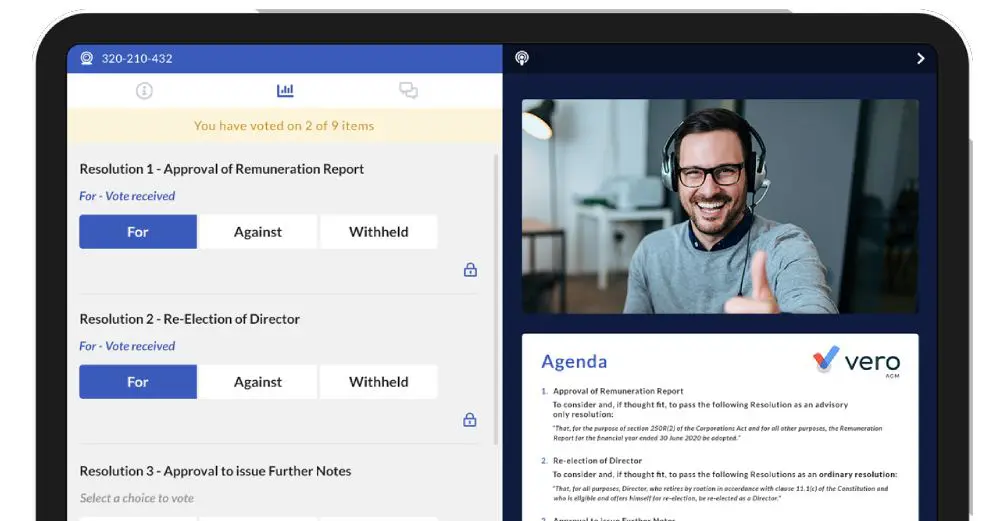
Online Voting for Companies Limited by Guarantee: Governance Made Easier
Wednesday, 9 September 2026, 1:54 pm

For many companies limited by guarantee, member voting is still managed through a mixture of paper forms, email responses, spreadsheets, proxy forms and votes taken during an AGM.
That approach can work when membership is small and everyone is in the same room.
It becomes considerably harder when members are spread across Australia, attending remotely, appointing proxies or voting on several resolutions at once.
This is where online voting for companies limited by guarantee can make a real difference.
A properly designed voting process can reduce administration without reducing the formality of the decision-making process. Members can receive secure voting access, cast their votes remotely, and receive clear instructions, while the organisation can maintain an auditable record of what happened.
The technology, however, is only part of the solution.
For a CLG, the voting process still needs to fit the organisation’s constitution, applicable legislation and, where relevant, its obligations as an ACNC-registered charity.
The objective isn’t simply to put a ballot online.
It is to make member participation easier while keeping governance sound.
What is a company limited by guarantee?
A company limited by guarantee is a type of public company commonly used by Australian not-for-profit and charitable organisations.
Unlike a company limited by shares, it does not have shareholders holding shares. Instead, members agree to contribute a specified amount if the company is wound up. ASIC notes that CLGs cannot pay dividends and cannot issue shares.
CLGs are commonly used by organisations such as:
Membership is therefore central to the way many CLGs operate.
Members may be involved in electing directors, approving resolutions, changing governing documents or making other decisions specified by the organisation’s constitution.
For a company without share capital, the Corporations Act’s replaceable rule provides for one vote per member, although organisations need to consider their constitution and any provisions that apply specifically to them.
That makes the integrity of member voting particularly important.
Why online voting makes sense for CLGs
The biggest advantage isn’t simply speed.
It is participation.
A member who lives in Perth, Brisbane or regional New South Wales may find it difficult to attend a physical AGM. A member working shifts may have the same problem. Others may be overseas or unable to travel on the day.
An online voting process can remove some of those practical barriers.
For example, imagine a national professional association with 2,000 members.
The organisation needs to:
Doing all of that manually creates plenty of opportunities for mistakes.
A dedicated online voting platform can bring those steps into one controlled workflow.
Better access for members
Members don’t necessarily need to be physically present to participate.
Depending on the voting arrangement and the organisation’s rules, online voting can allow eligible members to participate using a computer, tablet or mobile device.
That can be particularly useful for organisations with:
Less manual administration
Manual voting creates administrative work that often goes unnoticed until the day of the meeting.
Someone has to check voter eligibility, distribute ballots, follow up missing forms, process proxies, count votes and reconcile the final result.
An online system can automate much of this work.
That does not eliminate governance responsibilities. It moves them into a more controlled process.
Faster results
Where votes are counted electronically, results can be calculated quickly once voting closes.
This is particularly useful during an AGM when several resolutions need to be put to members.
Instead of someone manually counting paper ballots while the meeting waits, the chair or meeting administrator can have the result available once the vote has closed.
Is online voting legally allowed for a company limited by guarantee?
There isn’t a single answer that applies to every CLG.
The organisation needs to consider its constitution, the Corporations Act 2001, and whether it is registered as a charity with the ACNC.
This distinction matters.
CLGs that are not registered charities
A CLG is a public company and is generally subject to the relevant company meeting provisions in the Corporations Act.
For public companies, section 250N generally requires an AGM at least once in each calendar year and within five months after the end of the financial year, subject to the exceptions and relief provided by the legislation.
The Corporations Act also permits companies to hold meetings using physical venues, hybrid arrangements or virtual meeting technology. A virtual-only meeting is permitted where the company’s constitution expressly requires or permits it.
That is an important distinction.
A hybrid meeting and a virtual-only meeting are not necessarily treated the same way.
ASIC specifically advises companies to check their constitution when planning a virtual-only meeting.
CLGs that are registered charities
The position is different for a CLG that is also an ACNC-registered charity.
The ACNC explains that registered charities structured as companies are not required to comply with some Corporations Act requirements that would otherwise apply to companies, including requirements relating to member meetings.
Instead, they must comply with the ACNC framework, including Governance Standard 2: Accountability to members.
Governance Standard 2 requires charities with members to take reasonable steps to be accountable to those members and give them adequate opportunities to raise concerns about how the charity is run.
The ACNC identifies annual meetings with opportunities for members to ask questions and vote on resolutions as one common way of meeting the standard.
This means a charity CLG shouldn’t assume that because a particular Corporations Act requirement does not apply, member meetings and voting no longer matter.
They still matter.
The organisation’s constitution, governance arrangements and ACNC obligations need to be considered together.
What should a CLG check before moving voting online?
Before choosing a voting platform, start with the rules rather than the technology.
1. Check the constitution
The constitution should be the first document reviewed.
Look specifically for provisions covering:
ASIC notes that a company’s constitution governs its internal management and can modify or replace applicable replaceable rules.
If the proposed online voting process doesn’t fit the constitution, buying better software won’t solve the problem.
2. Identify who is entitled to vote
A reliable voting process starts with a reliable voter list.
Before a ballot opens, the organisation should establish:
This is one of the areas where a professional voting system can save substantial administrative effort.
3. Decide when voting should occur
Not every vote needs to happen in exactly the same way.
Depending on the governing rules, an organisation may use:
The key is that the voting method needs to match the resolution and the organisation’s rules.
Don’t start with the question, “What can the software do?”
Start with, “What does our constitution require?”
Online voting and virtual AGMs are not the same thing
This is a common source of confusion.
Online voting refers to the mechanism used to collect and count votes.
A virtual AGM is the meeting itself.
You can have:
The two technologies can work together, but they solve different problems.
For companies subject to the virtual meeting provisions of the Corporations Act, members must have a reasonable opportunity to participate.
ASIC’s guidance also emphasises that members using virtual technology need appropriate opportunities to ask questions and make comments, including orally and in writing where applicable.
A webcast that merely allows members to watch a meeting is not enough to provide the participation expected from a proper hybrid or virtual meeting.
This is why a video-conferencing platform alone should not automatically be treated as a complete AGM voting solution.
The meeting technology handles participation and communication.
The voting system needs to handle the governance process around the actual vote.
What should a good CLG voting system provide?
A professional online voting platform should make the process easier for administrators without turning the ballot into a black box.
Secure voter authentication
The organisation needs confidence that only eligible members can vote and that voting access cannot simply be passed around.
Depending on the circumstances, authentication may involve secure voting links, member identifiers, registration processes or other verification methods.
The appropriate approach depends on the sensitivity of the vote and the organisation’s membership structure.
Clear ballot design
Members should immediately understand:
A technically secure ballot can still be a poor voting experience if members don’t understand what they’re being asked to do.
Proxy management
Proxy voting can become complicated when it is handled manually.
The system should allow the organisation to establish which proxy appointments have been received and how they should be incorporated into the voting process, in accordance with the organisation’s rules.
ASIC recognises the right of eligible members to appoint proxies in applicable company meetings, subject to the relevant rules.
Transparent counting
The counting method should be clear before voting begins.
For example, a board election may use a preferential voting system rather than a simple first-past-the-post count.
If so, the voting platform needs to support the actual counting method rather than forcing the organisation to export the data and calculate the result manually.
Auditability
This is one of the most important considerations.
A governance team should be able to answer questions such as:
Good records help the organisation respond if a member later questions the outcome.
ASIC specifically highlights the importance of keeping written records of members’ resolutions and meetings.
Common mistakes when moving a CLG vote online
Moving from paper to digital voting can improve governance, but only if the underlying process is sound.
Mistake 1: Treating online voting as a survey
A member survey and a formal governance vote are not the same thing.
A survey tool may be perfectly suitable for collecting opinions.
A formal member election or resolution may require authentication, eligibility controls, specific counting rules, proxy handling and audit records.
The question isn’t whether a survey platform can collect responses.
It is whether the organisation can confidently demonstrate that the right people voted, under the right rules, and that the result was correctly determined.
Mistake 2: Ignoring the constitution
Technology does not override governing documents.
If the constitution requires a particular process, the organisation needs to work within that process or obtain appropriate advice about changing it.
This is especially important for virtual-only meetings, where ASIC specifically says the constitution must expressly permit or require that arrangement.
Mistake 3: Forgetting about accessibility
Members shouldn’t need to be technically confident to participate.
Instructions should be simple, the voting interface should work on common devices, and the organisation should provide a practical way for members to get assistance.
For larger organisations, accessibility should be considered during platform selection rather than added as an afterthought.
Mistake 4: Failing to test the process
A short test before opening the ballot can identify problems that otherwise appear at the worst possible time.
Test:
A rehearsal is particularly worthwhile for a major AGM or contested election.
How Vero Voting can assist companies limited by guarantee
For organisations that want to move beyond spreadsheets, paper ballots and general-purpose survey tools, Vero Voting provides dedicated voting and meeting technology designed around formal governance processes.
Vero’s platform supports AGM voting, elections, member voting, virtual and hybrid meetings, proxy management and audited reporting.
For example, a CLG could use a managed voting process to:
Vero also supports virtual and hybrid meetings, allowing voting to sit alongside the meeting rather than requiring administrators to manage separate systems.
For organisations with more complex requirements, Vero’s custom voting solutions can also be configured around specific membership structures, voting rights and governance workflows.
Security is another consideration when choosing a provider. Vero Voting states that it is ISO/IEC 27001:2022 certified and SOC 2 Type II audited.
The practical benefit is not simply having a digital ballot.
It is having a voting process that is designed around the governance requirements surrounding that ballot.
A practical approach to implementing online voting
If your CLG is considering online voting for the first time, keep the implementation straightforward.
Step 1: Review your governing documents
Identify the rules governing members, meetings, voting, elections and proxies.
Step 2: Define the vote
Write down exactly what members will be voting on and how the result needs to be determined.
Step 3: Confirm voter eligibility
Prepare the membership list and identify any different voting categories or restrictions.
Step 4: Choose the voting method
Determine whether voting will occur before the meeting, during the meeting, or through another process permitted by the organisation’s rules.
Step 5: Configure and test the ballot
Run a test using representative member accounts before opening voting.
Step 6: Communicate clearly
Tell members:
Step 7: Preserve the records
Keep the appropriate voting reports, meeting records, resolutions and supporting documentation in accordance with the organisation’s record-keeping requirements.
What good online voting looks like
The best online voting process is almost invisible to the member.
They receive clear instructions.
They authenticate themselves.
They understand the question.
They cast their vote.
They receive confirmation.
Behind the scenes, the organisation has confidence that eligibility, counting, records and reporting have been handled properly.
That is the real value of online voting for a company limited by guarantee.
It isn’t about replacing governance with technology.
It is about using technology to make good governance easier to administer.
Key takeaways
For companies limited by guarantee considering online voting:
If your organisation is considering online voting for an AGM, election or member resolution, Vero Voting can help you work through the practical requirements and determine an appropriate voting setup.
Need help planning your next member vote? Contact Vero Voting or request a demonstration to discuss your requirements.
FAQ Section
Online Voting for Companies Limited by Guarantee
Online Voting for Companies Limited by Guarantee
Online Voting for Companies Limited by Guarantee
Online Voting for Companies Limited by Guarantee
Online Voting for Companies Limited by Guarantee
Online Voting for Companies Limited by Guarantee
Can a company limited by guarantee use online voting?
Yes, a CLG may be able to use online voting, but the appropriate process depends on its constitution, the type of vote, applicable legislation and whether it is an ACNC-registered charity. The voting method should be checked against the organisation’s governing rules before implementation.
Can a CLG hold a virtual AGM in Australia?
A CLG that is subject to the Corporations Act may hold meetings using virtual meeting technology where the legislative requirements are met. A virtual-only meeting generally requires the constitution to expressly permit or require it. Hybrid meetings are treated differently.
For an ACNC-registered charity, the organisation should also consider its ACNC obligations and governing document.
Does every member of a company limited by guarantee get one vote?
For a company without share capital, the Corporations Act replaceable rule provides that each member has one vote on a show of hands and on a poll. However, the organisation should always check its constitution and the rules applicable to its particular vote.
Can members vote online during a virtual AGM?
Yes, where the meeting and voting arrangements permit it. For companies using virtual meeting technology, the technology needs to give members, as a whole, a reasonable opportunity to participate, including exercising applicable voting rights. ASIC also expects appropriate opportunities for members to ask questions and make comments.
Is online voting the same as using an online survey?
No.
A survey is generally designed to collect opinions or responses. A formal governance vote may require member authentication, eligibility controls, proxy management, defined counting rules and an auditable record of the result.
For elections and resolutions, those governance controls can be just as important as the voting interface itself.
Sources
Frequently Asked Questions
Can a company limited by guarantee use online voting?
Yes, a CLG may be able to use online voting, but the appropriate process depends on its constitution, the type of vote, applicable legislation and whether it is an ACNC-registered charity. The voting method should be checked against the organisation’s governing rules before implementation.
Can a CLG hold a virtual AGM in Australia?
A CLG that is subject to the Corporations Act may hold meetings using virtual meeting technology where the legislative requirements are met. A virtual-only meeting generally requires the constitution to expressly permit or require it. Hybrid meetings are treated differently.
Does every member of a company limited by guarantee get one vote?
For a company without share capital, the Corporations Act replaceable rule provides that each member has one vote on a show of hands and on a poll. However, the organisation should always check its constitution and the rules applicable to its particular vote.
Can members vote online during a virtual AGM?
Yes, where the meeting and voting arrangements permit it. For companies using virtual meeting technology, the technology needs to give members, as a whole, a reasonable opportunity to participate, including exercising applicable voting rights. ASIC also expects appropriate opportunities for members to ask questions and make comments.
Is online voting the same as using an online survey?
No.
A survey is generally designed to collect opinions or responses. A formal governance vote may require member authentication, eligibility controls, proxy management, defined counting rules and an auditable record of the result.
For elections and resolutions, those governance controls can be just as important as the voting interface itself.