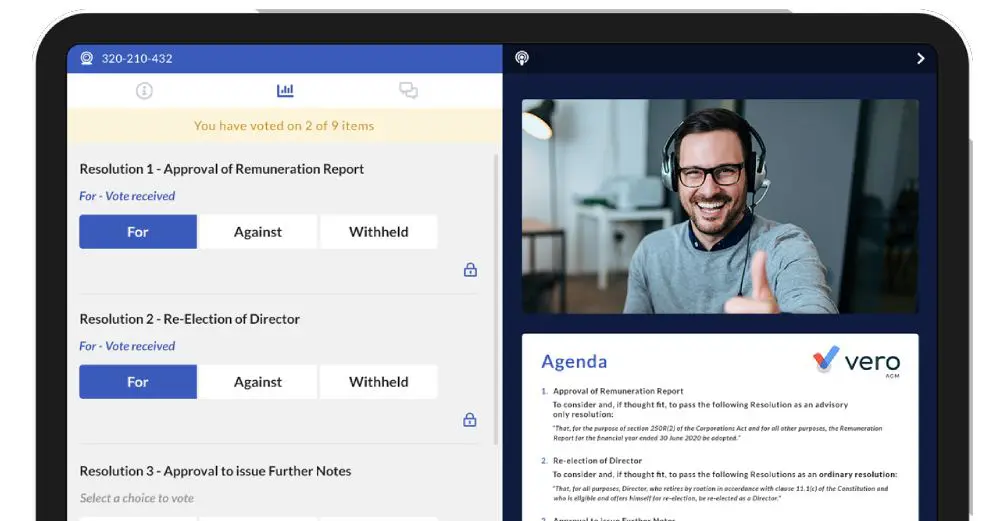
Online Voting Services Australia: Secure Elections & Ballots
Friday, 16 October 2026, 9:00 am

An online vote can look deceptively simple.
Send members a link. Let them choose an option. Close the ballot. Count the responses.
For an informal poll, that may be enough.
A formal election or member ballot is different.
The organisation may need to establish who is eligible to vote, protect ballot secrecy, prevent duplicate voting, manage proxies, apply preferential voting rules, provide assistance to members, maintain an audit trail and produce a result that can withstand scrutiny afterwards.
That is why many organisations are moving beyond basic online polls and using online voting services in Australia that combine voting technology with professional election administration.
The real question is not simply whether an organisation can run a vote online.
It is whether it should manage the entire process itself.
For a small, straightforward vote, self-management may be perfectly reasonable. For a large, contested or technically complicated election, a managed online voting service can reduce administrative risk and give members greater confidence in the process.
What are online voting services?
Online voting services allow eligible voters to participate in a formal election or ballot electronically.
Depending on the provider and the type of election, the service may cover much more than the voting screen itself.
A managed online voting service can include:
This distinction matters.
There is a big difference between online voting software and a managed online voting service.
Software gives an organisation a tool.
A managed service can provide people and processes around that tool.
For a formal election, that additional support can be just as important as the technology.
When should an organisation use a managed online voting service?
There is no need to outsource every vote.
A small organisation conducting a simple, uncontested ballot may be able to manage the process internally.
The case for a managed service becomes stronger when several parts of the election are difficult to coordinate or when the consequences of getting something wrong are significant.
1. The organisation has a large membership
Managing 30 voters is very different from managing 3,000.
Large elections create practical problems around:
A managed online voting provider can take much of this administrative workload away from internal staff.
That can be particularly useful for associations, professional bodies, unions, clubs and other member-based organisations.
2. Members are spread across different locations
Online voting becomes particularly useful when members are not all in one place.
A national association, for example, may have members in Sydney, Perth, Brisbane, Melbourne and regional areas.
A physical ballot can introduce unnecessary logistical work.
An online ballot can give eligible members access to the same voting process regardless of where they are located.
But accessibility should not be confused with simplicity.
The organisation still needs a reliable process for verifying voters and supporting members who experience problems.
3. The election is contested
A contested election deserves more administrative discipline than a routine poll.
Candidates and members may want to understand:
If the organisation is running all of those processes internally, it needs the people, systems and procedures to manage them consistently.
An experienced online voting service can provide a more structured process and, where required, greater separation between candidates and election administration.
4. The election uses preferential voting
Preferential voting is another area where a basic survey tool can fall short.
If voters are required to rank candidates, the ballot needs to capture those preferences correctly.
The counting process also needs to follow the applicable election rules.
A provider should therefore understand the required voting method before configuring the ballot.
This is particularly relevant for elections involving multiple candidates and positions.
The question is not simply:
“Can the software rank candidates?”
It is:
“Can the voting and counting process accurately implement the rules governing this election?”
5. The organisation needs a secret ballot
A formal election may require voters’ choices to remain confidential.
That creates a different technical requirement from an ordinary form.
An organisation may need to know that a particular member has voted without allowing administrators or other participants to see how that member voted.
A well-designed secret ballot needs to separate voter authentication and participation records from the contents of the ballot where the voting rules require secrecy.
The precise approach will depend on the voting system and election requirements.
This is one reason organisations should ask a provider to explain how ballot secrecy actually works rather than relying on general claims about security.
6. Proxy voting is involved
Proxy voting can make a member ballot significantly more complicated.
The organisation may need to manage:
A managed voting service can help create a consistent process for collecting and applying those instructions.
The provider should still work from the organisation’s rules.
Technology cannot resolve an unclear proxy provision.
7. The vote is part of an AGM
Online voting services can be particularly useful during AGMs and other formal meetings.
A meeting may involve several types of votes, including:
For companies using virtual or hybrid meeting arrangements, ASIC guidance emphasises that members as a whole must have a reasonable opportunity to participate, including exercising voting rights where applicable.
That means voting needs to be considered as part of the meeting design.
It should not be bolted on at the last minute.
8. Internal staff are already stretched
Running an election can consume more staff time than expected.
Someone needs to manage the election timetable.
Someone needs to prepare the voter list.
Someone needs to deal with nominations.
Someone needs to respond when a member cannot access their ballot.
Someone needs to monitor the voting period.
Someone needs to count the result and prepare the report.
If the election happens at the same time as an AGM, annual reporting, membership renewals or other major organisational activities, that workload can become difficult to absorb.
A managed voting service allows internal staff to remain focused on their normal responsibilities.
What makes an online voting service secure?
“Secure online voting” is a useful phrase, but it is too broad on its own.
Organisations should look at the controls behind the service.
Voter authentication: The system should provide a reliable way of establishing that the person accessing the ballot is an eligible voter. Depending on the election, this may involve unique credentials, controlled access links, authentication procedures or other verification methods. The appropriate method depends on the risk and voting requirements.
One-person-one-vote controls: Where each voter is entitled to one ballot, the system should prevent the same voting entitlement from being used more than once. This sounds obvious. It becomes much more important when thousands of members are voting.
Ballot confidentiality: If the election requires a secret ballot, the provider needs to explain how voter identity and ballot choices are protected. The organisation should understand who can access what information.
Administrator access: The security of an election does not depend only on voters. Administrator accounts can provide access to sensitive voter or election information. Ask the provider how administrator access is controlled, monitored and restricted.
Audit records: A formal election should produce appropriate records showing what happened during the process. Audit information can help answer questions such as when voting opened, when voting closed, whether a voting credential was used, whether administrative changes occurred, and how the final result was produced. Auditability does not mean exposing confidential votes. A good system should support scrutiny without compromising ballot secrecy.
Privacy matters as much as voting security
Online elections often involve personal information.
Depending on the organisation, this can include:
The OAIC’s current APP 11 guidance states that APP entities must take reasonable steps to protect personal information from misuse, interference and loss, as well as unauthorised access, modification or disclosure. The guidance specifically identifies third-party providers and cloud services as part of the security considerations organisations need to address.
That makes provider due diligence important.
Before sending a membership database to an online voting provider, ask:
Privacy and election integrity should be considered together.
Online voting does not remove the organisation’s governance responsibilities
One of the biggest misconceptions about online elections is that the platform determines how the election should work.
It does not.
The organisation still needs to establish:
The technology should implement those requirements.
It should not invent them.
A useful rule is:
Start with the constitution and applicable rules. Then design the election. Then select the technology.
Doing it in the opposite order can create problems.
What about registered organisations and unions?
This is an area where organisations need to be particularly careful.
The Fair Work Commission states that the Fair Work (Registered Organisations) Act 2009 requires every office in a registered organisation and its branches to be elected, with organisation rules covering matters including nominations, ballot eligibility, voter-roll closure, scrutineers and terms of office.
The Fair Work Commission also states that, unless an organisation has an applicable exemption, its elections must be conducted by the Australian Electoral Commission and use an approved voting system. Direct voting system elections generally use a secret postal ballot unless an exemption allows another method.
The AEC likewise states that it must conduct registered organisation officer elections unless the Fair Work Commission has granted an exemption.
This means a registered organisation should not assume that a commercial online voting platform can simply replace the statutory election process.
The legal framework comes first.
For regulated elections, the organisation needs to establish what process is permitted before selecting technology or a service provider.
What about charities and not-for-profit organisations?
Member-based charities also need to think about voting as part of their broader governance framework.
ACNC Governance Standard 2 applies to charities with members and requires them to take reasonable steps to be accountable to members and provide adequate opportunities for members to raise concerns about how the charity is run.
The ACNC identifies annual meetings where members can ask questions and vote on resolutions, as well as clear processes for appointing Responsible People, as examples of how a charity can meet the standard.
For a small charity with a straightforward election, an internal process may be sufficient.
For a larger member-based organisation, more formal procedures may be appropriate.
The level of voting infrastructure should match the organisation’s circumstances.
Managed online voting vs doing it yourself
The decision becomes easier when the two approaches are compared directly.
| Consideration | Self-managed voting | Managed online voting service |
|---|---|---|
| Voter-roll management | Internal staff | |
| Ballot setup | Organisation | |
| Voter authentication | Organisation responsibility | |
| Member support | Internal team | |
| Preferential voting | Requires internal expertise | |
| Proxy management | Often manual | |
| Vote counting | Internal | |
| Audit records | Organisation must establish process | |
| Election administration | Internal | |
| Independence | Depends on internal structure | |
| Scalability | Can become labour-intensive | |
| Technical responsibility | Organisation |
Neither option is automatically better.
The right choice depends on the election.
When is self-managed voting probably enough?
A managed online voting service may be unnecessary when:
For example, a small club with 25 eligible voters and one nominee for each available position may not need a specialist election provider.
A simple process may be entirely appropriate.
The mistake is assuming that the same process will work when the election grows to 2,500 voters and eight candidates.
When is a managed service worth considering?
The case becomes stronger when several of the following apply:
The more of these factors that apply, the more valuable specialist support can become.
What should you ask an online voting provider?
Before signing up, ask specific questions.
About the election: Can you work from our constitution and election rules? Can you support our voting method? Can you manage preferential voting? Can you support multiple positions? Can you handle proxies? Can you manage a secret ballot?
About voter management: How is voter eligibility established? Can we upload or integrate our membership list? How are duplicate voters prevented? What happens when a member’s contact details are incorrect? How are replacement voting credentials handled?
About security: How is voter information protected? How is administrator access controlled? Is the platform independently audited or certified? What security monitoring is used? What happens if there is a security incident?
About auditability: What election records are generated? Can we obtain a final election report? What information can authorised scrutineers access? Can the result be independently reviewed?
About support: Who supports members during the election? What are the support hours? What happens if the system experiences an outage? Is there a contingency process?
These questions will tell you far more than a list of software features.
A practical example
Consider an association with 1,800 members.
It is electing five committee members from nine candidates.
The election uses preferential voting, members are spread across Australia, and the ballot is being conducted around the organisation’s AGM.
The organisation could create a form and send it to members.
But then the practical questions begin.
A managed online voting service can take responsibility for those operational elements while the association retains control over its governance decisions.
That is the real advantage.
The service is not simply collecting clicks.
It is managing a formal election process.
How Vero Voting can assist
Vero Voting provides online voting and election services for Australian organisations that need more than a basic polling tool.
Its election services cover processes such as voter management, online candidate nominations, secure voting, preferential voting, election administration, counting and reporting. Vero also offers a dedicated returning officer and support around election-day administration.
That can be useful for organisations where the challenge is not simply providing an online ballot, but coordinating the entire voting process. You can explore these online voting services to see how they can support your next ballot.
Vero supports different types of organisational voting, including elections, member ballots and AGM voting, as well as online preferential voting and proxy voting services.
Vero states that its platform is ISO/IEC 27001:2022 certified and SOC 2 Type II audited, providing organisations with independently assessed information-security controls to consider as part of their procurement and due-diligence process.
The important point is that security certification is only one part of choosing a provider.
Organisations should also consider election expertise, governance knowledge, voter support, auditability and the provider’s ability to implement the actual rules of the ballot.
A pre-election checklist
Before choosing an online voting service, work through these questions:
If those questions can be answered before voting opens, the actual online ballot is usually much easier to manage.
Key takeaways
Online voting is not automatically a better election simply because it is digital.
The quality of the process depends on what sits behind the voting screen.
For simple, low-risk ballots, an organisation may be able to manage voting internally.
For larger or more complex elections, a managed online voting service can provide:
The most important step is to start with the rules.
Understand who can vote, how the ballot must operate and how the result must be determined. Then choose the technology and level of professional support that fits those requirements.
For regulated elections, check the applicable statutory framework before engaging a commercial provider. The AEC and Fair Work Commission arrangements for registered organisations are a good example of why this matters.
A secure online ballot should make an election easier to administer without making the underlying governance harder to understand.
If your organisation is planning an online election, AGM vote or member ballot and would like to discuss how a managed voting service could work for your requirements, you can contact Vero Voting for any assistance or request a demonstration.
FAQ Section
online voting services Australia
online voting services Australia
online voting services Australia
online voting services Australia
online voting services Australia
online voting services Australia
online voting services Australia
online voting services Australia
online voting services Australia
What is an online voting service?
An online voting service allows eligible voters to participate in a formal election or ballot electronically. A managed service can also include voter-roll management, authentication, ballot setup, member support, counting, reporting and election administration.
Is online voting secure in Australia?
Online voting can be designed with controls such as voter authentication, duplicate-vote prevention, access controls, ballot confidentiality, audit records and security monitoring. Organisations should assess the specific security controls, certifications and processes of the provider rather than assuming every online voting system offers the same level of protection.
Should an organisation use online voting software or a managed voting service?
A simple, low-risk election may only require software. A managed service becomes more useful when the election involves a large membership, complex voting rules, preferential voting, proxies, contested candidates, independent administration or significant administrative workload.
Can online voting be used for an AGM?
Yes, where the organisation’s governing rules and applicable legislation permit the voting method. Online voting can support AGM resolutions, director or committee elections, proxy voting and other formal votes. Companies using virtual or hybrid meetings also need to ensure members have the required opportunity to participate and exercise voting rights.
Can unions use online voting services?
It depends on the type of union and election. Registered organisations operate under the Fair Work (Registered Organisations) Act 2009 framework, including specific requirements concerning elections and the AEC’s role. Organisations should establish whether an exemption or particular statutory process applies before selecting an online voting provider.
Sources
Frequently Asked Questions
What is an online voting service?
An online voting service allows eligible voters to participate in a formal election or ballot electronically. A managed service can also include voter-roll management, authentication, ballot setup, member support, counting, reporting and election administration.
Is online voting secure in Australia?
Online voting can be designed with controls such as voter authentication, duplicate-vote prevention, access controls, ballot confidentiality, audit records and security monitoring. Organisations should assess the specific security controls, certifications and processes of the provider rather than assuming every online voting system offers the same level of protection.
Should an organisation use online voting software or a managed voting service?
A simple, low-risk election may only require software. A managed service becomes more useful when the election involves a large membership, complex voting rules, preferential voting, proxies, contested candidates, independent administration or significant administrative workload.
Can online voting be used for an AGM?
Yes, where the organisation’s governing rules and applicable legislation permit the voting method. Online voting can support AGM resolutions, director or committee elections, proxy voting and other formal votes. Companies using virtual or hybrid meetings also need to ensure members have the required opportunity to participate and exercise voting rights.
Can unions use online voting services?
It depends on the type of union and election. Registered organisations operate under the Fair Work (Registered Organisations) Act 2009 framework, including specific requirements concerning elections and the AEC’s role. Organisations should establish whether an exemption or particular statutory process applies before selecting an online voting provider.