Section 249R of the Corporations Act — Virtual Meeting Requirements
Thursday, 23 April 2026, 5:05 pm

If you’re dealing with company meetings — especially online ones — section 249R is the provision that tends to matter more than people expect.
It sits inside the Corporations Act 2001 (Cth), and on its face, it’s fairly simple. But in practice, it’s what determines whether a virtual meeting actually holds up if it’s ever questioned.
The short version? Running a meeting online isn’t enough. People need to be able to genuinely take part in it.
What section 249R actually requires
The wording in section 249R(1) is that members must be given a “reasonable opportunity to participate”.
That’s it. No prescribed platform. No checklist in the Act itself. Just that outcome.
Which sounds straightforward — until you try to apply it in a virtual setting.
There’s also section 249S, which deals with holding meetings at a reasonable time and place. Once you move online, that “place” becomes your tech setup. And that’s where 249R starts doing the real work.
What “reasonable opportunity” actually looks like
This is usually where the grey area sits.
In a physical meeting, participation is obvious. You can hear, speak, vote. Online, you have to recreate that — and do it reliably.
At a minimum, members should be able to:
Where groups run into trouble is assuming that having the feature available is enough.
For example, a Q&A box that’s technically open but barely monitored doesn’t really cut it. Same with voting tools that are clunky or confusing — people disengage quickly, and that starts to chip away at participation.
From a governance perspective, the question tends to be: if someone wanted to engage properly, could they?
Technology — where most issues start
The legislation doesn’t tell you what platform to use, but regulators have been fairly consistent about what the technology needs to achieve.
That means:
This is where general video platforms can fall short. They’re built for meetings, not governance. There’s a difference.
You don’t always notice it until something goes wrong — or until someone challenges a result.
Do virtual attendees count as “present”?
Yes, they do — provided everything else is compliant.
The position was clarified through the Treasury Laws Amendment (2022 Measures No. 1) Act 2022, which confirmed that companies can hold fully virtual meetings, and that attendees using approved technology are taken to be present.
But there’s a practical catch here.
If the setup doesn’t give people a proper opportunity to participate, then you start to undermine that “presence”. In extreme cases, that can flow through to quorum and the validity of resolutions.
So it’s not just about logging attendance anymore. It’s about whether that attendance is meaningful.
ASIC’s approach in practice
ASIC hasn’t been heavy-handed on format, but it has been clear on expectations.
Members shouldn’t be worse off just because they’re attending online. That’s really the underlying principle.
In practical terms, that usually means:
It’s less about ticking boxes and more about whether the process stands up if someone looks closely at it later.
Where things tend to go wrong
Most of the issues we see aren’t legal misunderstandings — they’re execution problems.
A few that come up often:
None of these are unusual. But left unchecked, they can put the meeting at risk.
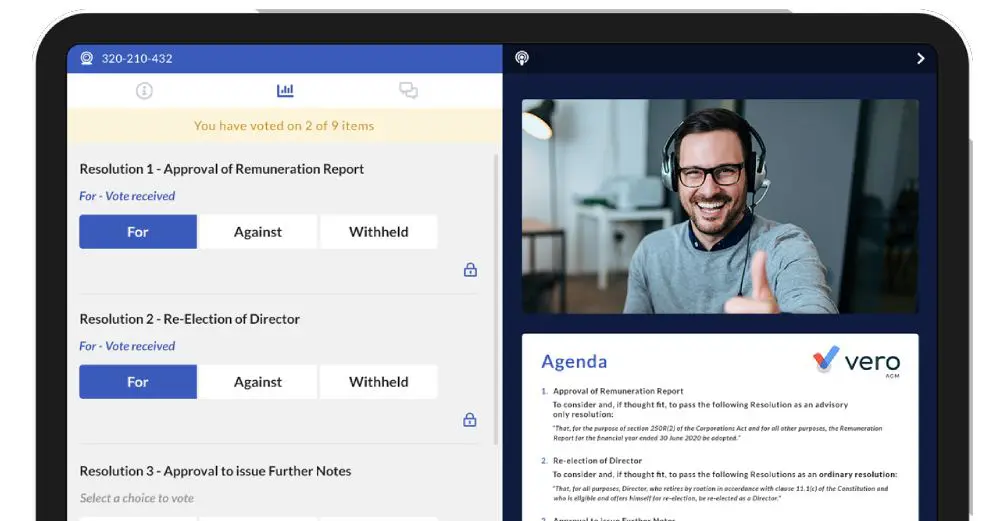
This is where having a structured process — and the right support around it — makes a difference. With Vero Voting, for instance, the focus is less on the software itself and more on how the meeting runs: verified attendance, controlled voting, clear audit trails, and active moderation so participants aren’t left in the background.
It’s a quieter part of governance, but it’s the part that tends to matter when it counts.
A final word
Section 249R isn’t complicated to read. Applying it properly is another story.
Virtual meetings can work very well — but only when participation is built into the design, not added as an afterthought.
If you’re planning one and want to sense-check the setup, it’s worth doing that early. It’s much easier to get it right upfront than to fix it after the fact.