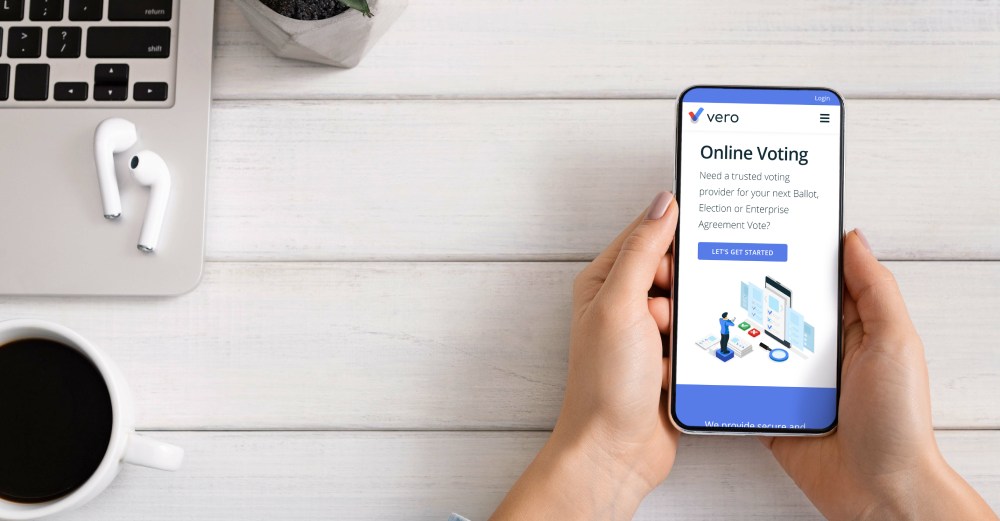
What is End-to-End Verifiable Voting?
Friday, 8 May 2026, 3:52 pm

Trust sits at the centre of every election. Whether it’s a shareholder vote, a union ballot, an AGM resolution or a board election, people want to know two things: that their vote stayed private, and that it was counted properly.
As more organisations across Australia move toward online and hybrid voting, the focus has shifted beyond convenience alone. Questions about transparency, auditability and election integrity are becoming just as important. That’s where end-to-end verifiable voting comes in.
Often shortened to “E2E verifiable voting”, this approach allows voters and independent auditors to confirm that votes were cast, recorded and counted correctly — without exposing how any individual voted.
What does “end-to-end verifiable voting” actually mean?
At its core, end-to-end verifiable voting is designed to give evidence that an election result is accurate and trustworthy.
The “end-to-end” part refers to the full voting journey:
What makes these systems different is that verification happens without compromising ballot secrecy.
Traditional paper elections rely heavily on physical controls, scrutineers and manual oversight. Verifiable digital systems add another layer by using cryptographic checks and audit mechanisms to show that votes haven’t been changed, removed or manipulated during the process.
Why this matters for Australian organisations
Australia already has strong expectations around election integrity. Electoral bodies place significant emphasis on transparency, fairness and secrecy of the ballot, and those expectations increasingly carry across into organisational voting as well.
At the same time, more member-based organisations, unions, associations and companies are running elections online. That creates understandable questions around cyber security, accountability and trust in digital systems.
A basic online polling tool may be enough for a casual survey, but it usually isn’t suitable for high-stakes elections or formal ballots. When outcomes affect governance, leadership or member resolutions, organisations need confidence that the process can stand up to scrutiny if challenged.
End-to-end verifiable voting helps address concerns such as:
How end-to-end verification typically works
Different platforms use different technologies, but most follow a similar structure.
1. The voter casts a ballot
The voter logs in securely and submits their vote through the voting platform.
2. A verification reference is generated
After voting, the system provides a receipt, encrypted reference or tracking code. This does not reveal how the person voted, but it allows them to later confirm their ballot was included in the election.
3. Votes are encrypted and protected
Votes are securely stored using encryption and other security controls designed to prevent unauthorised access or tampering.
4. Independent verification takes place
Auditors, scrutineers or authorised stakeholders can verify that:
The goal is transparency without sacrificing voter privacy.
Secure does not always mean verifiable
Many online voting platforms describe themselves as secure. Security is obviously important, but it is only part of the picture.
A secure system may protect user accounts and stored data. A verifiable system goes further by providing evidence that the election outcome itself is accurate.
That distinction becomes important if an election result is questioned. In those situations, organisations often need more than assurances that “the system worked”. They need clear audit trails and processes that can be independently examined.
The challenges of electronic voting
Implementing verifiable voting correctly is not simple. Electronic voting systems need to balance several competing priorities at once:
If verification processes are overly technical or difficult to understand, they can undermine confidence rather than improve it. The technology therefore needs to be supported by clear procedures, good communication and reliable voter support.
For many organisations, the success of a digital election depends just as much on governance and administration as it does on the software itself.
How Vero Voting supports transparent elections
At Vero Voting, we work with Australian organisations that need secure and professionally managed election services.
Our voting solutions support a wide range of election types, including:
We work closely with clients to ensure elections are transparent, auditable and straightforward for voters to participate in. That includes secure voter authentication, managed election workflows and reporting processes designed to support accountability.
As expectations around governance and cyber security continue to grow, organisations are placing greater value on systems that provide both security and verifiable audit trails.
Looking ahead
Research into verifiable voting continues to evolve, including work focused on future cyber threats and post-quantum security considerations.
At the same time, conversations around digital voting in Australia are becoming more sophisticated. Organisations are no longer asking only whether online voting is possible. They are increasingly asking how election integrity can be demonstrated clearly and confidently.
The future of voting is not simply digital. It is transparent, auditable and verifiable.
Final thoughts
A successful election is not only about reaching a result. It is also about ensuring participants trust the process used to reach that result.
End-to-end verifiable voting gives organisations stronger transparency, clearer auditability and greater confidence in digital election processes. As governance expectations continue to rise, verifiable systems are likely to become an increasingly important part of modern voting.
If your organisation is exploring secure and professionally managed voting solutions, visit
the Vero Voting contact page
to learn more about how we can support your next election or ballot process.