AGM Voting Software in Australia: What Features Should Organisations Look For?
Friday, 9 October 2026, 10:15 am

AGM Voting Software in Australia: What Features Should Organisations Look For?
An annual general meeting can look straightforward on the agenda. Approve the minutes, consider the reports, elect directors and vote on a few resolutions.
The voting itself can be another matter.
Members may be attending in person, joining online or appointing proxies. Some resolutions may require a poll, while director elections could involve several candidates and a specific voting method. In organisations with different membership classes or voting entitlements, the system must also apply the correct rules.
That is why choosing AGM voting software in Australia deserves more thought than finding a platform that lets people click Yes or No.
The right system should support your organisation’s governance rules, make it easy for members to participate and produce a reliable record of the results. It should also fit the way your AGM actually operates, whether the meeting is held in person, online or in a hybrid format.
Here are the features worth examining before you choose a provider.
What Is AGM Voting Software?
AGM voting software is a digital system that helps organisations prepare, conduct and record voting during an annual general meeting.
Depending on the platform, it may support:
Some platforms are designed primarily for simple audience polls. Others are built to handle formal governance processes where eligibility, proxies, voting methods and records all matter.
The difference is significant.
A live meeting poll might be perfectly adequate for asking members which topic they would like discussed next. It may not be suitable for a formal resolution involving proxies, different voting rights or a director election that must follow the organisation’s constitution.
Before comparing software, work out what your AGM requires.
Why the Right AGM Voting System Matters
Voting is often one of the most consequential parts of an AGM. The outcome might determine who joins the board, whether a constitutional change is approved or how the organisation proceeds with an important decision.
For companies, the Corporations Act 2001 and the company’s constitution or applicable replaceable rules govern important aspects of meetings, resolutions, proxies and voting. ASIC explains that companies must follow the relevant rules for a resolution to be valid.
Charities and incorporated associations may have different obligations under their governing documents and the laws that apply to their legal structure and jurisdiction.
Software cannot make an otherwise incorrect voting process valid. It can, however, help an organisation apply its rules consistently and manage the practical work involved.
A suitable system can also reduce manual counting, simplify the administration of larger meetings and help organisers respond to questions about how a result was reached.
10 Features to Look for in AGM Voting Software
1. Support for Your Constitution and Voting Rules
Start here. Before looking at dashboards or reporting features, confirm that the platform can support the rules governing your AGM.
Depending on your organisation, those rules may determine:
The requirements can vary considerably between a company, a not-for-profit association, a charity and a strata scheme.
Ask a prospective provider how the voting rules are configured and tested. Can the system accommodate your actual requirements, or will your team need to work around limitations manually?
A platform should support the process your organisation is required to follow, rather than forcing the organisation to change its process to suit the software.
2. Live Voting During the AGM
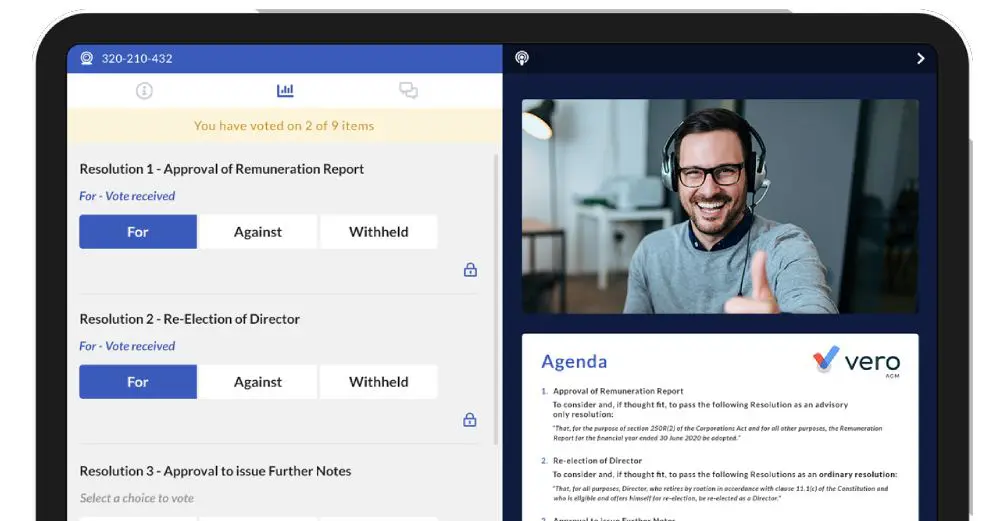
For many organisations, one of the most useful features is the ability to open a ballot during the meeting and display the result once voting closes.
This allows the chair to move through the agenda without waiting for someone to count paper ballots or combine figures from several spreadsheets.
Useful live voting functionality may include:
The exact requirements depend on the vote. Some organisations may need a simple majority calculation, while others need to account for voting weights, proxies or specific thresholds.
Real-time results can make meetings more efficient, but speed should not come at the expense of accuracy. Confirm that the system can apply the correct voting method before relying on automated counting.
3. Proxy Voting Management
Proxy voting can become difficult to manage when a large number of members appoint someone else to vote on their behalf.
Depending on the organisation and applicable rules, administrators may need to record proxy appointments, check their validity, identify the relevant member or representative, and determine how the proxy is authorised to vote.
A suitable AGM voting system should support the proxy arrangements that apply to your organisation.
Ask whether it can:
For companies, proxy arrangements are governed by relevant provisions of the Corporations Act and may also be affected by the company’s constitution and the type of meeting.
Do not assume that every platform handles proxies in the same way. A system that works well for a straightforward member poll may not have the functionality needed for a shareholder meeting with complex proxy arrangements.
4. Director and Committee Elections
AGMs often include elections for directors, office bearers or committee members. These require more than adding candidate names to a poll.
Before selecting software, identify the election method required by your organisation’s rules.
For example, the process may use a simple vote for each position, a ballot in which members select from several candidates, or preferential voting in which candidates are ranked.
Look for functionality that can support the relevant election method, including:
If your organisation uses preferential voting, ask the provider to demonstrate how the count works using a realistic example. Do not assume that every system offering online polls can calculate preferential results.
The same principle applies to contested elections, multiple vacancies and other scenarios where the counting method matters.
5. Accurate Handling of Voting Entitlements
Not every AGM uses a simple one-member-one-vote arrangement.
Depending on the organisation, voting power may be based on shareholding, membership class, unit entitlements or another rule defined by the governing documents or applicable legislation.
The software must be able to apply the correct entitlements for each ballot.
For example, a system used by a company may need to reflect the voting rights attached to particular shares. A strata voting process may require a different approach based on the relevant legislation and voting circumstances.
Before choosing a platform, ask:
Incorrect voting weights can produce an incorrect result even if every submitted vote is recorded accurately.
That is why testing the entitlement rules is just as important as testing the voting interface.
6. Support for In-Person, Virtual and Hybrid Meetings
An AGM voting platform should fit the meeting format rather than complicate it.
An organisation may run a traditional face-to-face meeting, a virtual AGM or a hybrid event where some members attend in person and others join remotely.
For companies covered by the relevant Corporations Act requirements, members as a whole must have a reasonable opportunity to participate in the meeting. ASIC’s guidance also addresses participation, including voting and the ability to ask questions and make comments when virtual meeting technology is used.
When evaluating software, check whether it can support your intended meeting format.
Consider whether:
A video-conferencing platform and a dedicated voting platform serve different purposes. Some organisations need both, integrated into one workable meeting process.
7. Secure Voter Access and Ballot Confidentiality
Security is about more than putting a password on a voting link.
An AGM voting system may handle member details, voting entitlements, proxy information and records of participation. Depending on the ballot, it may also need to preserve the confidentiality or anonymity of individual votes.
Look for clear explanations of how the provider manages:
It is also worth distinguishing voter authentication from ballot anonymity. Authentication establishes whether a person is authorised to vote. Anonymity concerns whether their individual voting choice can be linked back to them.
A well-designed process can verify eligibility while protecting confidential voting choices, where the voting method requires it.
Ask providers for evidence of their security practices rather than relying on broad claims that their platform is secure. Independent certifications and audits can help with supplier due diligence, but they do not guarantee that every possible risk has been eliminated.
8. Clear Audit Trails and Reporting
A result is useful. Being able to explain how that result was produced is even more valuable when a decision is challenged.
AGM voting software should provide appropriate records of the voting process. The precise records required will depend on the organisation, the ballot and any applicable record-keeping obligations.
Useful reporting may cover:
A good audit trail should help authorised people review the integrity of the process without unnecessarily exposing confidential individual votes.
Ask to see a sample results report before purchasing. Can your company secretary, returning officer, chair or committee understand it? Could the organisation use it to prepare the minutes and respond to a reasonable query about the outcome?
The final report should be more useful than a screenshot showing a percentage.
9. An Accessible, Straightforward Voting Experience
Even sophisticated software will struggle if members cannot work out how to use it.
Some AGM participants will be confident with technology. Others may be unfamiliar with online ballots or joining a meeting from a mobile device.
Look for a system that offers:
Where practical, test the voting process with people who reflect your actual membership. Ask them to access the ballot, understand the question, submit a vote and confirm completion without assistance.
This can reveal problems that a software demonstration may not expose.
Accessibility also involves the broader meeting arrangements. Consider whether members can obtain the information they need, ask questions and participate effectively, rather than treating the voting interface as the entire experience.
10. Reliable Support, Testing and Contingency Planning
An AGM is not the ideal time to discover that a voting rule has been configured incorrectly.
Before committing to a provider, ask what happens before, during and after the meeting.
A useful service should help your team understand the setup process, test the voting configuration and know whom to contact if something goes wrong.
Discuss:
Run realistic tests, not just a basic Yes/No demonstration. Include the scenarios most likely to cause difficulty, such as proxy votes, multiple resolutions, different voting entitlements and contested elections.
The provider should also explain what the organisation needs to do if the platform or meeting connection becomes unavailable.
A contingency plan is part of good meeting preparation, not an admission that the software will fail.
AGM Voting Software Compared with Basic Meeting Polls
A basic poll tool may be enough for informal questions. A formal AGM may require more control over eligibility, proxies, voting rules and reporting.
Basic Meeting Polls vs Dedicated AGM Voting Software
| Requirement | Basic Meeting Poll | Dedicated AGM Voting Software |
|---|---|---|
| Informal audience questions | Often suitable | Usually supported |
| Voter eligibility controls | May be limited | Designed to support defined eligibility rules |
| Proxy voting | May require manual handling | Can support configured proxy arrangements |
| Director and committee elections | Depends on functionality | May support formal election workflows |
| Weighted voting | Often limited or unavailable | May support configured voting entitlements |
| Preferential voting | Not commonly a core feature | Available on platforms that support preferential counts |
| Live meeting voting | Common | Common, with additional governance functionality |
| Audit trail and results reporting | Varies | Can provide more detailed voting records |
| Formal governance requirements | Must be checked carefully | Can be configured to support the relevant rules |
This is a general comparison, not a guarantee of what any individual product provides. Features vary by provider, and organisations should verify them against their own requirements.
The practical distinction is that dedicated AGM voting software is designed to manage formal voting requirements, while basic polls generally focus on collecting responses quickly.
Questions to Ask an AGM Voting Software Provider
A product demonstration should help you establish whether the system can handle your real meeting requirements.
Use questions such as these to compare providers:
Ask the provider to demonstrate the answers rather than relying entirely on a feature list.
A platform may advertise proxy voting, for example, but you still need to know whether it supports the particular proxy rules your organisation uses.
Common Mistakes When Choosing AGM Voting Software
Choosing on Price Alone
The cheapest platform may be adequate for a straightforward vote. It can become more expensive in practice if your team has to manage proxies manually, reconcile voting records or work around missing features.
Compare the total service, including setup, support and reporting, rather than the subscription price alone.
Assuming All Voting Software Works the Same Way
An online survey, a live meeting poll and a formal AGM ballot are not interchangeable.
Check the voting methods and governance functionality you actually need.
Leaving Configuration Until the Meeting Day
Late changes create unnecessary risk. Confirm the voter list, voting entitlements, ballot wording, proxy information and counting method in advance.
Ignoring the Member Experience
If members cannot access the ballot or understand how to submit their vote, even a technically capable platform can create frustration and delay.
Treating Software as a Substitute for Governance
The organisation remains responsible for understanding and following its applicable legislation, constitution and rules. Software can help administer a voting process, but it cannot determine every legal question or correct an unsuitable voting procedure automatically.
A Practical AGM Voting Software Checklist
Before making a decision, confirm that your preferred provider can meet the following requirements.
Governance and voting
Meeting experience
Security and records
Provider and support
If several items remain unresolved, ask for clarification before signing a contract or scheduling the AGM.
Where Vero Voting Can Assist
For organisations running formal AGMs, the challenge is often not collecting votes. It is managing the full process around them.
Vero Voting provides voting technology and managed voting services for AGMs, extraordinary general meetings, elections and other formal voting processes. Depending on the organisation’s requirements, these can include live voting, proxy management, director and committee elections, voting reports and audit trails.
Vero’s meeting voting solutions can be used to support in-person, virtual and hybrid meeting arrangements. The appropriate configuration depends on the organisation’s rules, the voting method and the way the meeting is conducted.
For organisations comparing options, it is worth starting with the actual voting scenarios you need to manage. That makes it easier to assess whether a dedicated platform is appropriate and which features are essential.
You can read more about meeting voting software for AGMs, EGMs and committee meetings or explore 10 features every AGM voting software should have in 2026.
If your organisation needs help assessing its requirements, contact Vero Voting to discuss your AGM or request a demonstration.
Key Takeaways
Choosing AGM voting software is a governance decision as well as a technology decision.
The best platform for your organisation will depend on how your members vote, which rules apply and what records you need to retain.
Before deciding, focus on these essentials:
A well-chosen system should make voting easier to administer without making the underlying governance process harder to understand.
If you are comparing AGM voting platforms for an upcoming meeting, contact Vero Voting for assistance or request a demonstration to explore the available options.
Frequently Asked Questions About AGM Voting Software
What Is the Best AGM Voting Software in Australia?
The best option is a platform that supports your organisation’s voting rules, voter eligibility, proxy arrangements, election methods, security needs and reporting requirements. Compare providers using realistic voting scenarios rather than feature lists alone.
Can AGM Voting Software Manage Proxy Votes?
Some platforms support proxy appointments and proxy voting instructions. Confirm that the software can accommodate the arrangements permitted by your organisation’s constitution and applicable legislation.
Can Members Vote Online During an AGM?
Online voting can support virtual and hybrid meetings, subject to the requirements that apply to the organisation and meeting. Companies must consider the relevant Corporations Act requirements and ensure members have a reasonable opportunity to participate.
Is AGM Voting Software Secure?
Security depends on the platform’s controls and how the voting process is configured and managed. Ask about voter authentication, administrator access, protection of voting data, ballot confidentiality, incident response and audit records.
How Much Does AGM Voting Software Cost in Australia?
Pricing varies according to the number of voters, meeting format, voting complexity, support requirements and features such as proxy management or preferential voting. Request a quote based on your actual meeting requirements and confirm any setup or live-support charges.
Sources
This article provides general information, not legal advice. Requirements vary according to the organisation’s legal structure, governing documents, jurisdiction and type of meeting. Check the current rules that apply to your organisation before finalising an AGM voting process.