Can a Union Run Your EBA Vote? Third-Party vs Union-Administered
Tuesday, 28 April 2026, 6:13 pm

If you’ve been through enterprise bargaining before, you’ll know the vote itself can carry more weight than people expect. It’s the point where everything gets tested — the process, the communication, and, sometimes, the relationships between parties.
A question that comes up often is whether a union can run that vote.
Technically, yes. In practice, it’s not always that simple.
So, can a union run an EBA vote?
There’s nothing in the legislation that says they can’t.
Under the Fair Work Act 2009, the responsibility sits with the employer to ensure employees genuinely agree to the agreement. The law doesn’t prescribe who must administer the vote or what platform has to be used.
You can check the current approval process guidance from the Fair Work Commission here:
https://www.fwc.gov.au/work-conditions/enterprise-agreements/approval-enterprise-agreements
Neither requires an independent provider.
So yes — a union can run the vote.
The more relevant question is whether that’s the right call for your situation.
What a union-administered vote actually looks like
When a union takes on the mechanics of the vote, they’re usually handling things like:
In smaller or tightly aligned workplaces, this can work without much friction. Everyone knows each other, the agreement is broadly supported, and the process is relatively straightforward.
But that setup does mean the union is wearing two hats — they’re both advocating for the agreement and running the vote that determines whether it passes.
That’s where things can get a bit delicate.
Independence isn’t just legal — it’s practical
From a strictly legal perspective, independence isn’t mandatory.
From a practical perspective, it matters a lot.
If the agreement sails through with a strong majority, no one tends to question the process. But if the result is narrow, or someone challenges it, the focus shifts very quickly to how the vote was run.
At that point, you’re not just ticking off legal requirements. You’re explaining decisions:
The Commission doesn’t expect perfection. But it does expect a clear, credible process that shows employees genuinely agreed.
If the organisation administering the vote is also a bargaining representative, that explanation can become harder than it needs to be — even when everything was done properly.
Why many employers bring in a third party
This is less about compliance and more about risk.
An independent provider creates distance between the bargaining process and the vote itself. That separation tends to solve a few problems in one go:
None of that is strictly required by law. But if the vote is ever questioned, it becomes very useful very quickly.
In practice, organisations don’t think much about this until they’re asked to prove the integrity of a vote after the fact. By then, options are limited.
What the Fair Work framework actually requires
The baseline obligations are reasonably clear.
Before employees vote, the employer must:
These requirements sit within sections 180–188 of the Fair Work Act 2009.
The challenge is that the legislation sets the standard, but not the method. There’s no prescribed system or checklist for how to run the vote itself.
That’s why process design matters. It fills in the gaps the legislation leaves open.
When a union-run vote can make sense
There are situations where it’s perfectly reasonable.
For example:
In those cases, adding a third party may not deliver much extra value.
But once you’re dealing with larger groups, multiple unions, or a history of disputes, the calculation changes. The cost of uncertainty — or a challenged vote — starts to outweigh the simplicity of handling it internally.
A quick reality check
Most issues with EBA votes don’t come from bad intent. They come from small gaps.
An outdated employee list. Inconsistent communication. Unclear voting records.
Those details are easy to overlook during bargaining. They become very important later.
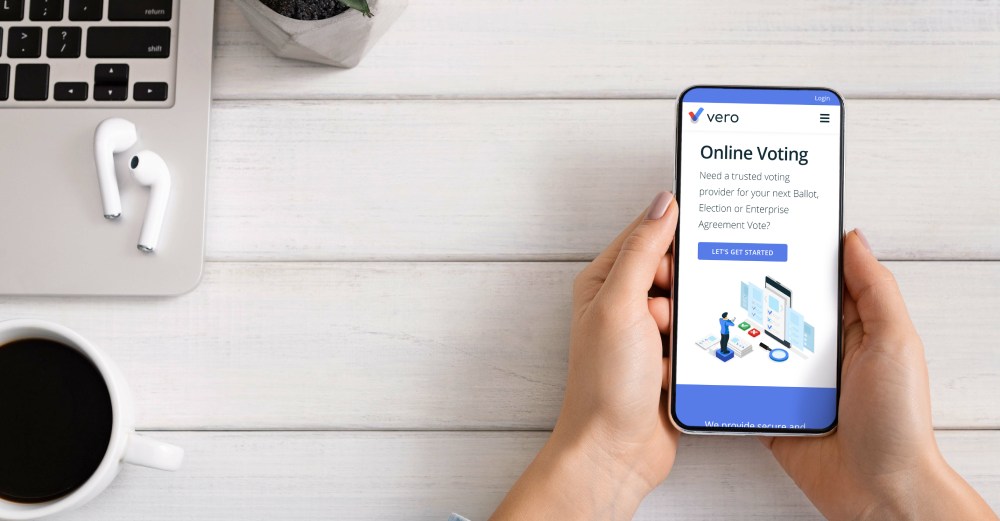
Independent, defensible EBA voting with Vero
Vero Voting focuses on running the voting process itself — independently, securely, and with a clear audit trail.
That includes managing voter eligibility, distributing ballots, and producing a result that can be confidently relied on if it’s ever tested.
It’s not about adding layers. It’s about removing uncertainty.
If you’re planning an EBA vote and weighing up your options, it’s worth getting the structure right early. It tends to make everything that follows a lot simpler.