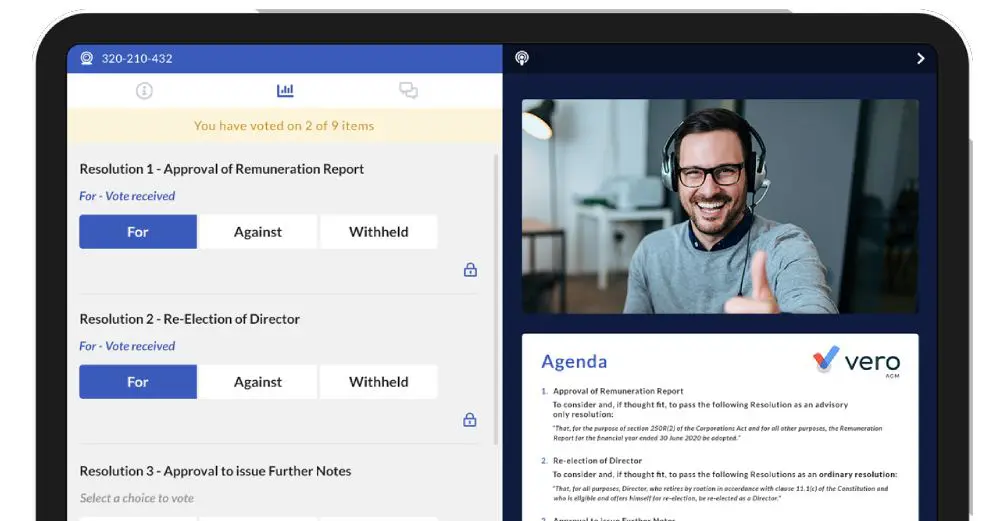
Can Shareholders Ask Questions at a Virtual AGM?
Tuesday, 14 April 2026, 6:51 pm

Yes. They can — and if they can’t, you’ve got a problem.
That might sound blunt, but it’s the reality. A virtual AGM isn’t just a webcast with a voting button attached. If shareholders don’t have a proper way to ask questions while the meeting is happening, it starts to fall short of what the law expects.
And more importantly, it feels wrong to anyone attending.
The legal bit (without overcomplicating it)
The starting point is section 249S of the Corporations Act 2001. It says shareholders must be given a “reasonable opportunity to participate”.
That’s the phrase that matters.
Here’s the link if you want the exact wording:
https://www.legislation.gov.au/Details/C2024C00357
Now, “reasonable” does a lot of heavy lifting there. The Act doesn’t spell out virtual meetings in detail, so you’re left interpreting what participation actually looks like on a screen instead of in a room.
But there’s a fairly settled view on this now.
Watching isn’t participating. Submitting a question days in advance isn’t really participating either. The expectation is that shareholders can engage in the moment.
What ASIC is really getting at
ASIC hasn’t banned virtual AGMs — far from it. But their position has been pretty consistent: going digital shouldn’t water down shareholder rights.
In practical terms, that means:
Where companies get into trouble isn’t usually outright non-compliance. It’s when the process technically exists, but doesn’t really work in practice.
What it looks like when it’s not done well
You see the same patterns crop up.
From the outside, that feels like a closed loop.
What tends to work better
There’s no perfect format, but the better AGMs usually get a few basics right.
Even small signals from the chair — like acknowledging recurring themes — make the process feel more transparent.
The technology side — where things quietly fall apart
This is often underestimated.
On paper, a platform might tick all the boxes. In reality, if it’s awkward to use or slows things down, participation drops off quickly.
You need real-time Q&A. That’s a given. But you also need:
This is where providers like Vero Voting come in — focusing not just on the platform, but how the meeting is structured around it.
A few things that are easy to miss
Some of the smallest details make the biggest difference.
None of these are complicated. But they shape how the meeting is perceived.
So, can shareholders ask questions?
They should be able to. Clearly, easily, and while the meeting is actually happening.
That’s really the benchmark.
Anything less starts to drift away from what “reasonable opportunity to participate” is meant to cover — even if, on paper, everything looks compliant.
Vero Voting can help If you’re planning a virtual AGM and want to sense-check your approach, it’s worth getting a second view before the meeting. It’s much easier to fix issues early than explain them afterwards.
Can Shareholders Ask Questions at a Virtual AGM?. Can Shareholders Ask Questions at a Virtual AGM?