How to Run an AGM in Australia (Step-by-Step Guide)
Wednesday, 3 June 2026, 10:49 am

Annual General Meetings can look straightforward on paper.
Send the notice. Hold the meeting. Count the votes.
In practice, AGMs are where governance problems often surface. Poor notice periods, unclear voting procedures, disputes over proxies, technology failures, quorum issues, and procedural mistakes can quickly turn a routine meeting into a governance headache.
Whether you’re running an AGM for a company, incorporated association, union, club, not-for-profit, strata organisation, or member-based body, the fundamentals are the same: members need a fair opportunity to participate, ask questions, vote, and hold leadership accountable.
The challenge is making sure the process is legally valid and runs smoothly.
This guide walks through the key steps involved in planning and conducting an AGM in Australia.
Step 1: Check Your Governing Rules First
One of the most common mistakes organisations make is assuming all AGMs follow the same rules.
They don’t.
The requirements for an AGM may come from:
Your governing documents should always be the starting point.
Before setting a date, review:
Many governance disputes arise because organisations follow custom rather than their actual constitution.
A process that worked for the last ten years can still be invalid if it does not comply with the rules.
Step 2: Determine the AGM Date and Format
For public companies, the Corporations Act requires an AGM to be held at least once each calendar year and within five months after the end of the financial year.
Other organisation types may have different deadlines under their governing legislation or constitution.
Once the date is selected, decide how members will attend.
Most organisations now choose one of three formats:
Physical meeting
Members attend in person.
Hybrid meeting
Members can attend either in person or online.
Virtual meeting
Members participate entirely through meeting technology.
Hybrid meetings have become increasingly popular because they improve attendance without excluding members who prefer attending in person.
For companies regulated under the Corporations Act, hybrid meetings are permitted. Virtual-only meetings may also be permitted where the constitution expressly allows them.
Step 3: Prepare the Agenda and Meeting Materials
An AGM should focus on governance and member business.
Typical AGM agenda items include:
For public companies, financial reports, directors’ reports, and auditor reports must be presented to members at the AGM.
If elections are being conducted, candidate information should be prepared well in advance so members can make informed decisions.
Where resolutions are complex, explanatory notes are often worth the effort. Members are more likely to engage positively when they understand what they are being asked to vote on.
Step 4: Issue a Proper Notice of Meeting
The notice of meeting is one of the most important governance documents in the AGM process.
If the notice is defective, resolutions may be challenged later.
Under the Corporations Act, meeting notices must include:
Different organisations may have different notice periods.
The safest approach is to check both legislation and your constitution before distributing notices.
Many organisations now issue notices electronically, but only where permitted under their governing rules and applicable legislation.
Step 5: Manage Registrations, Proxies and Voting Entitlements
This is where administration starts becoming more complex.
Before the meeting, you should have a clear understanding of:
Leaving membership disputes unresolved until the meeting itself rarely ends well.
Where proxy voting is permitted, proxy appointments should be verified before the meeting begins.
For organisations with large memberships, independent proxy processing can significantly reduce disputes and administrative burden.
This is also where electronic voting systems can help. Rather than manually checking voting entitlements during the meeting, eligible members can often be validated in advance.
Step 6: Test Your Technology
If you are running a hybrid or virtual AGM, technology should never be treated as an afterthought.
ASIC has made it clear that members must have a reasonable opportunity to participate when virtual technology is used. Members attending online should be able to engage meaningfully in the meeting, including asking questions and making comments.
Before the AGM:
The technology itself is only part of the process.
The real question is whether members can participate fairly.
Step 7: Confirm Quorum Before Opening the Meeting
No quorum.
No meeting.
The chair should confirm that quorum requirements have been met before formally opening proceedings.
Quorum requirements vary considerably between organisations and constitutions.
For some organisations, quorum may be a fixed number.
For others, it may be a percentage of membership.
Where members attend electronically, governing legislation and constitutions may deem them present for quorum purposes, provided participation requirements are met.
Step 8: Conduct the AGM Properly
A well-run AGM should feel organised without feeling rigid.
The chair plays a critical role.
Strong chairs keep discussion focused, ensure members are heard, manage procedural issues consistently, and maintain fairness throughout the meeting.
The AGM should generally proceed according to the agenda while allowing reasonable opportunities for member questions and debate.
Where resolutions are put to a vote, the chair should clearly explain:
Confusion around voting procedures creates more member dissatisfaction than most organisations realise.
Clear instructions prevent disputes.
Step 9: Run Elections and Voting Transparently
Election management deserves special attention.
Members need confidence that voting outcomes are accurate and impartial.
For smaller organisations, this may be manageable internally.
For larger organisations, contested elections, constitutional amendments, or sensitive resolutions often benefit from independent oversight.
Electronic voting can provide:
Independent vote management and scrutineering can also help address concerns around impartiality, particularly where elections are closely contested.
Many organisations now separate election administration from internal management altogether to avoid perceived conflicts of interest.
Step 10: Record Minutes and Finalise Outcomes
The AGM is not finished when members leave.
Accurate records remain essential.
Minutes should capture:
For organisations required to lodge documents with regulators, additional post-meeting obligations may apply.
This is particularly relevant where constitutional amendments, director appointments, or special resolutions have been approved.
Common AGM Mistakes
Some issues appear repeatedly across all types of organisations.
These include:
Most AGM problems are preventable.
They usually arise from planning assumptions rather than deliberate misconduct.
Where Electronic Voting Fits Into the AGM Process
Electronic voting is no longer limited to large listed companies.
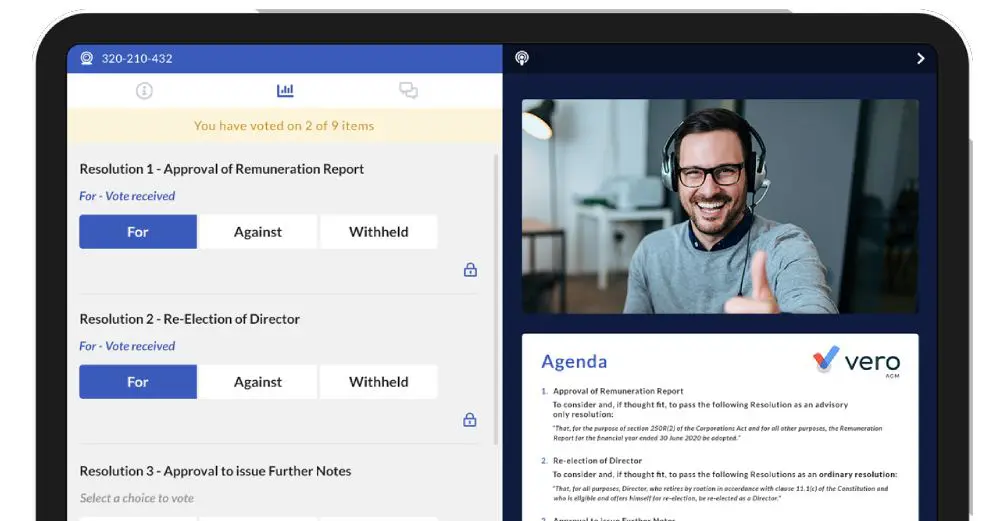
Associations, unions, clubs, professional bodies, strata organisations and not-for-profits increasingly use electronic voting to improve participation and reduce administrative complexity.
Depending on the organisation, electronic voting may be used for:
The key benefit is not simply convenience.
It is transparency.
Members are more likely to trust outcomes when voting processes are clearly documented, independently managed, and supported by reliable audit records.
FAQ
Is an AGM legally required in Australia?
That depends on the type of organisation.
Public companies must generally hold an AGM each calendar year and within five months after the end of their financial year. Other organisations should check the legislation and governing rules that apply to them.
Can an AGM be held entirely online?
For companies governed by the Corporations Act, virtual-only meetings may be held where the constitution expressly permits or requires them. Hybrid meetings are generally permitted.
Can members vote online during an AGM?
In many cases, yes. The availability of online voting depends on the organisation’s governing rules, meeting format, and voting procedures.
Do proxies count towards quorum?
This depends on the legislation and governing rules applicable to the organisation. The constitution should always be checked before the meeting.
Should AGM elections be independently managed?
Not always. However, independent election management becomes increasingly valuable where elections are contested, membership numbers are large, or governance disputes are likely.
Final Thoughts
A successful AGM is rarely about the meeting itself.
Most of the work happens beforehand — preparing accurate member records, issuing compliant notices, managing voting processes properly, and ensuring members can participate fairly.
When those foundations are in place, the meeting tends to run smoothly.
For organisations planning an AGM, election, member vote, or hybrid meeting, the team at Vero Voting can provide practical guidance on electronic voting, proxy management, independent scrutineering, and meeting technology support tailored to Australian governance requirements.
Sources
ASIC – Company Meetings and Resolutions: https://www.asic.gov.au/for-business-and-companies/companies/company-building-blocks/company-meetings-and-resolutions/
ASIC – FAQs: Virtual Meetings for Companies and Registered Schemes: https://www.asic.gov.au/regulatory-resources/corporate-governance/shareholder-engagement/faqs-virtual-meetings-for-companies-and-registered-schemes/
ASIC – Shareholder Rights and Responsibilities: https://www.asic.gov.au/for-business-and-companies/companies/company-share-and-shareholder-rules-and-changes/shareholder-rights-and-responsibilities/
Corporations Act 2001 (Cth) – Section 249L: https://www5.austlii.edu.au/au/legis/cth/consol_act/ca2001172/s249l.html
Corporations Act 2001 (Cth) – Section 250N: https://www5.austlii.edu.au/au/legis/cth/consol_act/ca2001172/s250n.html
Corporations Act 2001 (Cth) – Section 317: https://www5.austlii.edu.au/au/legis/cth/consol_act/ca2001172/s317.html
Frequently Asked Questions
Is an AGM legally required in Australia?
That depends on the type of organisation.
Public companies must generally hold an AGM each calendar year and within five months after the end of their financial year. Other organisations should check the legislation and governing rules that apply to them.
Can an AGM be held entirely online?
For companies governed by the Corporations Act, virtual-only meetings may be held where the constitution expressly permits or requires them. Hybrid meetings are generally permitted.
Can members vote online during an AGM?
In many cases, yes. The availability of online voting depends on the organisation’s governing rules, meeting format, and voting procedures.
Do proxies count towards quorum?
This depends on the legislation and governing rules applicable to the organisation. The constitution should always be checked before the meeting.
Should AGM elections be independently managed?
Not always. However, independent election management becomes increasingly valuable where elections are contested, membership numbers are large, or governance disputes are likely.