How to Verify Attendees at a Virtual AGM
Thursday, 9 April 2026, 9:21 pm

How to Verify Attendees at a Virtual AGM
In today’s increasingly digital corporate environment, virtual Annual General Meetings (AGMs) have become standard practice across Australia. However, one critical requirement remains unchanged: attendee verification. Without robust verification processes, the validity of an AGM—and any resolutions passed—can be called into question.
This guide explains how to verify attendees at a virtual AGM, the technology required, and how organisations can ensure compliance with Australian regulatory standards while maintaining a seamless user experience.
Why Attendee Verification Matters
Verifying attendees is not just a technical step—it is a legal necessity.
Under the Corporations Act 2001 (Cth), companies must ensure that only eligible members (or their authorised proxies) can attend, vote, and be counted toward quorum. Failure to properly verify participants may result in:
The Australian Government has reinforced the legitimacy of virtual meetings through reforms allowing hybrid and fully virtual AGMs, provided that members are given a reasonable opportunity to participate.
Key sources:
Treasury Laws Amendment (2022 Measures No. 1) Act 2022
Core Verification Methods for Virtual AGMs
To ensure only authorised participants attend and vote, organisations should implement layered verification measures.
1. Unique Access Links
Each attendee is issued a personalised meeting link tied to their identity.
2. Two-Factor Authentication (2FA)
Adding a second authentication layer significantly enhances security.
This ensures that even if login details are compromised, unauthorised access is prevented.
3. Pre-Registration and Approval
Participants must register in advance, allowing organisers to:
4. Proxy Validation
For proxy voting, verification must confirm:
Corporations Act 2001 (consolidated version)
What Technology Is Needed for a Virtual AGM?
Delivering secure and compliant attendee verification requires purpose-built technology—not just standard video conferencing tools.
Essential Features Include:
ASIC emphasises that virtual meeting technology must allow members to participate, ask questions, and vote in real time, not just observe.
Balancing Security with User Experience
While security is critical, overly complex verification processes can discourage participation and create frustration—especially for less tech-savvy attendees.
Best practice is to:
The goal is to ensure compliance without compromising accessibility.
How Vero Voting Handles Attendee Verification
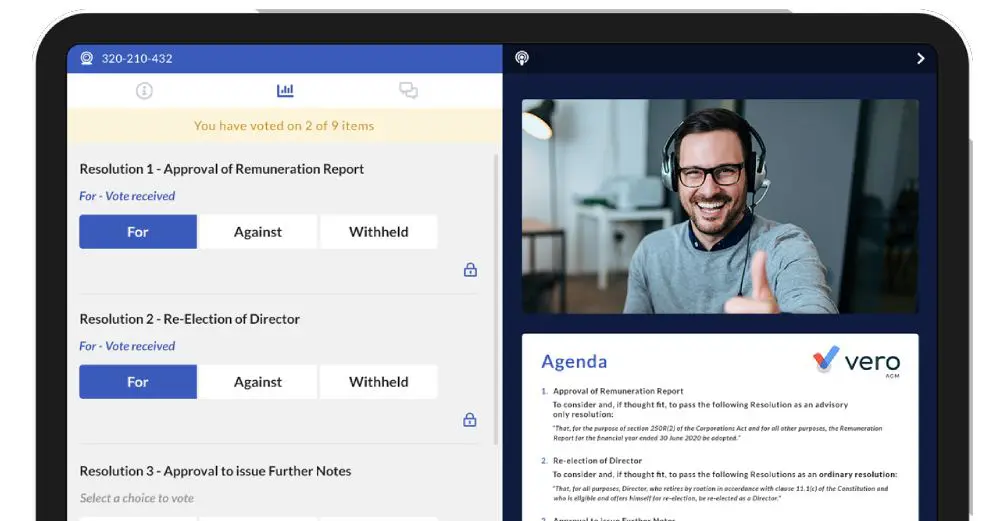
At Vero Voting, attendee verification is built into every stage of the virtual AGM process, ensuring both regulatory compliance and a smooth user experience.
Our approach includes:
Importantly, our platform is designed specifically for Australian regulatory requirements, aligning with ASIC expectations and the Corporations Act.
We also provide end-to-end support, helping organisations manage everything from attendee onboarding to live meeting facilitation.
Final Thoughts
Verifying attendees at a virtual AGM is not optional—it is fundamental to ensuring the legitimacy, fairness, and legal compliance of your meeting. With the right combination of secure technology and thoughtful user experience design, organisations can confidently run virtual AGMs that meet both regulatory standards and shareholder expectations.
If you’re planning your next AGM and want to ensure secure, compliant attendee verification, Vero Voting can help.
Visit our contact page today to book a demo and see how our platform delivers seamless, secure virtual AGM experiences tailored to Australian organisations.