How to Verify Attendees at a Virtual AGM
Thursday, 9 April 2026, 9:21 pm

If you strip an AGM back to its essentials, it comes down to two things: who is in the room, and who is entitled to vote. Move that meeting online, and both questions become more complex—but no less critical. Get attendee verification wrong, and you risk invalid votes, challenged resolutions, or in the worst case, a meeting that doesn’t meet its legal obligations.
I’ve seen organisations focus heavily on the broadcast side of a virtual AGM—video quality, slides, chair scripts—while underestimating the mechanics of verifying attendees. That’s the part regulators, auditors, and disgruntled members tend to care about most.
Let’s walk through how to get it right.
Why verification matters more than you think
Verification isn’t just a technical step. It underpins the legal integrity of the entire meeting.
At a minimum, you need to be confident about three things:
The framework for virtual AGMs has evolved, particularly following reforms to the Corporations Act 2001. The current position supports hybrid and fully virtual meetings, provided participation requirements are met.
You can review the legislation here:
https://www.legislation.gov.au/Details/C2024C00003
If you can’t demonstrate that only eligible participants attended and voted, you’re exposed.
Practical methods for verifying attendees
There’s no single “correct” approach, but robust virtual AGMs tend to combine a few layers of verification rather than relying on just one.
Unique access links
Each attendee receives a personalised link tied to their identity in the register.
It’s simple and effective, but on its own it has limitations—links can be forwarded, particularly in smaller organisations.
Two-factor authentication (2FA)
Adding a second step—typically a one-time code sent via SMS or email—reduces the risk of unauthorised access.
It provides a clear audit trail and confirms the person logging in has access to the registered contact details.
Registration and approval workflows
Pre-registration allows attendees to confirm their details in advance, which are then checked against the membership register.
This approach is particularly useful where records may be inconsistent or where proxy usage is common.
Proxy validation
If your AGM allows proxies, your verification process must distinguish between members and appointed representatives.
This needs to be integrated into your verification workflow—not handled separately.
What technology do you actually need?
You don’t need an overly complex tech stack, but you do need systems that work together.
Getting the balance right
There’s a temptation to make verification as tight as possible. More steps, more controls.
But if the process becomes too complex, participation drops. People struggle to log in or disengage entirely.
The goal is appropriate security—strong enough to ensure compliance, but simple enough to encourage participation.
How Vero Voting handles attendee verification
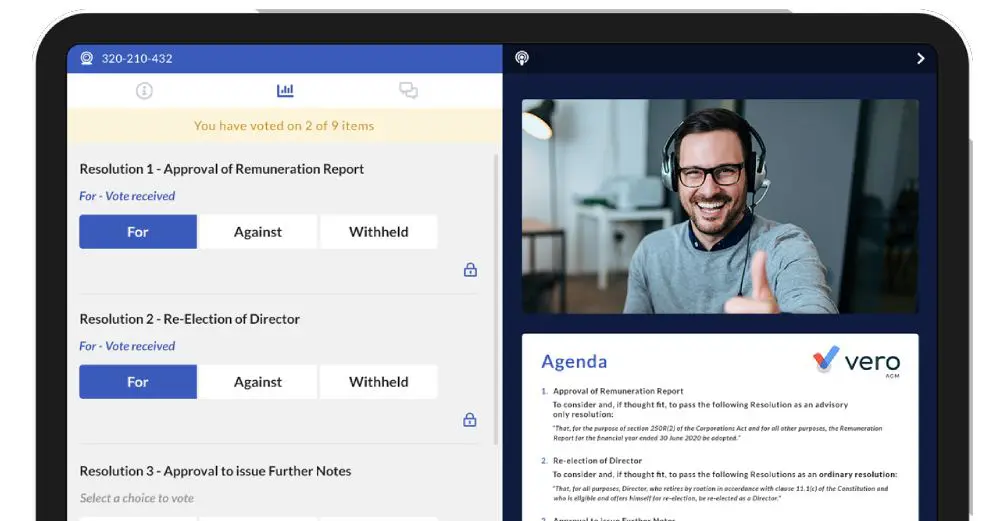
Vero Voting’s platform is designed to bring verification, voting, and reporting into a single, consistent process.
This approach reduces risk while keeping the experience straightforward for attendees.
Final thoughts
Virtual AGMs are now a standard part of governance in Australia, and expectations haven’t eased. Verification remains central to ensuring your meeting stands up to scrutiny.
If you’re preparing for an upcoming AGM and want to see how a secure verification process works in practice, consider booking a demo. It’s often the quickest way to understand where issues can arise—and how to avoid them.