Member Voting Software in Australia: Features That Matter Most
Thursday, 13 August 2026, 8:50 am

Running a member vote sounds straightforward.
Prepare the question, send it to members, collect the votes and announce the result.
Anyone who has actually managed an AGM, committee election, constitutional resolution or large member ballot knows it rarely works that neatly.
The difficult part is not simply collecting votes. It is making sure the right people can vote, each person can vote in the right way, the process is fair, confidential where required, and the final result can be explained and defended afterwards.
That is where member voting software earns its place.
For Australian organisations, however, choosing a platform should involve more than comparing features on a pricing page. Your constitution, governing legislation, membership structure and voting rules all matter. A good system should support those requirements rather than forcing your organisation into a generic voting process.
So, what should you actually look for in member voting software in Australia?
What is member voting software?
Member voting software is a digital system used to manage elections, resolutions, ballots and other decisions involving an organisation’s members.
Depending on the organisation, it might be used for:
The important distinction is that professional voting software is not simply an online form.
A basic form may record that someone selected “Yes” or “No”. A properly designed voting system needs to manage the entire voting process — including eligibility, authentication, voting rules, security, counting, reporting and the audit record.
For organisations where a result may later be questioned, that distinction matters enormously.
Why organisations are moving member voting online
There is an obvious practical advantage to online voting: members do not have to be in the same room.
That can make a significant difference for organisations with members spread across different cities, states or countries.
It can also remove a surprising amount of administration.
A traditional ballot may require someone to:
With an appropriately configured online voting system, much of this process can be managed digitally.
But convenience should not be the primary reason for moving a member vote online.
The better question is:
Can the technology make the voting process easier without compromising the integrity of the result?
That is the standard organisations should be aiming for.
The legal framework matters more than the software
There is no single Australian law that governs every member vote.
A company, incorporated association, charity, union, strata scheme and professional association can all operate under different legislation and governing documents.
For example, incorporated associations are generally governed by the legislation of the state or territory in which they are incorporated, while their own constitution or rules will also determine how the organisation operates. The ACNC notes that incorporated associations are established under state or territory law and generally have their own governing rules.
For companies, the Corporations Act 2001 contains specific requirements concerning member meetings, participation and voting. The legislation permits the use of virtual meeting technology provided the relevant requirements are met, including giving entitled participants a reasonable opportunity to participate.
ASIC has also made clear that virtual participation should provide members with meaningful opportunities to participate, including asking questions, making comments and voting.
For charities, the ACNC similarly advises organisations considering remote meetings to check their governing document and any applicable state or territory requirements before proceeding.
This is why the first question when selecting voting software should not be:
“Does it have online voting?”
It should be:
“Can it implement our voting rules accurately?”
1. Flexible voter eligibility rules
One of the easiest ways to compromise a ballot is to get voter eligibility wrong.
A professional member voting system should allow the organisation to establish exactly who is entitled to vote.
That might be based on:
Consider an association with three membership categories. Full members may have one vote, corporate members may have weighted voting rights, and associate members may have no voting rights.
A generic survey tool is not designed for that.
A proper voting platform should apply the eligibility rules before the ballot opens and prevent an ineligible member from simply submitting a vote.
Why voter lists need careful attention
The quality of the voting result is only as good as the voter register behind it.
Before a ballot opens, organisations should confirm:
Data accuracy is not just an administrative concern.
The Australian Privacy Principles include requirements around the quality and security of personal information. OAIC guidance states that APP entities should take reasonable steps to ensure personal information is accurate, up to date and complete.
2. Secure voter authentication
The system needs to establish that the person voting is entitled to vote — without unnecessarily compromising ballot secrecy.
This is where voting software needs to be more sophisticated than an ordinary online form.
Depending on the ballot, authentication might involve:
The right approach depends on the risk and nature of the ballot.
A low-risk internal poll does not necessarily need the same controls as a contested board election.
The important thing is that the organisation can choose an authentication method appropriate to the vote.
3. One person, one vote — when that is the rule
Preventing duplicate voting sounds obvious.
In practice, it needs to be built into the voting system.
A member voting platform should be able to identify whether a voter has already submitted a ballot and enforce the applicable voting rule.
That becomes particularly important when voting is available through more than one channel.
For example, if an organisation offers online and SMS voting, the system needs to prevent the same member from casting a valid vote through both channels.
This is one reason to be cautious about stitching together several unrelated tools.
A collection of forms, spreadsheets and email processes can create gaps that are difficult to detect until after the ballot closes.
4. Support for different voting methods
Not every election uses the same voting method.
Depending on the organisation’s rules, a ballot may require:
The software should support the actual voting method required by the organisation, rather than forcing administrators to adapt their rules to the platform.
This is particularly important for committee and board elections.
A candidate election with five positions available is fundamentally different from a resolution asking members to approve a constitutional amendment.
The system should know the difference.
5. Anonymous or secret voting
Confidentiality is another feature that deserves careful attention.
Not every member vote needs to be anonymous. Some organisational decisions may require an identifiable voting record.
Others may require a secret ballot.
The software should therefore allow the voting model to match the rules of the ballot.
A useful distinction is between:
Authentication: establishing that an eligible person has voted.
and
Ballot secrecy: preventing the organisation or other participants from knowing how that person voted where secrecy is required.
Those are not the same thing.
A well-designed system can authenticate a voter while keeping the contents of their ballot confidential.
This is particularly relevant for elections, workplace ballots and other sensitive decisions.
6. A proper audit trail
If there is one feature that should receive more attention during software selection, it is the audit trail.
The question is not simply:
“Who won?”
It is:
“Can we demonstrate how the voting process was conducted and how the result was produced?”
A strong audit trail can record relevant events such as:
The precise information retained will depend on the voting model and privacy requirements.
For companies, ASIC notes that minutes of member meetings and resolutions form part of the company’s records, and signed minutes provide evidence of the proceedings or resolution unless proved otherwise.
That broader principle is useful when thinking about digital voting: the outcome should not exist as an isolated number with no supporting record.
7. Immutable or tamper-evident records
An audit trail is only useful if administrators cannot quietly rewrite history.
For higher-risk elections and ballots, look for controls that make unauthorised alteration detectable and preserve the integrity of voting records.
This is where terms such as immutable audit trail, tamper-evident records and vote-to-record traceability become relevant.
The goal is simple:
If someone asks months later how the result was produced, the organisation should have a defensible record of the process.
That can be especially valuable where a result is contested by a candidate, member, union, shareholder or regulator.
8. Real-time results — but with appropriate controls
Real-time results are useful, particularly during AGMs and live elections.
A chairperson may need to know whether a resolution has passed before moving to the next item.
Election administrators may need to monitor participation during a voting period.
But real-time reporting should not mean that sensitive information is unnecessarily exposed.
For example, an administrator may need to see participation rates without being able to see individual ballot choices.
The best systems separate operational reporting from confidential voting information.
That distinction helps preserve trust in the process.
9. Proxy and attendance management
For many member meetings, voting does not start when the chairperson asks the question.
It starts much earlier.
Members may need to register, nominate proxies, verify attendance or provide voting instructions before the meeting.
A voting platform that integrates attendance and proxy management can reduce manual reconciliation.
For company meetings in particular, the relationship between attendance, voting entitlement and proxies can become complicated quickly.
ASIC’s guidance on virtual meetings emphasises that members must have meaningful opportunities to participate rather than simply watch a webcast.
A meeting platform and voting platform therefore need to work together.
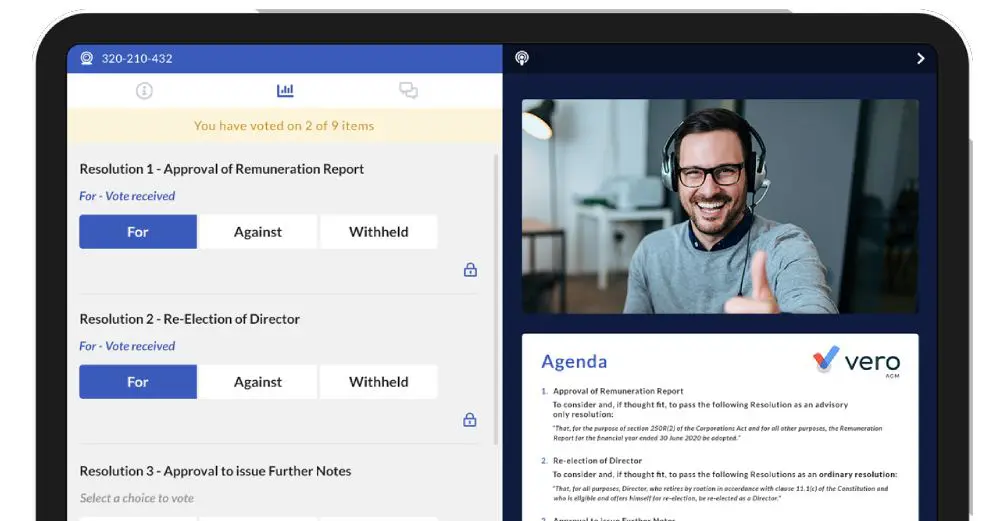
10. Integration with AGM and meeting technology
If an organisation runs virtual or hybrid meetings, voting should not feel like a separate event.
Members should be able to:
This is particularly important for AGMs.
ASIC specifically distinguishes between technology that merely allows members to watch a meeting and technology that enables meaningful participation. A webcast that only allows viewing does not, by itself, provide the participation required for a hybrid meeting.
For organisations using platforms such as Zoom, Microsoft Teams or Webex, an integrated voting solution can make the experience considerably smoother.
11. Accessibility for members
The most secure voting system in the world is not particularly useful if members cannot use it.
Consider your membership.
Do members have different levels of technical confidence? Are some members older? Are some working remotely? Do members primarily use mobile phones?
A good member voting system should make voting straightforward across common devices and provide clear instructions.
It should also provide alternative voting arrangements where appropriate.
The aim is not to make voting technologically impressive.
The aim is to make it easy for an eligible member to understand the question and cast the correct vote.
12. Privacy and data security
Voting systems often contain personal information.
Depending on the organisation, that might include:
Security therefore needs to be considered before choosing a platform.
Under APP 11, organisations covered by the Australian Privacy Principles must take reasonable steps to protect personal information against misuse, interference, loss and unauthorised access, modification or disclosure.
OAIC guidance also recommends considering information security throughout the information lifecycle, from collection through to destruction or de-identification when information is no longer required.
When assessing a voting provider, ask practical questions:
Security claims should be verifiable.
For example, ISO/IEC 27001:2022 is an international standard for information security management systems. ISO describes certification as one way an organisation can demonstrate its commitment and ability to manage information securely.
13. Data sovereignty and hosting location
Australian organisations increasingly ask where their data is stored.
There is no universal rule saying that every Australian organisation must store every piece of voting data in Australia. The applicable requirements depend on the organisation, its obligations and the nature of the information.
Nevertheless, data location is a sensible procurement question.
Ask:
For organisations subject to the Privacy Act, APP 8 can also be relevant when personal information is disclosed overseas.
14. Independent administration
For contentious or high-stakes votes, independence can matter as much as technology.
Consider a contested committee election.
If the same person who is standing for election is also:
there may be an obvious governance problem, even if the software itself is secure.
An independent election administrator or returning officer can provide another layer of confidence.
The technology should support that separation of duties.
15. Reporting that administrators can actually use
At the end of the ballot, someone has to explain what happened.
A useful voting system should provide clear reports covering the information the organisation legitimately needs.
Depending on the vote, that could include:
Reports should be easy to export and retain with the organisation’s governance records.
For charities, the ACNC notes that registered charities have record-keeping obligations and that records may be maintained electronically.
16. Testing before the ballot opens
A feature that rarely appears on a software comparison table can be one of the most valuable: proper pre-election testing.
Before members vote, administrators should test the actual ballot.
That means checking:
Do not wait until the ballot opens to discover that a candidate is missing or a voting entitlement has been configured incorrectly.
For important elections, a controlled test vote should be treated as part of the election process.
Common mistakes when choosing member voting software
Choosing a survey tool for a formal election
Survey software is excellent for collecting opinions.
That does not automatically make it suitable for conducting a formal election.
The requirements are different.
A survey may ask:
“How satisfied are you with the committee?”
A governance ballot may ask members to elect directors under a particular voting method, with defined eligibility rules, proxies and a result that may later be challenged.
Those are very different problems.
Focusing on price instead of risk
The cheapest platform can become expensive if the organisation has to manually reconcile votes, resolve duplicate submissions or defend a disputed result.
Look at the total process cost — not just the software subscription.
Assuming “online” means “secure”
An online voting system is not secure simply because it uses HTTPS.
Security involves authentication, access controls, data protection, monitoring, administration, software development practices, incident response and governance.
Ignoring the constitution
The software does not override your constitution.
Before moving a ballot online, check the organisation’s governing rules and applicable legislation.
For companies, ASIC specifically advises organisations to consider their constitutional requirements when holding virtual-only meetings.
Forgetting about the member experience
A complicated voting process can reduce participation.
Members should not need a technical manual to cast a vote.
A practical checklist for choosing member voting software
Before selecting a provider, ask the following.
| Requirement | Question to ask |
|---|---|
| Voter eligibility | |
| Authentication | |
| Duplicate prevention | |
| Voting method | |
| Confidentiality | |
| Audit trail | |
| Security | |
| Certification | |
| Data location | |
| Proxies | |
| Meetings | |
| Accessibility | |
| Reporting | |
| Independence | |
| Support | |
| Testing |
If a provider cannot answer these questions clearly, that is worth paying attention to.
Where Vero Voting can help
Vero Voting provides online voting, election and meeting solutions for Australian organisations, including member voting, AGM voting, elections and other governance-related ballots. Its platform supports different voting rights and structures, including voting and non-voting member groups, weighted voting and specific membership rights.
For organisations running a significant election or member ballot, the value is not simply having somewhere for members to click “Vote”.
Vero can support the wider process, including voter setup, election configuration, online voting, proxy management, meeting integration, live results and audit reporting.
Vero also states that its information security management system is certified to ISO/IEC 27001:2022, independently audited by Insight Assurance.
That type of independently assessed security framework is particularly relevant when voting systems are handling member information and sensitive governance processes.
For organisations that need a straightforward online ballot, Vero can provide the voting technology and administration without requiring the organisation to build its own election infrastructure.
The best voting software is the one that fits your governance process
There is no single “best” member voting platform for every Australian organisation.
An association running a 200-member committee election has different requirements from a listed company conducting a shareholder meeting. A union ballot has different considerations from a charity constitutional vote.
The right platform should therefore be judged against the risk, rules and complexity of the actual ballot.
At a minimum, look for:
Technology should make the process easier.
It should not introduce a new governance risk.
Key takeaways
When choosing member voting software in Australia:
A member vote is ultimately about trust.
Members need to trust that they were entitled to vote, that their vote was recorded correctly and that the result represents the voting process that was promised to them.
The organisation needs to be able to demonstrate the same thing.
If your organisation is planning an AGM, committee election, constitutional ballot or other member vote and you are unsure which voting approach is appropriate, Vero Voting can help you work through the requirements and demonstrate the available options.
Request a demonstration or speak with the Vero Voting team about your next member ballot.
Member Voting Software in Australia
Member Voting Software in Australia
Member Voting Software in Australia
Member Voting Software in Australia
Member Voting Software in Australia
Member Voting Software in Australia
Member Voting Software in Australia
Frequently Asked Questions
What is member voting software?
Member voting software is a system for managing elections, resolutions and ballots involving an organisation’s members. Depending on the platform, it can handle voter eligibility, authentication, ballot secrecy, vote counting, proxies, reporting and audit records.
Is online member voting legal in Australia?
Online voting can be used for many types of Australian organisational ballots, but there is no single rule covering every organisation. The applicable legislation, constitution, rules and type of ballot need to be considered. For companies, the Corporations Act provides a legislative framework for meetings using virtual meeting technology, subject to its requirements.
What features should I look for in online voting software?
At a minimum, look for accurate voter eligibility controls, secure authentication, appropriate ballot secrecy, duplicate-vote prevention, flexible voting methods, audit trails, reporting, security controls and reliable support. For higher-risk elections, independent administration and testing should also be considered.
Can member voting software be used for AGM voting?
Yes. Voting software can support resolutions, elections and polls conducted during physical, hybrid or virtual meetings. For companies using virtual meeting technology, ASIC expects members to have meaningful opportunities to participate, including asking questions, making comments and voting.
How do I know if an online voting system is secure?
Look beyond claims such as “secure” or “encrypted”. Ask about authentication, access controls, encryption, audit logging, data hosting, incident response, independent security assessments and information security certifications. ISO/IEC 27001 is one recognised international standard for information security management systems.
Sources
Australian Securities and Investments Commission (ASIC) — FAQs: Virtual meetings for companies and registered schemes
https://asic.gov.au/regulatory-resources/corporate-governance/virtual-general-meetings/
ASIC — What companies and registered schemes should know about virtual-only meetings
https://asic.gov.au/about-asic/news-centre/articles/what-companies-and-registered-schemes-should-know-about-virtual-only-meetings/
Federal Register of Legislation — Corporations Act 2001
https://www.legislation.gov.au/Series/C2004A00818
Australian Charities and Not-for-profits Commission (ACNC) — Holding meetings remotely
https://www.acnc.gov.au/tools/guides/holding-meetings-remotely
ACNC — Incorporated associations
https://www.acnc.gov.au/for-charities/start-charity/choose-legal-structure/incorporated-associations
Office of the Australian Information Commissioner (OAIC) — Australian Privacy Principles
https://www.oaic.gov.au/privacy/australian-privacy-principles
OAIC — APP 11: Security of personal information
https://www.oaic.gov.au/privacy/australian-privacy-principles-guidelines/chapter-11-app-11-security-of-personal-information
OAIC — APP 10: Quality of personal information
https://www.oaic.gov.au/privacy/australian-privacy-principles-guidelines/chapter-10-app-10-quality-of-personal-information
International Organization for Standardization (ISO) — ISO/IEC 27001:2022
https://www.iso.org/standard/27001.html
Frequently Asked Questions
What is member voting software?
Member voting software is a system for managing elections, resolutions and ballots involving an organisation’s members. Depending on the platform, it can handle voter eligibility, authentication, ballot secrecy, vote counting, proxies, reporting and audit records.
Is online member voting legal in Australia?
Online voting can be used for many types of Australian organisational ballots, but there is no single rule covering every organisation. The applicable legislation, constitution, rules and type of ballot need to be considered. For companies, the Corporations Act provides a legislative framework for meetings using virtual meeting technology, subject to its requirements.
What features should I look for in online voting software?
At a minimum, look for accurate voter eligibility controls, secure authentication, appropriate ballot secrecy, duplicate-vote prevention, flexible voting methods, audit trails, reporting, security controls and reliable support. For higher-risk elections, independent administration and testing should also be considered.
Can member voting software be used for AGM voting?
Yes. Voting software can support resolutions, elections and polls conducted during physical, hybrid or virtual meetings. For companies using virtual meeting technology, ASIC expects members to have meaningful opportunities to participate, including asking questions, making comments and voting.
How do I know if an online voting system is secure?
Look beyond claims such as “secure” or “encrypted”. Ask about authentication, access controls, encryption, audit logging, data hosting, incident response, independent security assessments and information security certifications. ISO/IEC 27001 is one recognised international standard for information security management systems.