Virtual AGMs for Not-for-Profits — Rules & How to Run Them
Wednesday, 22 April 2026, 6:10 pm

Virtual AGMs for Not-for-Profits — What the Rules Actually Say
Virtual AGMs are no longer a stop-gap. For many not-for-profits, they’ve become the default — and in plenty of cases, they work better than a room full of folding chairs and patchy attendance.
The short answer is yes: most Australian not-for-profits can hold virtual AGMs. But the detail sits in a mix of legislation, regulator guidance, and your own constitution. That’s where things can either run smoothly — or come unstuck.
Here’s how it fits together in practice.
State-by-State: Incorporated Associations
If your organisation is an incorporated association, the starting point is your state or territory legislation. Across Australia, the trend is consistent — laws have been updated to allow technology-assisted meetings, including fully virtual AGMs, provided certain conditions are met.
For example, in Queensland, the Associations Incorporation Act 1981 (Qld) allows meetings to be held using technology as long as members can communicate with each other in real time. The regulator guidance from Queensland Office of Fair Trading reinforces this — the key is that members must have a reasonable opportunity to participate.
It’s a similar position in other jurisdictions:
So while the wording varies, the underlying rule is consistent: if members can hear, be heard, and vote, a virtual AGM is generally valid.
What About ACNC-Registered Charities?
If your organisation is a registered charity, the Australian Charities and Not-for-profits Commission (ACNC) doesn’t prescribe how AGMs must be held. Instead, it focuses on governance standards — particularly that members’ rights are respected and decisions are properly made.
In practice, that means the same thing: virtual AGMs are acceptable if your governing rules allow them and members can meaningfully participate.
Your Constitution Still Matters
This is where many organisations trip up.
You can have legislation on your side, but if your constitution is silent — or worse, requires a “place” or “physical meeting” — you may have a problem.
Well-drafted modern constitutions usually include language along the lines of:
If your rules don’t say this, it’s worth fixing before your next AGM. Running a technically invalid meeting can create issues later — particularly if resolutions are challenged.
Engagement: The Real Test of a Virtual AGM
Holding a virtual AGM is one thing. Running a good one is another.
The legislation talks about “reasonable opportunity to participate”. In practice, that means:
This is where format matters. A webinar-style AGM with no interaction might technically tick a box, but it rarely holds up if members feel shut out. A structured meeting with moderated Q&A, clear agenda control, and visible voting tends to work far better.
Short version: if it feels like a one-way broadcast, you’re probably missing the mark.
Voting at Virtual AGMs
Voting is often the most sensitive part of any AGM — and the easiest place for disputes to arise.
Most state legislation allows voting by a show of hands, poll, or other method determined by the chair. In a virtual setting, that usually translates to:
The key is transparency. Members should understand how their vote is counted, and the process should be auditable if challenged.
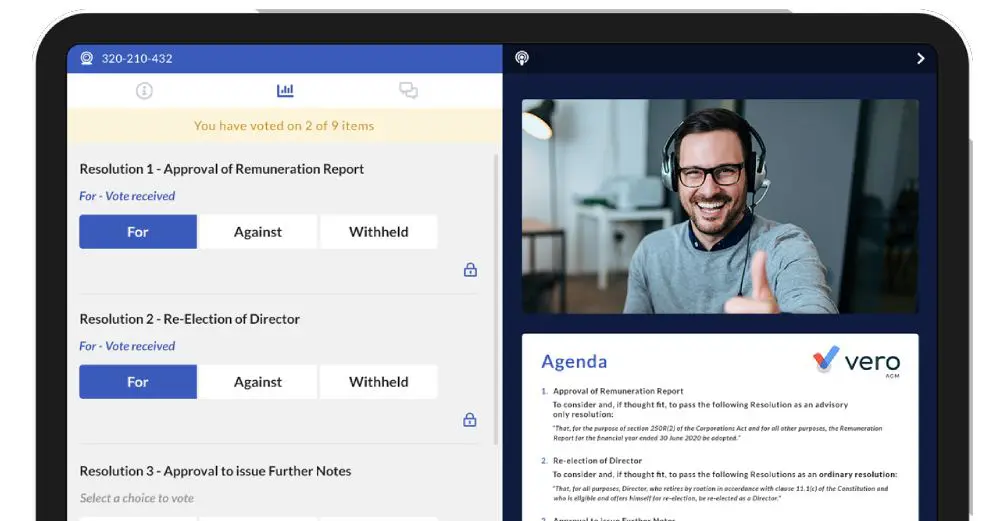
This is where a purpose-built platform can make a difference. Vero Voting, for example, supports secure online voting integrated with AGM workflows — handling eligibility, vote weighting, and real-time reporting without the usual manual workarounds. It’s not about adding complexity; it’s about removing doubt.
Common Issues (and How to Avoid Them)
After working across a range of not-for-profit AGMs, the same issues tend to surface:
None of these are unusual. But they are avoidable with a bit of planning — and by treating the AGM as a governance process, not just an event.
Where Vero Voting Fits
For not-for-profits, the goal is usually straightforward: run a compliant meeting, give members confidence in the outcome, and avoid unnecessary administration.
Vero Voting supports that by combining meeting management with secure voting — whether fully virtual or hybrid. That includes handling member verification, proxy management, live voting, and post-meeting reporting. For smaller organisations, it removes the manual burden. For larger ones, it adds structure and auditability.
Importantly, it works alongside your existing governance framework — not over the top of it.
Final Thoughts
Virtual AGMs are here to stay for not-for-profits. The legal framework supports them, regulators accept them, and members increasingly expect them.
The real question isn’t whether you can run one — it’s whether you’re set up to run it properly.
If you’re planning your next AGM and want to sense-check your approach or simplify the process, it’s worth having a conversation. A small amount of preparation now can save a lot of time — and risk — later.