Voting Services Australia: Choosing a Provider
Wednesday, 21 October 2026, 9:00 am

Voting Services in Australia: What Organisations Should Look for in a Professional Provider
Running a vote sounds straightforward until the outcome matters.
An organisation may need to elect directors, appoint committee members, approve a resolution, conduct a member ballot, run an AGM vote or ask employees to vote on a proposal. The mechanics can look simple from the outside: identify the voters, collect their votes and announce the result.
The difficult part is making sure the process is fair, secure, accurate and consistent with the rules that apply to the organisation.
That is where professional voting services in Australia can provide value.
A good voting provider does more than supply a ballot screen. It should help an organisation translate its rules into a practical voting process, manage voter eligibility, protect ballot information, deal with complicated voting methods and produce a clear record of what happened.
The right provider should make the voting process easier to administer without taking decision-making authority away from the organisation.
What are professional voting services?
Professional voting services are managed election, ballot or meeting-voting services provided by a specialist organisation.
Depending on the type of vote, the service may cover some or all of the process, including:
The exact service required depends on the organisation and the rules governing the vote.
A company AGM, an incorporated association election, a strata vote and a registered organisation election should not automatically be treated as the same type of ballot.
That distinction is one of the first things a professional provider should understand.
Why organisations use professional voting services
Small, straightforward votes can sometimes be managed internally.
The situation changes when an organisation has a large membership, complicated voting rules, multiple voting channels or a result that could potentially be challenged.
Consider a board election involving 2,000 members.
The organisation needs to know who was entitled to vote when the roll closed. It needs to make sure each voter receives the correct ballot. If preferential voting applies, preferences must be captured and counted correctly. If a member reports an access problem, someone needs to investigate it without compromising the secrecy of the ballot.
Then there is the result.
The organisation should be able to explain how the election was conducted and demonstrate that the published result came from the voting process.
This is where professional election and ballot administration becomes more than simply purchasing voting software.
The first question: what rules apply to your vote?
A professional provider should start with the governance framework, not the software.
Before selecting a voting service, identify:
For companies, voting and meeting procedures are governed by the Corporations Act 2001 together with the company’s constitution and applicable rules. ASIC explains that companies must follow the relevant rules for meetings, voting, proxies and resolutions, and that failure to follow those rules can create problems with the validity of a resolution.
For charities with members, the ACNC’s Governance Standard 2 requires reasonable steps to be taken to be accountable to members and provide adequate opportunities for members to raise concerns. The ACNC identifies annual meetings, voting on resolutions and clear processes for appointing Responsible People as examples of governance practices.
Registered organisations have a different regulatory framework again. The Fair Work Commission explains that the Fair Work (Registered Organisations) Act 2009 requires offices in registered organisations and branches to be elected, with organisation rules covering matters including nominations, ballot eligibility, voter-roll closure, scrutineers and terms of office.
In some cases, the Australian Electoral Commission has a statutory role.
That means a commercial voting provider should never simply say, “Our system is compliant” without first understanding which rules actually apply to the particular vote.
What should you look for in a voting provider?
There are plenty of features that can look impressive in a software demonstration.
The more useful question is whether those features solve the governance problems associated with your particular vote.
Here are the areas worth examining.
1. Experience with different types of elections and ballots
Voting is not one-size-fits-all.
A provider may be asked to conduct:
Ask the provider how many different voting scenarios its systems can support.
More importantly, ask whether the provider has experience with votes similar to yours.
A provider that understands preferential elections may still need additional experience if your ballot also involves proxies, weighted voting or multiple classes of voters.
2. Strong voter eligibility controls
The integrity of a ballot starts before the first vote is cast.
The provider should have a clear process for determining who is eligible to vote and how that eligibility is established.
Depending on the organisation, this might involve:
The provider should also be able to prevent unauthorised people from voting and identify attempts to vote more than once.
This does not necessarily mean collecting excessive personal information. Good voter verification should be designed around the minimum information necessary for the particular process.
3. Security and privacy controls
Voting systems can hold names, contact details, membership information, voter eligibility data and other personal information.
Security therefore deserves more attention than a simple question such as, “Is the website encrypted?”
Ask about:
The Office of the Australian Information Commissioner states that APP 11 requires an APP entity holding personal information to take reasonable steps to protect it from misuse, interference and loss, as well as unauthorised access, modification or disclosure.
The OAIC also specifically identifies third-party providers, cloud computing, access security, ICT security and data breaches as matters organisations should consider when taking reasonable security measures.
So if a voting provider is handling member data on your behalf, privacy and security should be part of the procurement discussion from the beginning.
4. Secret and confidential voting
Not every vote needs to be secret.
An election for office bearers might. A public AGM resolution may not.
The provider should understand the difference and be able to configure the voting process appropriately.
For a secret ballot, the organisation may need to verify that a person is entitled to vote while ensuring that their identity cannot subsequently be connected to their ballot choice.
That requires careful system design.
A provider should be able to explain, in plain English, how voter authentication and ballot confidentiality are separated.
If the explanation is simply “the system is anonymous”, ask for more detail.
5. Support for the correct voting method
Different organisations use different methods to determine an outcome.
Depending on the rules, a ballot may involve:
A provider should not assume that the most common voting method is suitable for your organisation.
The AEC’s material on industrial elections, for example, identifies first-past-the-post, preferential and proportional representation or quota-preferential systems among the voting systems used in industrial elections.
The key is to establish the required method before the ballot is configured.
6. Proxy management
Proxies can turn a relatively simple AGM vote into a detailed administrative exercise.
A provider may need to account for:
For companies, proxy arrangements are specifically addressed under the Corporations Act.
ASIC explains that a member entitled to attend and vote at a company meeting may appoint a person as their proxy, subject to the applicable requirements.
If your organisation uses proxies, ask a prospective provider to demonstrate the complete proxy workflow rather than simply confirming that “proxy voting is supported”.
7. Real-time voting for meetings
AGMs and other meetings create a different requirement from a standalone election.
The voting system may need to operate while the meeting is taking place.
For example:
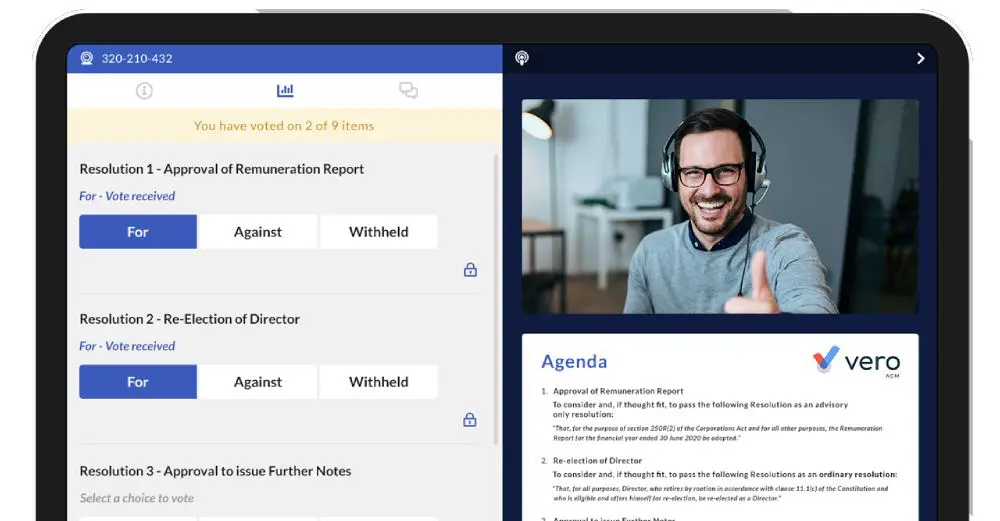
The chair introduces Resolution 4, allows questions and discussion, opens the poll, members cast their votes, the voting period closes and the result is provided to the chair.
That process needs to work smoothly without creating confusion for participants or the meeting chair.
For company meetings using virtual technology, ASIC says members as a whole must have a reasonable opportunity to participate and that the technology used must be sufficient to allow members to vote.
The provider should therefore understand the meeting environment, not just the ballot itself.
8. A clear audit trail
A good voting process should leave behind enough information to explain how it was conducted.
That does not mean revealing how individuals voted in a secret ballot.
An audit trail can instead record appropriate administrative events such as:
The exact information retained should depend on the type of ballot and applicable privacy and retention requirements.
The goal is straightforward: if someone asks, “How do you know this result is correct?”, the organisation should have a credible answer.
9. Independent administration
Independence can be particularly valuable when an election is contested or sensitive.
For example, imagine that two candidates are members of the same committee that is responsible for overseeing the election.
Even if everyone involved acts honestly, members may still question whether the process was impartial.
An independent election provider can separate the administration of the ballot from the people standing for election.
That does not mean the provider decides who is eligible, changes the constitution or determines the outcome.
The organisation’s rules still determine those matters.
The provider’s role is to administer the process consistently with the instructions and requirements that apply.
10. Human support when something goes wrong
Software cannot answer every voting problem.
A member might lose access to their ballot. A candidate might question the nomination process. An administrator might identify an error in the voter list. A meeting chair might need help opening a poll.
This is why the quality of the service team matters.
Ask:
The difference between a software vendor and a professional voting provider often becomes obvious when something unexpected happens.
Don’t confuse voting software with voting services
This is one of the most useful distinctions when comparing providers.
A software-only approach may give your organisation access to a platform and leave the organisation responsible for configuring the ballot, importing voters, handling questions and interpreting the results.
A managed voting service can take more responsibility for the process.
| Software-only approach | Managed voting service |
|---|---|
| Organisation configures the ballot | Provider assists with ballot setup |
| Organisation manages voter data | Provider assists with voter-roll preparation |
| Organisation handles participant questions | Provider may provide voter support |
| Organisation manages election workflow | Provider can coordinate the voting process |
| Organisation interprets results | Provider provides counting and reporting |
| Internal team carries more administration | Specialist team shares the workload |
| Suitable for straightforward processes | Useful for complex or sensitive votes |
Neither approach is automatically better.
The important question is how much responsibility your organisation is realistically equipped to manage.
When should an organisation use a professional voting service?
Professional support is particularly useful when the vote has one or more of the following characteristics:
A large or geographically dispersed membership
Managing hundreds or thousands of voters manually can create unnecessary administration.
An online voting service can give members access from different locations while providing the organisation with centralised administration.
A contested election
If candidates or groups have competing interests, independent administration can provide additional confidence in the process.
Complex voting rules
Preferential voting, weighted voting, multiple positions and different classes of voters all increase the risk of manual errors.
A secret ballot
The organisation may need to verify voter eligibility while protecting ballot confidentiality.
Proxy voting
Proxy appointments and voting instructions can create significant administrative complexity.
An AGM with live voting
The voting process needs to work alongside the meeting, questions, discussion and decisions of the chair.
Limited internal resources
A company secretary, association manager or committee may understand the organisation’s rules very well but simply not have the time to administer a large election.
Professional support can remove a substantial amount of administrative work.
Questions to ask a voting provider before signing up
A provider demonstration is a good starting point, but ask questions that reveal how the service actually works.
Governance
Security
Administration
Results
Privacy
If the provider cannot give clear answers to these questions, keep looking.
A professional provider should also help you test the ballot
Never wait until election day to discover that a voting rule has been configured incorrectly.
A proper pre-election test should cover the situations most likely to cause problems.
For example:
Voter eligibility:
Can an eligible voter access the ballot?
Ineligible voter:
Does the system correctly prevent access?
Duplicate voting:
What happens if someone attempts to vote again?
Proxy:
Is the proxy’s voting entitlement correctly represented?
Preferential ballot:
Are preferences captured and counted correctly?
Weighted vote:
Are voting entitlements applied correctly?
Candidate information:
Is the correct candidate information displayed?
Closing time:
Does the ballot close at the specified time?
Results:
Can administrators reconcile the final result?
Contingency:
What happens if a participant cannot access the system?
Testing is not just a technical exercise.
It is a governance control.
What a professional voting process can look like
A typical managed election might follow this sequence:
Step 1: Understand the rules
The organisation provides its constitution, election rules, meeting requirements and voting instructions.
Step 2: Confirm the electorate
The voter list is prepared and eligibility requirements are confirmed.
Step 3: Configure the ballot
Candidates, resolutions, voting methods, preferences, proxies and other requirements are configured.
Step 4: Test
The organisation and provider test the voting process before it opens.
Step 5: Communicate with voters
Members receive clear instructions about eligibility, voting dates, access and support.
Step 6: Open voting
The ballot becomes available through the agreed voting channels.
Step 7: Monitor and support
The provider monitors the process and assists participants with voting issues.
Step 8: Close and count
Voting closes according to the approved timetable and votes are counted using the required method.
Step 9: Verify and report
Results are checked and appropriate reports are supplied to the organisation.
Step 10: Retain appropriate records
The organisation retains the records required for its governance, legal and operational needs.
The exact process will vary. That flexibility is a feature, not a weakness.
What about unions and registered organisations?
This is an area where organisations need to be particularly careful.
Registered organisations operate under the Fair Work (Registered Organisations) Act 2009 and related requirements.
The Fair Work Commission states that elections for offices in registered organisations and branches must be conducted in accordance with the applicable framework. Unless an organisation has an exemption, elections must be conducted by the Australian Electoral Commission and use an approved voting system.
The AEC also explains that it conducts industrial elections and ballots for registered organisations under the relevant legislation.
That means a registered organisation should not assume that it can simply appoint any commercial online voting provider to replace the statutory process.
A professional voting provider should identify this issue early and tell the organisation when another statutory body or approval process applies.
That is a sign of a responsible provider.
What about charities and not-for-profit organisations?
Member-based charities and associations also need to think beyond the voting platform.
The ACNC’s Governance Standard 2 applies to charities with members and requires reasonable steps to be taken to be accountable to those members and provide adequate opportunities to raise concerns about how the charity is governed.
The ACNC gives annual meetings, opportunities to ask questions and vote on resolutions, and clear processes for appointing Responsible People as examples of ways charities can meet this standard.
For a member-based organisation, voting is therefore part of a wider governance process.
A professional voting service should fit into that process rather than treating the ballot as an isolated technical exercise.
Where Vero Voting can assist
Vero Voting provides managed voting and election services for organisations across Australia.
Its services cover a range of organisational voting requirements, including elections, member ballots, AGM voting, preferential voting, enterprise agreement voting, strata voting and custom voting workflows.
For elections, Vero can assist with processes from nominations through to voting and results, including a dedicated returning officer, candidate nomination workflows and real-time election management.
For AGM voting, services can include election planning, nominations, proxy voting, preferential voting, vote counting, auditing and final results.
Vero also operates its own voting platform and states that its information security management system is ISO/IEC 27001:2022 certified and its controls are SOC 2 Type II audited.
The practical advantage of using a specialist provider is not simply that members can click a button online.
It is having an experienced team behind the ballot when the voting process involves real governance responsibilities.
A simple checklist for choosing voting services in Australia
Before appointing a provider, ask yourself:
If the answer to several of these questions is unclear, the provider may not be the right fit.
Key takeaways
Choosing voting services in Australia should not be based on the number of features shown in a software demonstration.
The more important questions are about governance, security, voter eligibility, ballot integrity and support.
A good provider should:
The software matters.
But the process around the software matters just as much.
If your organisation is planning an election, AGM, member ballot or other organisational vote and needs help designing or managing the process, contact Vero Voting to discuss the requirements and find out what voting service would be appropriate for your organisation.
voting services Australia
voting services Australia
voting services Australia
FAQ
What are voting services in Australia?
Voting services are professional election and ballot services that help organisations manage processes such as member elections, AGM voting, ballots, referendums and other organisational votes. Depending on the provider, services can include voter management, ballot setup, secure voting, counting, reporting and election administration.
How do I choose a voting provider in Australia?
Start with the rules governing your vote. Then assess the provider’s experience, voter authentication, ballot confidentiality, security controls, voting methods, audit trail, reporting, support and ability to manage complicated requirements such as proxies or preferential voting.
Are online voting services legal in Australia?
There is no single rule that makes every organisational vote online or offline. The answer depends on the type of organisation, applicable legislation, constitution or rules and the particular voting process. Some regulated elections have specific statutory requirements, so organisations should establish the applicable framework before selecting a provider.
Should an organisation use an independent voting provider?
An independent provider can be useful where impartiality is particularly important, such as contested elections, elections involving current office holders or ballots where members may question the administration. Independence does not replace the organisation’s own governance responsibilities or applicable legal requirements.
Can professional voting services manage preferential voting and proxies?
Some specialist providers can support preferential voting, proxy voting, weighted voting and other customised ballot requirements. Organisations should confirm the exact voting method and rules with the provider before the ballot is configured.
7. Sources
The article above was checked against current Australian regulator and government material, including:
Frequently Asked Questions
What are voting services in Australia?
Voting services are professional election and ballot services that help organisations manage processes such as member elections, AGM voting, ballots, referendums and other organisational votes. Depending on the provider, services can include voter management, ballot setup, secure voting, counting, reporting and election administration.
How do I choose a voting provider in Australia?
Start with the rules governing your vote. Then assess the provider’s experience, voter authentication, ballot confidentiality, security controls, voting methods, audit trail, reporting, support and ability to manage complicated requirements such as proxies or preferential voting.
Are online voting services legal in Australia?
There is no single rule that makes every organisational vote online or offline. The answer depends on the type of organisation, applicable legislation, constitution or rules and the particular voting process. Some regulated elections have specific statutory requirements, so organisations should establish the applicable framework before selecting a provider.
Should an organisation use an independent voting provider?
An independent provider can be useful where impartiality is particularly important, such as contested elections, elections involving current office holders or ballots where members may question the administration. Independence does not replace the organisation’s own governance responsibilities or applicable legal requirements.
Can professional voting services manage preferential voting and proxies?
Some specialist providers can support preferential voting, proxy voting, weighted voting and other customised ballot requirements. Organisations should confirm the exact voting method and rules with the provider before the ballot is configured.