AGM Ballot Software in Australia: When Is Dedicated Voting Software Worth Using?
Thursday, 8 October 2026, 9:09 am

AGM Ballot Software in Australia: When Is Dedicated Voting Software Worth Using?
AGM voting can look deceptively simple.
For a small organisation with a handful of members and straightforward resolutions, a show of hands or a basic voting process may be perfectly adequate.
But the picture changes quickly when an AGM involves a large membership, proxy appointments, multiple resolutions, director elections, different voting entitlements or members attending remotely.
That is where AGM ballot software can become more than a convenience. It can take much of the administration out of the voting process and give the chair, company secretary or meeting team a clearer way to manage the result.
The key question, however, is not “Do we need voting software?”
It is:
“Does the complexity of our AGM justify a dedicated voting system?”
For some organisations, the answer will be no. For others, trying to manage the vote manually can create unnecessary work and avoidable risk.
What is AGM ballot software?
AGM ballot software is a digital system designed to manage formal voting during an annual general meeting.
Depending on the platform and the organisation’s requirements, it may support:
The distinction between a general polling tool and dedicated AGM ballot software is important.
A simple polling application might tell you that 68% of respondents selected “Yes”.
That does not necessarily answer the governance questions behind an AGM vote.
Who was entitled to vote?
Were proxy votes included correctly?
Did different members have different voting rights?
Could someone vote twice?
Was the result calculated according to the organisation’s rules?
Can the organisation explain how the final result was produced?
A dedicated voting system is designed to deal with those issues as part of the voting process.
Does every AGM need dedicated voting software?
No.
There is no general rule that every Australian AGM must use dedicated electronic ballot software.
The appropriate voting process depends on the organisation’s legal structure, governing document, applicable legislation, meeting format and voting rules.
For companies, the Corporations Act 2001 contains rules covering meetings, proxies and voting. ASIC also points out that companies must follow the Corporations Act together with their constitution or applicable replaceable rules.
Under the replaceable rules, for example, a resolution at a company members’ meeting may generally be decided by show of hands unless a poll is demanded. For a company with share capital, voting entitlements on a poll can be based on shares held, subject to the applicable rights and restrictions. ASIC provides further information about the replaceable rules for company governance.
Listed companies have additional poll requirements under section 250JA of the Corporations Act. The Federal Register of Legislation provides the relevant legislation.
Other organisations may operate under completely different legislation and rules. An incorporated association, charity, union, strata scheme or member-based organisation should not simply assume that the rules applying to a company also apply to them.
So the starting point should always be the rules governing the particular AGM.
When does AGM ballot software become worthwhile?
There is no magic membership number at which an organisation suddenly needs voting software.
Complexity is usually a better indicator than headcount.
A 100-member organisation with complicated voting rights may need more sophisticated voting arrangements than a 1,000-member organisation where every member has exactly one vote.
Here are some of the strongest indicators that dedicated AGM voting software is worth considering.
1. Your AGM involves proxy voting
Proxy administration is one of the areas where AGM voting can become surprisingly complicated.
A member may appoint another person to attend and vote on their behalf. The appointment may also contain instructions about how the proxy should vote.
For companies, the Corporations Act contains specific provisions dealing with proxy appointments and voting. ASIC also identifies proxy voting as part of the rules governing company members’ meetings.
Trying to manage a large number of proxies manually can create a substantial administrative workload.
Dedicated AGM ballot software can help by bringing proxy information into the voting workflow rather than leaving administrators to reconcile separate spreadsheets, emails and paper forms.
That does not remove the need to check the validity of proxy appointments. It simply gives the team a more controlled way of administering them.
2. Members have different voting entitlements
This is one of the clearest reasons to consider a dedicated system.
Not every AGM operates on a simple one-person-one-vote basis.
Depending on the organisation, voting may be affected by:
For companies with share capital, the replaceable rules provide that each member has one vote on a show of hands, while on a poll each member generally has one vote for each share held, subject to applicable rights and restrictions. ASIC provides guidance on these replaceable rules.
That difference can be significant.
Imagine an AGM where 150 people attend, but the members collectively hold very different voting entitlements.
Counting raised hands might be quick.
Calculating the actual poll result correctly is another matter.
A dedicated voting system can apply the configured entitlements automatically, reducing the amount of manual calculation required during the meeting.
3. Your AGM includes several resolutions
One resolution is manageable.
Ten or fifteen resolutions, followed by a director election, proxy votes and questions from members, is a different proposition.
When voting is spread across multiple motions, the meeting team needs to keep track of:
A dedicated ballot system can centralise those processes.
That can make the meeting easier for the chair to control and easier for administrators to monitor.
4. You are holding a hybrid or virtual AGM
Technology becomes particularly useful when members are not all in the same room.
The Australian corporate framework permits companies to use virtual meeting technology, subject to the requirements of the Corporations Act and applicable constitutional arrangements. The Government’s 2025 response to the statutory review confirmed that the virtual meeting provisions remain in place. The Australian Treasury provides further information in its Government response.
ASIC’s guidance also emphasises that members participating through virtual technology need a reasonable opportunity to participate, including asking questions, making comments and voting.
That creates a practical challenge for meeting organisers.
If people are attending in person, some online and some by proxy, how do you make sure the voting process works consistently for everyone?
Dedicated AGM ballot software can provide a separate voting layer that works alongside the meeting platform.
The video-conferencing system manages the meeting.
The voting system manages the vote.
That separation can be useful, particularly when the voting requirements are more complicated than a simple poll.
AGM ballot software vs ordinary meeting polls
It is tempting to assume that the polling feature inside a video-conferencing platform is all an organisation needs.
Sometimes it is.
But meeting polls and formal voting systems solve different problems.
Side-by-Side Comparison
| Requirement | Basic Meeting Poll | Dedicated AGM Ballot Software |
|---|---|---|
| Simple yes/no poll | Usually suitable | Suitable |
| Voter eligibility | Limited | Can be configured |
| Proxy management | Usually limited | Designed for formal voting |
| Different voting entitlements | May be difficult | Can be supported |
| Multiple resolutions | Usually possible | Designed for formal workflows |
| Director elections | Basic options | Can support election processes |
| Weighted voting | Often limited | Can be configured |
| Pre-meeting voting | Depends on platform | Common feature |
| Live AGM voting | Yes | Yes |
| Detailed voting records | Limited | More comprehensive |
| Formal results reporting | Basic | Designed for governance use |
The point is not that a dedicated system is always better.
It is that the voting requirements should determine the technology.
If the AGM only requires a straightforward poll, using an existing meeting platform may be entirely reasonable.
If the vote involves proxies, complex entitlements or formal elections, dedicated software starts to make much more sense.
What are the main benefits of dedicated AGM voting software?
More accurate vote administration
Manual calculations create opportunities for mistakes.
A voting platform can apply predefined voting rules consistently across the ballot.
This is particularly useful when there are multiple resolutions or different voting entitlements.
Less manual administration
Instead of moving information between spreadsheets, paper forms, emails and meeting software, the voting process can be managed through a single workflow.
That can save considerable time before and during the AGM.
Faster results
Once a poll closes, a dedicated system can calculate the configured result without requiring the meeting team to manually count votes.
For a meeting with several resolutions, that can make a noticeable difference.
Better support for remote members
A properly designed voting system can give remote members a direct way to participate in votes rather than relying on informal methods such as chat responses or reactions.
ASIC’s guidance stresses the importance of giving members participating through virtual technology a reasonable opportunity to participate.
Better records
Formal voting often needs more than a final percentage.
Organisations may need to retain records showing how the voting process was conducted.
A dedicated system can provide voting reports and an audit trail of relevant events, depending on the platform and configuration.
What AGM ballot software cannot fix
This is where organisations sometimes get the technology decision backwards.
Software cannot correct a flawed governance process.
Before setting up the ballot, the organisation still needs to determine:
ASIC specifically advises companies to follow the applicable meeting rules and constitution. A failure to follow those rules can affect the validity of company resolutions.
For charities and incorporated associations, the position can be different. The ACNC notes that AGM requirements for incorporated associations depend on the relevant state or territory legislation, while a charity’s governing document can also establish requirements around meetings and decision-making.
So the right order is:
Rules first. Voting process second. Software third.
That simple approach avoids many problems.
How to decide if your organisation needs AGM voting software
Before purchasing or engaging a provider, ask these questions.
How many people will vote?
A larger voter population generally creates more administration, but size alone should not determine the decision.
Are voting rights complicated?
If everyone has one vote and there are only a few straightforward resolutions, a basic approach may be sufficient.
If votes are weighted or affected by shareholdings, proxies or membership categories, dedicated software becomes more attractive.
Are proxies involved?
If administrators are receiving and processing a significant number of proxy appointments, look closely at systems that support proxy management.
Is the AGM hybrid or virtual?
If members are joining from different locations, think about how they will authenticate, vote, receive instructions and obtain support if something goes wrong.
Are there elections?
Director, board or committee elections can introduce additional requirements such as candidate lists, preferential voting or secret ballots.
Does the result need to be independently explainable?
For contentious or high-value resolutions, organisations should think beyond the final result.
They should be able to explain how eligibility was established, how votes were collected and how the result was calculated.
How much administration is involved?
Sometimes the best argument for dedicated voting software is simply the amount of work involved.
If several staff members need to spend days preparing spreadsheets, reconciling proxies and manually calculating results, the organisation may already be paying for the process through staff time.
A practical AGM voting checklist
Before the AGM, work through the following checklist.
The testing stage is particularly important for hybrid and virtual meetings. ASIC recommends planning ahead, considering anticipated usage and conducting rehearsals to identify technical problems before the meeting.
Common mistakes when choosing AGM voting software
Choosing software because it is cheap
The cheapest voting tool is not necessarily the cheapest solution.
If administrators have to manually manipulate voter lists, proxies and results, the organisation may simply be shifting the cost from software to staff time.
Choosing a platform based only on the user interface
A clean voting screen is useful.
It is not enough.
The more important questions are about eligibility, voting rules, security, proxy handling, reporting and auditability.
Assuming Zoom or Teams automatically solves voting
Video-conferencing software can be excellent for running the meeting.
It does not necessarily provide the governance functionality required for a complicated AGM ballot.
Leaving testing until the day of the AGM
This is one of the easiest mistakes to avoid.
Test the actual voter list, actual resolutions and actual voting configuration before members arrive.
Treating software as a substitute for the constitution
Technology should implement the rules.
It should not determine them.
Where Vero Voting can assist
For organisations running a straightforward AGM, dedicated voting software may not be necessary.
For organisations dealing with more complicated voting arrangements, however, having a purpose-built system can make the meeting considerably easier to administer.
Vero Voting’s meeting voting solutions can support formal meeting voting processes including live voting, proxy management, elections and reporting.
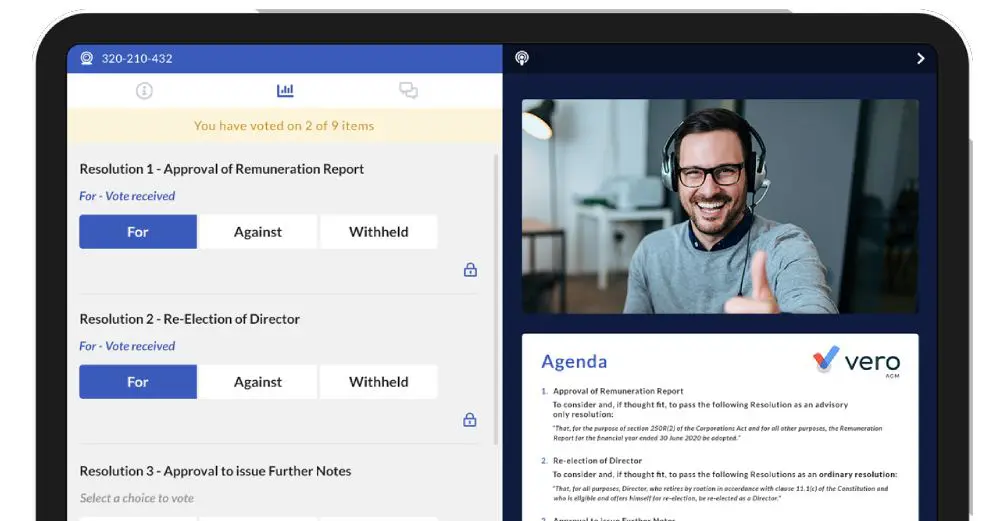
Vero Voting can also support voting during physical, virtual and hybrid meetings, allowing organisations to separate the meeting experience from the administration of the formal vote.
For organisations considering electronic voting more broadly, Vero’s guide to how electronic voting works during AGMs provides further practical information about voter verification, proxies, live polls and results.
The important consideration is fit.
The right system should reflect the organisation’s voting rules, member structure and meeting requirements rather than forcing the organisation to change its governance process to suit the software.
Key takeaways
Dedicated AGM ballot software is not automatically necessary for every Australian organisation.
It becomes particularly useful when an AGM involves:
The decision should therefore be based on voting complexity, not simply organisation size.
A small organisation with complicated voting rules may benefit significantly from dedicated software. A large organisation with a very simple one-person-one-vote process may not need the same level of functionality.
Most importantly, start with the rules.
Once you know how the vote needs to work, you can decide whether dedicated AGM ballot software is the right tool to deliver it.
FAQ Section
AGM Ballot Software Australia: Is It Worth It?
AGM Ballot Software Australia: Is It Worth It?
AGM Ballot Software Australia: Is It Worth It?
AGM Ballot Software Australia: Is It Worth It?
AGM Ballot Software Australia: Is It Worth It?
AGM Ballot Software Australia: Is It Worth It?
Is AGM ballot software legally required in Australia?
No. There is no general Australian requirement for every AGM to use dedicated ballot software. The voting method depends on the organisation’s legal structure, governing documents and applicable legislation. Companies must comply with the Corporations Act and their constitution or applicable replaceable rules. ASIC provides guidance on company meetings and resolutions.
Can AGM voting software manage proxy votes?
Yes, some dedicated AGM voting systems can manage proxy appointments and incorporate valid proxy instructions into the voting process. The system still needs to be configured according to the organisation’s governing rules and applicable legislation.
Is electronic voting allowed at an Australian AGM?
Electronic voting can be used for many Australian AGMs, but the precise requirements depend on the organisation and the rules applying to the meeting. For companies, the Corporations Act provides for technology-enabled meetings and participation, while ASIC expects virtual meeting technology to give members a reasonable opportunity to participate, including voting.
Is Zoom enough for AGM voting?
It can be enough for a simple poll, depending on the circumstances. However, a video-conferencing platform is not necessarily designed to manage formal voter eligibility, proxy instructions, weighted voting, elections and detailed voting records. More complicated AGMs may benefit from dedicated AGM voting software.
What should I look for in AGM ballot software?
Look for functionality that matches your actual voting requirements. Key areas include voter eligibility, proxy management, voting entitlements, live and pre-meeting voting, election functionality, security, reporting, auditability and support for physical, virtual or hybrid meetings.
Sources
The following are the primary Australian Government and regulator sources used to verify the legal and governance information in this article.
Note: The legal requirements for an AGM vary according to the organisation’s structure and applicable legislation. This article is general information and should not be treated as legal advice.
Frequently Asked Questions
Is AGM ballot software legally required in Australia?
No. There is no general Australian requirement for every AGM to use dedicated ballot software. The voting method depends on the organisation’s legal structure, governing documents and applicable legislation. Companies must comply with the Corporations Act and their constitution or applicable replaceable rules. ASIC provides guidance on company meetings and resolutions.
Can AGM voting software manage proxy votes?
Yes, some dedicated AGM voting systems can manage proxy appointments and incorporate valid proxy instructions into the voting process. The system still needs to be configured according to the organisation’s governing rules and applicable legislation.
Is electronic voting allowed at an Australian AGM?
Electronic voting can be used for many Australian AGMs, but the precise requirements depend on the organisation and the rules applying to the meeting. For companies, the Corporations Act provides for technology-enabled meetings and participation, while ASIC expects virtual meeting technology to give members a reasonable opportunity to participate, including voting.
Is Zoom enough for AGM voting?
It can be enough for a simple poll, depending on the circumstances. However, a video-conferencing platform is not necessarily designed to manage formal voter eligibility, proxy instructions, weighted voting, elections and detailed voting records. More complicated AGMs may benefit from dedicated AGM voting software.
What should I look for in AGM ballot software?
Look for functionality that matches your actual voting requirements. Key areas include voter eligibility, proxy management, voting entitlements, live and pre-meeting voting, election functionality, security, reporting, auditability and support for physical, virtual or hybrid meetings.